29Jan
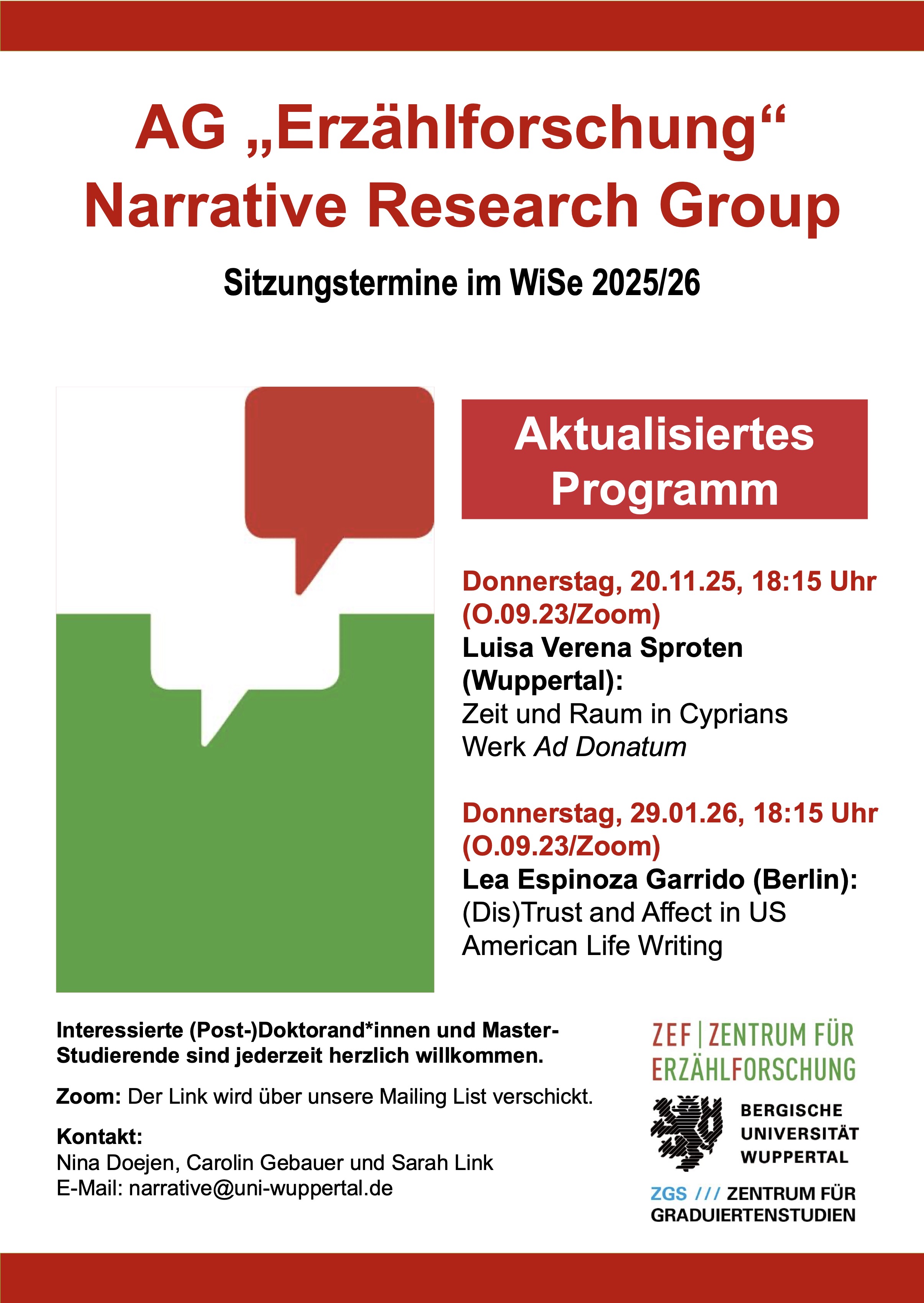
"(Dis)Trust and Affect in US American Life Writing"
Abstract:
While the Declaration of Independence famously enshrines “unalienable rights,” U.S. literature has long insisted that the national promises of liberty and equal opportunity have been unevenly realized, particularly along racialized, gendered, classed, and religious lines. In my current research project “(Un)Doing Trust // Textual Infrastructures of (Dis)Trust in American Life Writing from the 19th Century to the Present,” I examine how this unequal distribution is entangled with practices of (dis)trust that organize vulnerability and belonging. Building on Sara Ahmed’s account of “affective economies” and Lauren Berlant’s notion of an “infrastructure of trust,” I argue that (dis)trust functions as an affective hinge within U.S. national imaginaries: it is extended to some as evidence of full citizenship and withheld from others as proof of contingent belonging, marking them as suspect, untrustworthy, or disposable.
Tracing these dynamics across U.S. history, the project focuses on moments of alleged “crisis” in which the nation’s boundaries are rhetorically and institutionally redrawn. Across a diachronic archive of Black and Asian American life writing (from nineteenth-century slave narratives to contemporary memoirs in the age of Trump), I analyze what I call textual infrastructures of (dis)trust: narrative strategies, modes, and autobiographical protocols that register how trust is demanded, denied, performed, or withdrawn. I propose that life narratives are particularly attuned to the politics of credibility and authenticity that subtend racialized and gendered vulnerability. At the same time, life writing from marginalized communities also provides a discursive space to use strategic distrust as critique and subversive self-positioning. Taken together, I hope to show how the (un)doing of trust in these texts can thus become not merely a symptom of exclusion, but an articulation of resistance that unsettles the nation’s most precarious scripts of belonging.
Termin ICS-Download