
Spillover - when pathogens jump from animals to humans
PD Dr Jean Baptist du Prel / Safety Engineering / Occupational Science
Photo: Mathias Kehren
Spillover: when pathogens jump from animals to humans
Epidemiologist Jean Baptist du Prel on a potential threat scenario in which humans play a major role
Ebola, Marburg, Hanta, COVID-19 and bird flu are all deadly viruses that have jumped from animals to humans. This process is called spillover. Many pathogens have long coexisted with humans, but are now becoming increasingly dangerous to us. Epidemiologist PD Dr Jean Baptist du Prel works in the Department of Ergonomics at the University of Wuppertal and says: "You have to see the whole thing as a complex process. Environmental conditions change and human behaviour changes nature. Viruses replicate every day as normal and copying errors can occur." Sometimes viruses then spread to other species as a result. "It's always about probabilities. So what is the probability that an animal will encounter another species and that viruses that have changed will be transmitted to the other species and infect it? It's a random game of mutation rate based on copying errors that makes it possible to jump to other species." The contact rate then also plays a decisive role, and then humans come into play.
At least another 10,000 unknown viruses could infect humans
The diversity of pathogens in animals is astonishing. Biologists estimate that there are at least 10,000 unknown viruses on our planet that could infect humans. So the danger of further spillover has not yet been banished. "That's right," states du Prel, "the changed conditions mean that a large number of animals that harbour viruses are more likely to encounter humans. The moment animal populations shift, for example due to climate change or human behaviour such as slash-and-burn, they leave their old habitat and are therefore more likely to encounter humans. The other probability is that copying errors can lead to viruses changing, spreading to humans and becoming pathogenic (disease-causing, editor's note). In this case, two probabilities practically come together. We make a decisive contribution to this through our behaviour by changing nature and the climate." But what causes a virus to change host? In this context, the epidemiologist speaks of the "survival of the fittest", i.e. the survival of the individuals best adapted to their environment, and makes it clear that this process is not a conscious, controlled process, but happens purely by chance. "If the virus carries certain structures that suit the host, then an infection begins in another species. It doesn't necessarily have to be humans, there are also intermediate hosts. Frequent mutations are often to the disadvantage of viruses, only in rare cases are they to their advantage because they are then better adapted to a potential host." A current example is the situation recently reported in the media on the cruise ship Hondius, where the hantavirus, a zoonotic pathogen that primarily "jumps" from infected rodents to humans by inhaling virus-containing aerosols from urine, faeces or saliva, was probably also transmitted at least partially from person to person through close contact. The so-called Andean virus is a specific variant of the hantavirus found in South America and the only one for which human-to-human transmission has been proven to date.
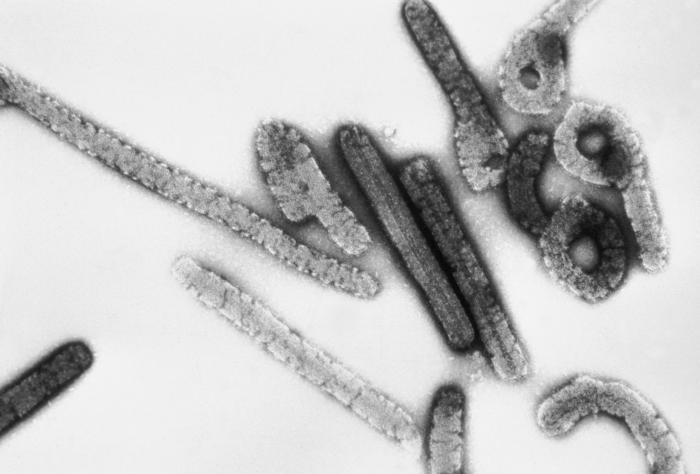
Marburg virus
Photo: public domain
Predicting spillover
In order to prevent spillover from animals to humans, the development of spillover must first be understood. du Prel explains: "It's a complex process. I first have to look at how viruses change and how pathogen reservoirs change, for example through movement. Then I also have to look at the virus's ability to bind to humans and examine the extent to which humans themselves spread the virus. It's always a Sherlock Holmes game. I have to see how these movements fit together. You can predict these spillovers to a certain extent in terms of probability theory by combining different mechanisms. There are viruses that have a relatively high mutation rate compared to other organisms, such as SARS-CoV-2, the pathogen that causes COVID-19. A high mutation rate, which is often the case with RNA viruses, increases the likelihood of a copying error occurring that enables the new virus variant to change host. In pandemics, humans themselves then play an important role again."
Humans amplify pandemics through their behaviour
The Hendra virus (1994), the Nipah virus (1999) and presumably also the Ebola virus (1976) were transmitted by bats. There are 1400 species of bats worldwide. That is 25% of all mammals. It is now known that these animals had to leave their original homes due to slash-and-burn agriculture or climate change, for example, and settled in other places - closer to humans. The Marburg virus (1967), on the other hand, came from monkeys that had themselves become infected during a transport diversions at Gatwick Airport in London. Many different animals from all over the world were loaded there, allowing the virus to spread. "Humans are an amplifier of a process that is actually natural," explains the expert. "These spillovers would also take place without humans, but humans as amplifiers make the occurrence of a spillover as well as the emergence and extent of a pandemic much more likely through their behaviour, for example by shifting habitats and contributing to the spread of the pathogen. Today, we have much more movement in the human population through flights, trade or flight. If there is then a mutant or a modified virus and we continue to move transcontinentally, the probability of a pathogen spreading worldwide is naturally also higher." The proximity of humans to their livestock can also play a role in this context. Reports of farms on which thousands of animals are culled for safety reasons in suspected cases are no longer a rarity.
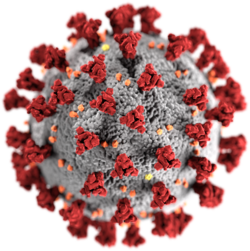
3D graphic of the SARS-CoV-2 virion (coloured model)
Photo: public domain
Viruses mutate every day
In 2003, a previously unknown coronavirus (SARS-CoV-1) killed people in Hong Kong for the first time. Until then, coronaviruses were considered harmless and perhaps caused the common cold. Today we know that coronaviruses can exchange genetic material with each other and create a new virus from it. Even back then, it was therefore only a matter of time before a pandemic would occur. Researchers predicted this as early as 2003, and viruses mutate every day. "Yes, that happens all the time and is completely normal," says du Prel. "We have an incredible number of virus species and copying errors are constantly occurring. For the most part, the mutations that occur are not bad at all, because they also lead to the demise of a virus or have no effect at all. But some mutations can lead to them becoming dangerous for us."
In 1980, the WHO (World Health Organisation) declared the eradication of monkeypox (MPOX). "But I think monkeypox never went away," says du Prel firmly, "the only question is, where did it stay?" Although human infections were rarer, they were still present in monkeys and rodents. After the declared end of smallpox, people were no longer vaccinated against it. "Vaccinations became increasingly rare, but the smallpox vaccination also provided a certain degree of protection against monkeypox. In this respect, it is also inherent to the host (due to factors in the host itself, editor's note) that we are more susceptible to monkeypox again."
Global warming promotes potential pandemics
Scientists say that global warming is setting everything on earth in motion. Just 1 degree of warming causes animals to migrate hundreds of kilometres further, where they meet other animals they would otherwise never have encountered. These encounters promote the possibility of spillover. Seen in this light, climate change could also promote the accumulation of pandemics. "At the very least, it is an important amplifier," concludes du Prel. "We will never eradicate mutations, they simply exist. It remains a game of different probabilities, both in the mutation and in the encounter of different species. These can be different animal species meeting each other, or humans meeting animals."
Uwe Blass
Jean-Baptist du Prel studied human medicine at the University of Würzburg, where he also gained his doctorate in 2000, and public health at the University of Düsseldorf. He was a research associate in epidemiology at the German Diabetes Centre and taught epidemiology and medical biometry at the Universities of Mainz and Ulm. Since 2015, he has been a member of the scientific management team at the Chair of Occupational Science at the University of Wuppertal, where he also habilitated in 2022 and teaches subjects including preventive medicine and biological risks.