Computer science is for women too
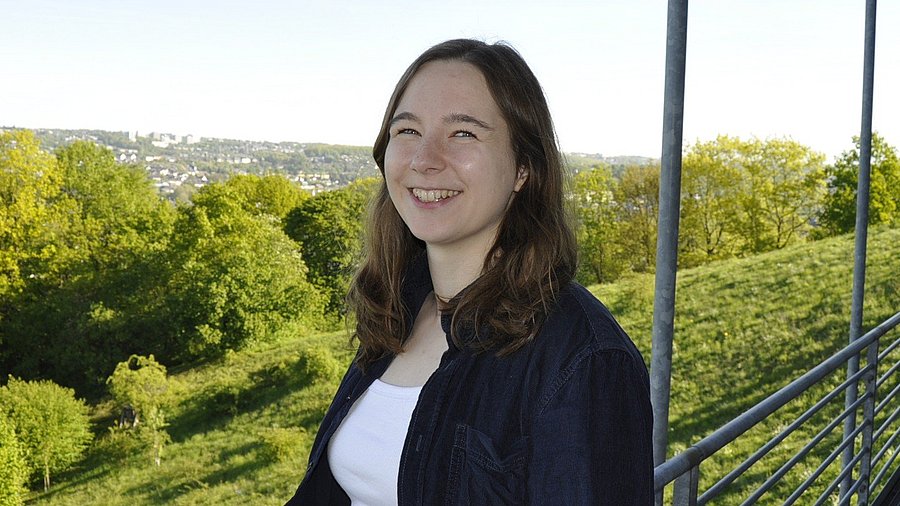
Denise Schmitz / Computer Science Education
Photo: UniService Third Mission
“Computer science is attractive for women too!”
Denise Schmitz, a research assistant at the University of Wuppertal, volunteers with the German Informatics Society Gesellschaft für Informatik e.V. (GI) to promote greater participation by women
She works in the School of Mathematics and Natural Sciences at the University of Wuppertal and has been campaigning for greater gender equality in computer science for a few years now: Denise Schmitz, a research assistant in the Didactics of Computer Science research group, describes the stereotypical image of the software developer as follows: “Computer science is a man’s job, and they all sit in the basement eating pizza and drinking cola.” This perception has become so deeply ingrained in society until today, she says, that it is particularly difficult to combat such stereotypes. “You only need to take a look at the lectures in computer sciences here at the university,” the expert says, “where female students make up well under 50 per cent.” And this trend continues in the course of their studies; so fewer women complete their degrees, and consequently, they are rarely seen in leadership roles. Admittedly, there are female role models; Schmitz cites the pioneer Ada Lovelace (1815–1852) and the American computer scientist Grace Hopper (1906–1992), and refers to the film *Hidden Figures* (German title: Unbekannte Heldinnen) from 2016. However, as a rule, young girls rarely opt for an apprenticeship or a degree in computer sciences after leaving school. “There is a work culture in computer sciences where, as a woman, you really have to assert yourself, and not every woman is up for that,” the researcher says. Structural barriers, such as unequal pay and a lack of promotion opportunities, further hindered their willingness to take the plunge. “And then there’s still the problem of balancing work and family life.”
Particularly in the rapidly advancing digital world, this lack of gender equality can have disastrous consequences. “Because we have so few women in computer science, there is less diversity,” Schmitz adds. The products that eventually emerge – for example AI – are very much geared towards one particular group.”

Portrait of Ada Lovelace, 1838
Photo: public domain
Applying for the Society for Computer Science’s Women Informatics Thesis Award was the initial spark
Encouraged by her supervising lecturers, Schmitz submitted her own Master’s thesis for the biennial Women Informatics Thesis Award, organised by the German Informatics Society Gesellschaft für Informatik e.V. (GI). “Although I didn’t win the prize, I was invited to the annual conference. It was easy to attend at the time, as I was able to take part comfortably online from home during the Covid-19 pandemic.” Later, she travelled to events, initially as a guest in Naumburg/Saale, but only one year later, at another conference in Berlin, she took on her first public relations tasks, as the aim was to reach younger target groups as well. After this first step, things moved at breakneck speed. “I’m now in charge of the public relations team, including LinkedIn posts. We repost content from our research group members, we write information about events, and I’m now organising the tasks for the award – the one I didn’t win back then – with the help of my predecessor. I’m in charge of the submissions and the peer-review process.” Schmitz is now also setting up a regional group in North Rhine-Westphalia and writes articles for the research group’s annual magazine. In April, she was elected to the steering committee for a second term.
Networking with women from business and academia
A key aim of the ‘Women and Computer Science’ research group, in which Schmitz is actively involved, is networking, which brings her into contact with women from academia and business. And that’s important, as the young researcher has so far only gained experience in the education sector. Having completed school, university and her teaching training, Schmitz is now coming into contact with many women in business through the association – female executives, company directors and self-employed professionals – meaning that when pupils ask her about the roles of computer scientists, she can now also cite specific examples from the business world.
Research into computer sciences education
Schmitz’s ‘Women and Computer Science’ research group organises an annual conference on a topic in computer sciences featuring an all-female line-up of speakers. She also uses the findings from these conferences for her own research and explains: “I am researching computer sciences education for all teachers, and I do this research by looking at the impact that professional development has on teachers. The professional development programmes I’m investigating were developed across North Rhine-Westphalia as part of a project called’ ComeIn (Communities of Practice NRW for Innovative Teacher Training, editor’s note). I wanted to do something on the topic of IT security and created a module entitled ‘Spam von der Schulleitung’ (‘Spam from the School Management’) with the subtitle ‘Digitale Selbstverteidigung’ (‘Digital Self-Defence’).” Thematically, she had already explored the topics of cybersecurity and digital sovereignty at previous conferences of the German Informatics Society Gesellschaft für Informatik e.V. (GI) and saw them as a huge source of inspiration for her own module.
Volunteering can be particularly demanding at times
Denise Schmitz volunteers for the association. But how time-consuming is this voluntary work? “It depends on the time of year. There are a few ongoing tasks, such as the steering committee, which we meet with every two weeks. Then there are some more intensive tasks from time to time. Following the annual conference, which took place in April, we now have to prepare the recap on LinkedIn, which involves publishing regular posts. Preparations for the specialist group award are also slowly getting under way, and November will be a busier period when everything has to be forwarded to the judges and the results collected.”
‘Women and Computer Sciences’ specialist group celebrates its 40th anniversary
Schmitz sees volunteering for the German Informatics Society Gesellschaft der Informatik e.V. (GI) as an opportunity for anyone interested to get involved. Membership is free for students. You can attend the annual conferences at reduced rates. “Otherwise, female students at the University of Wuppertal can, of course, also apply for the prize. So, anyone writing a thesis in computer sciences can submit it for the prize in November.”
In 2026, the specialist group will mark its 40th anniversary. This milestone has already been celebrated with a workshop and a major commemorative event in Munich. There, the founding members were interviewed, and an exhibition provided detailed information about the work carried out over the past four decades. The group’s objectives remain relevant for the future. These aims continue to include the equal participation of women in computer sciences and, in this context, raising the profile of new role models for women. The specialist group is committed to supporting young academics and advocates for equal opportunities in professional life, in terms of pay, career progression, and working conditions.
Further information is available at:
Gesellschaft für Informatik e.V. https://gi.de/
https://fg-frauen-informatik.gi.de/fachgruppe/ueber-uns[KR1]
Uwe Blass
Denise Schmitz is a research assistant in the Computer Science Didactics Research Group at the School of Mathematics and Natural Sciences.
[KR1]Der Link kann nicht aufgerufen werden (Fehler 404- Seite nicht gefunden, überprüft am 30.06.2026)