Anti-feminist narratives in literature
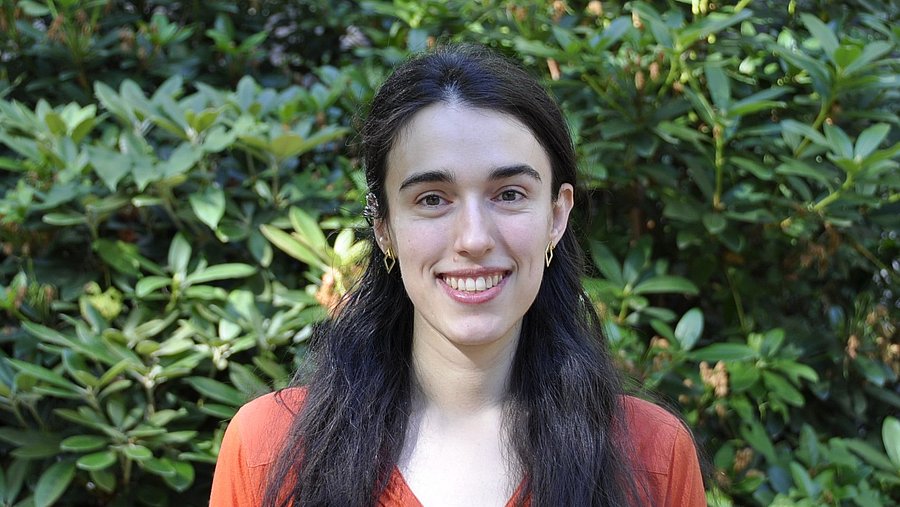
Dr Susana Pinilla Alba / Department of Romance Studies
Photo: UniService Third Mission
Dr Susana Pinilla Alba, a scholar of Romance languages, is organising a conference at the University of Wuppertal that examines anti-feminist narratives in literature
“Anti-feminist narratives are not a new phenomenon. In fact, they have been part of our society for a very long time. They are deeply rooted in patriarchal structures and have existed since those structures first emerged,” Dr Susana Pinilla Alba says, a scholar of Romance languages. Together with her colleague Mirjam Leuzinger, she is organising an international conference at the University of Wuppertal entitled ‘Conflicting Narratives’. The conference focuses on responses, strategies, and visions to combat sexism and anti-feminism.
In recent years, sexist and anti-feminist narratives have become increasingly visible worldwide, both in the digital and public spheres. “In my view, this is primarily linked to the strength of the fourth wave of feminism (the term ‘fourth wave of feminism’ has been used since around 2010. It is strongly characterised by digital media and denounces structural sexism, rape culture, and harassment, editor’s note),” Pinilla Alba explains. “Thanks to digital media information, discourse, and mobilisation now spread much more quickly and across national borders. However, this phenomenon applies not only to feminist positions but also to anti-feminist narratives. Both sides benefit from the possibilities offered by digital communication. Every phase in which feminist movements gain social influence also provokes a backlash.”
New forms of violence in the post-truth era
The topic is particularly relevant today, the Romanist emphasises, because new forms of digital violence have been added to the analogue forms of violence. “They create new opportunities to restrict women’s freedom and to perpetrate gender-based violence. Through social media, forms of social control such as constant surveillance or control over the body are easier to enforce today. Women are bombarded with distorted images and unattainable expectations.” Furthermore, we live in the age of post-truth or post-factuality, in which, in many contexts, numerous opinions are regarded as equally legitimate. “These circumstances lead to fake news and individuals with no real professional or social credibility becoming gurus or influential figures, and their statements are hardly ever questioned.”
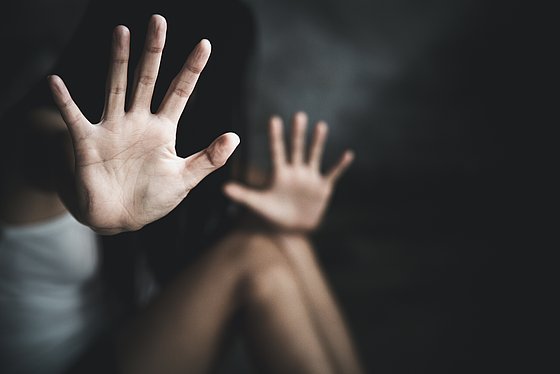
Violence against women in digital media is on the rise
Photo: Colourbox
Misogynistic views are commonplace in the manosphere
The conference also addresses the fact that misogynistic and anti-egalitarian views have now become the norm in online forums. The normalisation of sexism in digital forums is linked to various factors. “By the so-called ‘manosphere’, we mean those virtual spaces in which misogynistic (anti-women) ideas are developed, reinforced, and disseminated, and which in some cases can also contribute to violence in real life,” Pinilla Alba explains. These spaces allow people to remain anonymous and are therefore particularly attractive to certain men, as they lie beyond any taboo boundaries.
“There some men behave in ways they would never display in their professional or social circles. At the same time, these communities offer the opportunity to build a collective identity based on the denigration of women. In particular, men who feel unsuccessful or rejected in their relationships or social roles find recognition, mutual validation and a sense of community there.”
Furthermore, in parts of the manosphere, anti-feminist narratives are linked to authoritarian and far-right ideologies. An idealised past is frequently invoked, in which women are reduced to a subservient and subordinate role. These narratives are linked to the promise of restoring a supposedly ‘natural’ gender order. “Anti-feminist narratives are not, however, directed exclusively at men,” Pinilla Alba points out. “They also affect women and spread within what is sometimes referred to as the ‘Womansphere ’. There, traditional gender roles are promoted, intended to confine women once again to a subordinate and domestic role. A well-known example is the so-called ‘Trad Wives’, female influencers who convey an idealised image of traditional housewife and married life. They portray an exclusive focus on unpaid domestic and care work, as well as economic dependence on one’s husband, as a desirable way of life.”
The work-life balance is still not adequately addressed
Traditional gender roles are once again holding a certain appeal for women. Pinilla Alba has a theory to explain this development. “Many women today face an enormous double burden of paid work and unpaid care and domestic work, and they feel they have to choose between them. For many, the work-life balance remains inadequately addressed. Employment structures are often geared towards an ideal of constant availability and take insufficient account of the realities of many women’s lives, e.g., pregnancy, breastfeeding, or the continuing unequal distribution of care work. Against this backdrop, it is not surprising that some women are once again finding traditional role models attractive.” In the face of chronic exhaustion, burnout, or mental strain, the idea of a supposedly simpler and more secure way of life – as it is often idealised on social media – can seem appealing. However, this does not mean that this model actually offers more freedom or equality; rather, it appears to some as a response to the overwhelming demands that many women face today. Furthermore, there are also women who find their personal situation satisfactory and therefore see no immediate reason to campaign for social change. “By actively championing this way of life, they can justify their decision to themselves and their community. This attitude often creates a sense of supposed empowerment: the conviction that they have chosen this path of life of their own free will.”
Feminist ideas have a social impact
There are many works of literature that laid the foundations for women’s rebellion. In the 20th century, these included writers such as Virginia Woolf, who in her 1929 essay *A Room of One’s Own* argued that women need financial independence and space to write in order to free themselves from the dictates of men, or Simone de Beauvoir, whose 1949 work *The Second Sex* is still regarded today as the theoretical bible of modern feminism. Yet the present day seems to be calling these achievements into question once again. “In fact, the works mentioned already triggered significant backlash at the time of their publication”, Pinilla Alba comments, “and that has not changed to this day. Historically, progress towards gender equality has almost always been accompanied by anti-feminist backlashes. In a sense, such a reaction even demonstrates that feminist ideas are having an impact on society. If there were no resistance at all, one would have to assume that existing power structures were not being challenged at all. Feminism has always been uncomfortable and unwelcome.” Consequently, feminist authors and thinkers have been doubted or delegitimised throughout history.
Whilst literature has made an important contribution to the emancipation of women, at the same time a large part of our literary canon is shaped by patriarchal and misogynistic ideas. “The same applies to society as a whole,” Pinilla Alba states and adds: “Emancipatory and anti-feminist narratives coexist and are in a state of constant tension.”
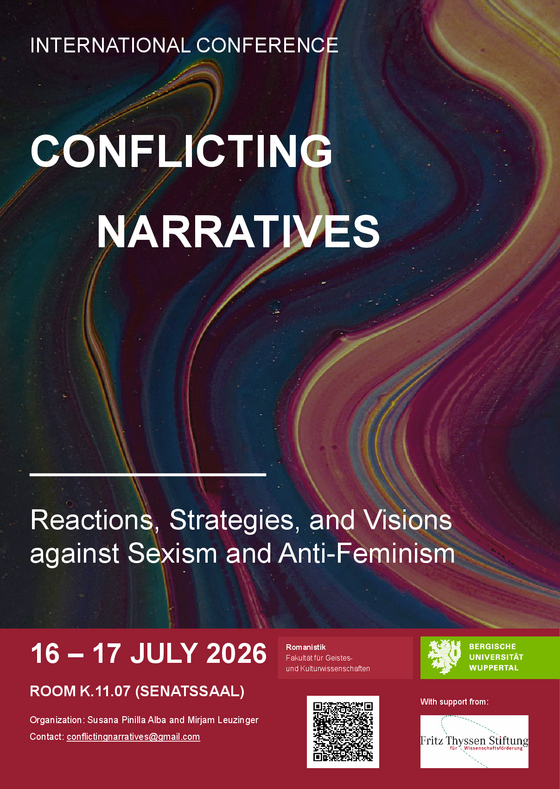
Poster for the event
Scientific authority has changed
The rise of right-wing populist and far-right forces in Europe is closely linked to the possibilities offered by digital media, the researcher notes. Social media platforms have facilitated the spread of simplistic narratives of disinformation and a post-factual culture of communication. “In such an environment, scientific evidence and rational arguments often lose their persuasive power because facts are increasingly treated as mere opinions,” Pinilla Alba regrets. “Sciences no longer carry as much weight as they used to. Sciences are constantly having to battle against opinions and no longer holds the authority they once did. Opinions no longer need to be proven these days.”
Feminist rap with socially critical message appeals to society
The conference examines both fictional and factual forms of such narratives. Pinilla Alba herself is conducting in-depth research into feminist Spanish rap in this context. “I must say that rap in Germany is different from rap in Spain. Here in Germany, we usually think of rap as gangster rap. In Spain, we tend to have ‘conscious rap’ (conscious rap is a genre of hip-hop that focuses on political and socially critical content. The lyrics often tackle issues such as racism, social injustice, police violence or poverty, and aim to foster a critical social consciousness [Editor’s note]). This is a style that is very appealing to academics, as feminist rap in particular represents a particularly clear form of counter-narrative, given that the rap genre, like large parts of commercial culture and literature, is heavily influenced by sexist structures. The existence of female feminist rappers shows that women can challenge and transform the patriarchal mechanisms of a genre from within.” The Romance studies scholar came to her research topic as an avid listener of rap music, having realised that she knew hardly any female rap artists. “When I decided to focus on this field of research, I was fortunate enough to discover the work of feminist female rappers from Spain and Latin America. This particular situation enabled me to understand feminism from a different perspective – not just as a theoretical concept, but also as an artistic practice that directly engages with the everyday lives and realities of many people.” The feminism of these female rappers, she says, is highly philosophical and deeply rooted in lived experience. It becomes visible in women’s bodies, on the streets and in their everyday experiences, and makes it clear that feminist struggles are not merely abstract debates, but concrete social realities.
Gata Cattana – a key figure who died too young continues to have an impact
A key focus of Pinilla Alba’s work is the oeuvre of the rapper Gata Cattana, who died in 2017. “She was a key figure in Spanish rap,” the researcher explains, “she did not only lay the foundations for an aesthetic and literary renewal of the genre and demonstrated that rap can be understood as literature, but she also imbued her work with an explicitly feminist perspective. Her lyrics offer a critical view of social power relations and open up new ways of analysing social reality.” Before her emergence, feminism had hardly played a central role in Spanish rap. Today, Gata Cattana is regarded as an important role model for feminist rap far beyond Spain and for a generation of female artists who see hip-hop as a tool for social critique and feminist intervention.
Feminism is an international field of research
The ‘Conflicting Narratives’ conference is taking place in Wuppertal. “Feminism is an international field of research”, Pinilla Alba explains. “As a theoretical approach, an academic perspective and a social practice, it is also firmly established in North Rhine-Westphalia and is closely linked to research in Romance studies. For this reason, we have deliberately designed the conference to be bilingual in English and Spanish and have invited researchers from various disciplines, including Germanists, translators, philosophers, political scientists, and many others, as the topic extends far beyond the boundaries of our respective fields.” It is also an interesting aspect that both Andalusia and North Rhine-Westphalia share significant structural similarities. Pinilla Alba comments: “Historically both regions have been strongly shaped by the working class, with high levels of migration and cultural diversity. It is precisely in such social contexts that the feminist perspective is particularly relevant, because women with limited economic resources, or women who are additionally affected by racial or ethnic discrimination, face an increased risk of experiencing gender-based violence.”
Pinilla Alba concludes by clearly emphasising once again how important it remains to engage continuously with the issues of sexism and anti-feminism. “Not much has changed yet. Women face the same challenges as in the past; the feminist agenda is still very much on the table. Issues such as prostitution, sexual violence in various forms and women’s rights are still being called into question. Today we may have the impression that culture allows the development of new forms of expression – perhaps even more provocative than before – but in reality, the problems are still the same. Censorship against women is still very much present. Many feminists speak out or highlight where the obstacles lie, but they still face difficulties in getting their work published. Acceptance of feminist narratives is still far from widespread. On the contrary, there are even new forms of violence, and that is one of the most dangerous aspects. We have more fake news, AI, and pornography on social media today, and this leads one to believe that earlier generations of women were actually freer than modern women.
Institutionally, there has certainly been progress, but when we look at how women still live today, we are not convinced that progress has been made. It is more a case of social pretence.”
Further information on the conference is available at: https://romanistik.uni-wuppertal.de/de/fachteile/literatur-und-kulturwissenschaft/forschung/fachtagungen-kolloquien-und-workshops/international-conference-conflicting-narratives/ (in German available only)
Uwe Blass
Dr Susana Pinilla Alba is a research assistant in the Department of Spanish and French Literature within the School of Humanities at the University of Wuppertal.