Strengthening media competence
Who believes that?
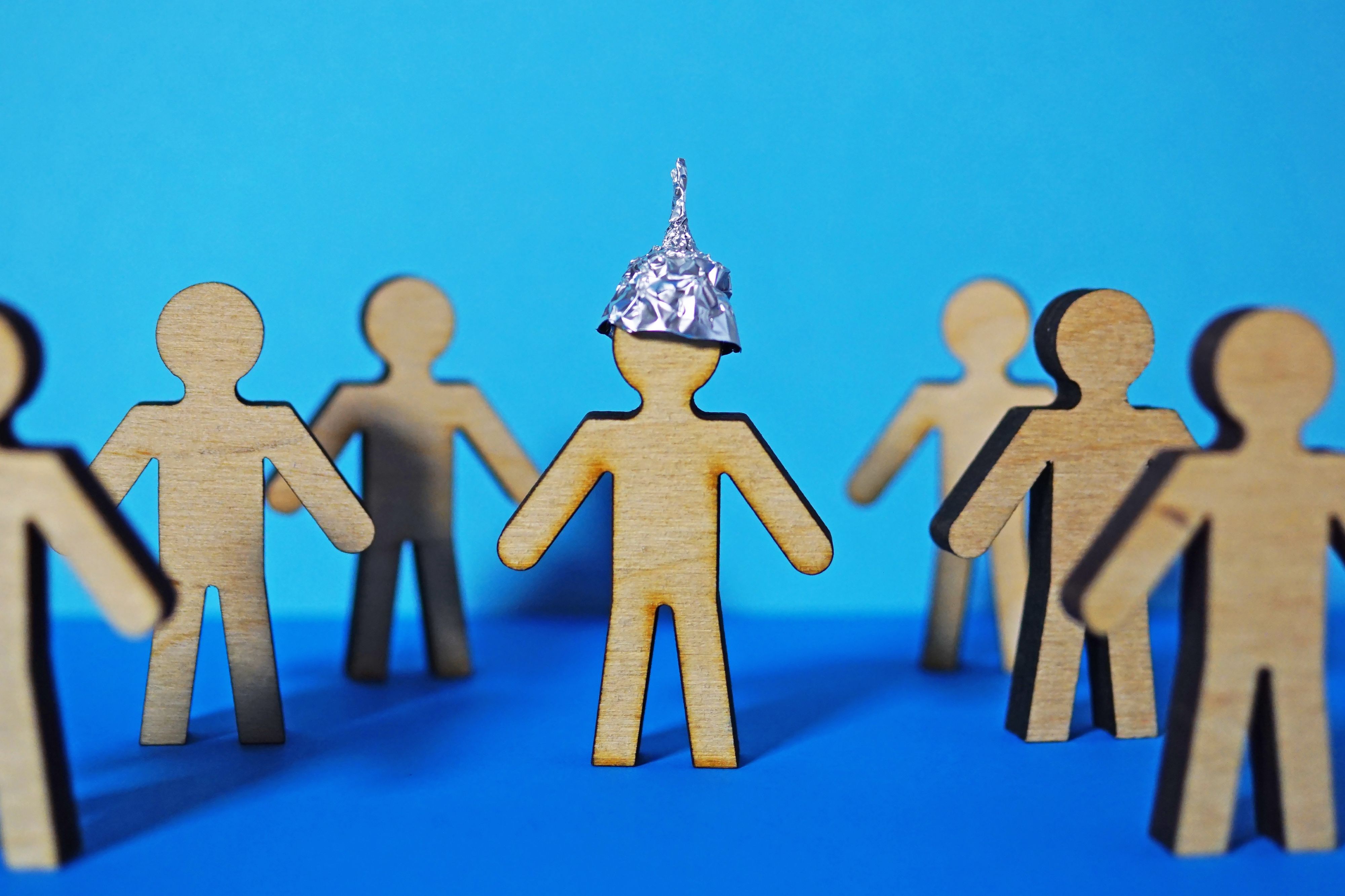
Sxmbolfoto Colourbox
The coronavirus pandemic is a staged event, the moon landing never happened and, of course, Elvis is alive. Examples of conspiracy narratives. "It is often claimed that the conspirators are a group operating in secret, trying to control or destroy an institution, a country or even the whole world for base motives," says Antonius Weixler, literary scholar at the University of Wuppertal. In an article, he analysed the narrative construction of conspiracy narratives and theories.
"Conspiracy narratives also rely heavily on constructing a problem of justice," adds Weixler. "In the public sphere and in politics, it is ultimately always about struggles over distribution. Conspiracy narratives always describe this as a problem of justice. And the perpetrators of such a conspiracy are usually always described by conspiracy believers using collective singulars. In other words, a collective singular such as 'the media', 'politics', 'the elite' or 'science'."
Consensus in science is questioned
Recognising conspiracy narratives is not that easy. "The supposedly 'true' knowledge is always hidden beneath the surface for followers of such stories. Conspiracy narratives therefore always construct the breaking of such a surface, whereby this surface can mean very different things. The surface can generally be seen as the official version of a story, but it can also refer to modernity itself. Other important characteristics that are then added to this are always a strong social hierarchisation of groups and a dualism of good and evil, a so-called Manichean world view. The expectation of conspiracy believers is always that the elites tend to be up to no good."
MAGA - Make America great again
Conspiracy narratives are often summarised in slogans in order to be effective. Weixler comments: "In this respect, Trump's election campaign slogan 'Make America great again' is certainly very well done, because it calls for a great deal with just a few, very concentrated words. We have a victim narrative, a loser narrative and ultimately also a defence narrative. Anyone who is of the opinion that America was once great and is no longer great feels almost automatically like a loser of this development. And if you feel like the loser of this development, then this creates a problem of justice and also impulses for defence. The loser and victim narrative automatically triggers a defence narrative, and that's why there's so much in it."
In addition, this slogan is also 'catchy', it works so well because it engages people by sending a 'we' message, making it easy to feel part of this group. And the abbreviation MAGA is also immediately memorable.
Learning to recognise conspiracy narratives
"Privileged knowledge is knowledge that is staged and merely resembles actual knowledge," says Weixler. "But there are a few ways to recognise the difference, which is why I also talk about conspiracy narratives or conspiracy narratives as opposed to conspiracy theories." This includes the use of the collective singular. So when it is claimed that 'the media' are selling us an official version, according to conspiracy believers this is merely the surface, under which a somehow constructed, supposedly 'true knowledge' can be found. "Beneath the surface, we not only have alternative facts and think we can recognise a conspiracy, but ultimately we also have a different kind of knowledge there.
This supposed 'initiated knowledge' that is under the surface is often something that could be called our own empiricism. It is often argued on the basis of personal experience, i.e. with a very subjective example in the sense of: 'I have experienced this' or 'I have heard that this is the case', 'I know someone to whom this happened'. It's based on subjective experience, even if it's often not your own experience at all, but just hearsay."
If you then ask about the specific sources of such information, many people are unable to provide an answer. It is a parallel world with a different kind of knowledge, which is often not described or justified as knowledge, but as belief.
Media developments are fuelling conspiracy narratives
Major events such as 9/11 in 2001, the financial crisis in 2007, the so-called 'refugee crisis' in 2015, but also the Trump election and the Brexit vote in 2016 as well as the coronavirus pandemic in 2020 were accompanied by a flood of false reports, fake news and, in particular, conspiracy narratives. Media developments have favoured this spread. "These events cover a period of over 20 years, so of course a lot has changed in terms of media history," says the expert. "Whereas with 9/11, we only received counterpoints to official statements with a time delay and then partly through traditional formats such as documentaries that were then uploaded to YouTube or even books that were written, things happened much faster with the coronavirus pandemic, precisely because the media has also changed significantly. The 'newer' and 'closed' social media such as Twitter, Instagram or Telegram evoke much faster reactions and, thanks to their share functions, exponential reproductions than was the case in the comparatively slow 'old' and 'open' social media such as YouTube or Facebook."
In this context, conspiracy narratives almost always provide simple explanations for very complex phenomena. "And people love to hear that. It's a very strong reduction of complexity. They offer simple explanations for areas that are very ambiguous, which means that we see a widespread inability or avoidance strategy among conspiracy believers to tolerate ambiguity. We are perhaps increasingly losing this in social media in general with the ever-increasing flood of information. Today, we have an incredible number of media channels that are not operated by trained journalists. Today, anyone can and does broadcast. As a result, it is often no longer possible to recognise what is an information or opinion channel and what is not, what information has been checked against journalistic standards and what has not. We need much more training in media skills, fiction skills and narrative skills. We also need to change a lot in education and teach people these basic skills again."
Conspiracy believers have a very entrenched world view
Science says that conspiracy narratives are finalised, meaning that it is clear from the outset how a story will end. This is why they always seem to be able to give definitive answers. "Conspiracy theorists or conspiracy believers have a very solidified world view," explains the literary scholar, which consists of the basic distinction between good and evil as well as a very simple idea of how agency works, for example that very few individuals can control global events.
"Ultimately, this contradicts everything that science knows about agency and decision-making processes, because global events are never controlled by individual people alone. However, as soon as a large number of individuals are involved in decisions, the probability increases that sooner or later someone will always spill the beans. Conspiracies, on the other hand, are based on the false assumption that a very small circle is planning something and that everyone in this circle is keeping quiet."
Transfer stories
This article is also published by Bergische Universität's university communications department. The "Bergisch Transfer Stories" use many examples to show how researchers are actively shaping society, the economy, the region and everyday life with their results.
You can find the entire article on the website of the UniService Third Mission.