World population of fire salamanders lives in Germany
Dr Sabrina Bleidißel / Biology
Photo: UniService Third Mission
The world population of fire salamanders lives in Germany
Biologist Sabrina Bleidißel on an amphibian that is widespread in the Bergisch Land and its uncertain future
People call it the rain man, yellow tailor, mountain fool, or rain mollusc when they refer to the local fire salamander, a nocturnal amphibian that the occasional hiker may well come across during the day.
“The fire salamander is native to us, which means that it is also originally widespread here,” Dr Sabrina Bleidißel from the Department of Biology at the University of Wuppertal says. “They live all over Europe, but Germany is where they are most prevalent. Germany therefore has a special responsibility for this species.”
Fire salamanders practically live next door
During the interview, the scientist reveals that you can find the fire salamander practically on your doorstep if you just know where to look. “For example, the fire salamander lives right next to the university in the Ostersiepenbach, which is the small stream between the main building and the university hall. There used to live a large population there. Today, we actually only find remnants of it, individual animals that students report to us. We've already mapped the stream several times.” Most fire salamanders are found in near-natural spring streams, which are very common here in Wuppertal, i.e., flowing, clean, and fish-free waters without signal crayfish. ”Signal crayfish are invasive animals that kill the native crayfish with the crayfish plague they bring with them and eat the larvae of the salamander.” In Wuppertal, there are still individual large and healthy populations, while other fire salamander populations such as those from the Burgholz or the Kaltenbachtal, for example, are almost extinct.
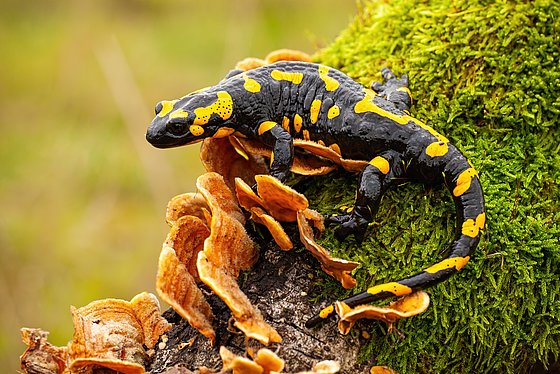
Fire salamanders in the wild
Photo: Colorbox
Its bright yellow colour acts as a deterrent
If you spot a fire salamander in the wild, its bright yellow colour immediately catches your eye. “It’s actually a warning,” explains Bleidißel, “a warning that says: I’m poisonous, don’t eat me! It’s always there – effectively a warning colouration. The aquatic larvae of fire salamanders don’t have this colouring yet. What we’ve already observed here is that the larvae in some streams are quite light in colour, whilst in others they are very dark.” Each individual animal has its own unique colour pattern, meaning that the same animal can be recognised time and again in photographs taken over several years. The scientists also receive help with identification from students, nature lovers and walkers who, whether by chance or deliberately, photograph live and dead salamanders and report these sightings. Reports can be sent at any time to the Biostation, the Lower Nature Conservation Authority, the State Office for Nature, Environment and Consumer Protection in North Rhine-Westphalia, or to the University of Wuppertal, as the biologists there are leading the BioBlitz campaign – a project running until the end of September with the aim of identifying as many plant, animal and fungus species as possible on the Grifflenberg campus and in the surrounding area.
Salamandrin is harmless to humans
“Salamanders have ear glands on both sides of their heads, known as parotid glands, and on their lower backs they have rows of glands from which they secrete their venom, salamandrin, when in danger or under stress. You sometimes read that they can spray it up to a metre away, but I haven’t seen that myself yet,” says the expert. This poison, which is harmless to humans, acts as a deterrent to predators. Nevertheless, they should not be handled by humans, but merely observed. When moulting, the animals retreat to hiding places, as they are particularly defenceless at this time.
If historical records are to be believed, a misconception led to the fire salamander’s name; indeed, the researcher explains, people used to think that these animals could be used to put out fires and would consequently throw them into the flames.
Offspring control in climate change
When mating, the female takes the male's sperm packet and can even store it for several years. ”This is a useful device if the females are unable to find a mating partner for a longer period of time or if the conditions outside are poor,” Bleidißel explains, ”if streams have dried up, the animals can delay this. They can then only fertilise their eggs one or two years later and then release the larvae.” This is how the animals adapt to the environmental conditions.
Fire salamanders are localised, which creates perfect research methods for scientists. “That's wonderful,” the biologist explains, ”especially in connection with the yellow spot pattern, because you can always recognise them. It's good for us because we can take photos of the animals and then recognise them. We get information on their age or movement radius or sometimes even which partner they are mating with. You can observe this very well in the evening.” The best time is about an hour after sunset, when it is raining, when you can make great observations. One place that is particularly busy at this time is the Kupferhammer in Ronsdorf. However, you can also observe fire salamanders in many cemeteries. “There are plenty of places to hide, enough moisture and it's quiet in the evening,” the scientist says.
Deadly disease spreads
A fire salamander can live for around 20 years, or even 50 years in captivity. However, many animals do not currently reach this age. The so-called salamander plague has been spreading for a few years now. In the Netherlands, the animals are already threatened with extinction. In Wuppertal's Burgholz area or around Müngsten area, there are already many salamander-free areas. ”Salamander plague is an introduced potty fungus that originally arrived in Europe from Asia via animal transport,” Bleidißel reports. ”This fungus causes a skin disease in salamanders, which usually kills them. Bsal, which is the abbreviation for this disease, is also widespread here in NRW and we have already had to accept heavy losses in Wuppertal.” Animals kept in captivity can be freed from this fungus by heat treatment. Amphibians living in the wild cannot be helped in this way. Therefore, captive breeding of the fire salamander is considered a sensible way to secure wild populations in the long term. The captive-bred animals can and should later be released into the wild.
People interested in nature are therefore called upon to report any sightings of salamanders. “This is the only way we can get a good overview of the current situation.” If you come across a sign in the forest that says 'salamander plague', you should also disinfect your shoes after your walk, the biologist advises, as otherwise you will also carry this fungus into the next forest area. ”Of course, you should also clean your dog's paws properly.” With its Department of Zoology, the University of Wuppertal is the only university in NRW to operate a quarantine and breeding centre for fire salamanders. The organisers are dependent on financial support to cover future costs to ensure that the fire salamander remains at home. The department is therefore happy to receive donations via this link: https://kooperation.uni-wuppertal.de/de/bergischer-feuersalamander/ (in German available only)
Man meets amphibian
Bleidißel concludes by explaining the correct behaviour when humans and amphibians meet: ”Take a quick look, take a photo with location data if possible and move on! The animal should not be disturbed and above all should not be touched, as it is a protected animal. If it is seen during the day, behaves strangely or wounds are visible, it should be reported. The Biostation Mittlere Wupper is the right place to contact.”
Further information can be found at:
https://www.lanuk.nrw.de/fileadmin/lanuvpubl/4_arbeitsblaetter/Anlage_1_-_Liste_der_regionalen_Bsal-Ansprechpersonen.pdf (in German available only)
https://nabu-naturgucker.de/meldeportal/naturbeobachtungen-melden/bsal/ (in German available only)
https://observation.org/bioblitz/17625/bioblitz-campus-grifflenberg-2025/ (in German available only)
Uwe Blass
Dr Sabrina Bleidißel works as a Permanent Lecturer in the Zoology and Didactics of Biology research group at the School of Mathematics and Natural Sciences at the University of Wuppertal.