
World Dog Day
Prof. Dr Gela Preisfeld / Zoology and Biology Education
Photo: Private collection
A loving, consistent approach to training with very clear instructions
Biologist Gela Preisfeld on ‘man’s best friend’ to mark World Dog Day
10 October is just around the corner once again. Dog lovers are set to celebrate World Dog Day. According to the Central Association of Zoological Retailers (ZZF), there are 10.5 million dogs living in private households in Germany. Reason enough to ask Gela Preisfeld, professor of Zoology and Biology Education at the University of Wuppertal, how the human–animal relationship has developed over time.
15,000 years of partnership
Around 15,000 years ago, during the Stone Age, this partnership developed from the grey wolf (Canis lupus), explains Preisfeld. “Scientifically, our dog is called Canis lupus familiaris and is therefore a subspecies. It is assumed that the relationship between humans and wolves evolved quite selectively for specific abilities, such as hunting, herding and protection; however, one must not only consider domestication – that is, the wolf’s adaptation to humans, which eventually resulted in the dog – but we must also consider how this could have come about in the first place, as humans and wolves did not exactly coexist peacefully, but were certainly also in competition.” So there must have been some evolutionary advantages for both species. “There are a whole range of theories,” explains the biologist. “A key factor here is that humans and wolves have a very similar diet. Both are omnivores. People back then hunted a great deal, and wolves hunt too. One could imagine it like this: the wolves followed the humans, perhaps scavenging the leftovers from their hunts, and the humans, for their part, eventually realised that when the wolves followed them, other predators were kept at bay.” At some point, people would then have raised the wolf cubs with them, and this could be interpreted as the beginning of the evolution into dogs. “Another reason why wolves were able to join humans could be that wolves are pack animals – they need leaders! Dogs, after all, do too, and the dog (formerly the wolf) accepts humans as its leader.”
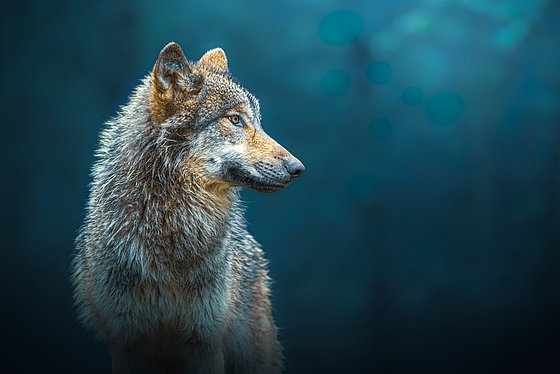
A wolf
Photo: Colourbox
All dogs are descended from the wolf
According to the largest international kennel club, the Fédération Cynologique Internationale (FCI), there are over 340 recognised dog breeds, all of which are indeed descended from the wolf. “Yes, that’s true, and there’s some fascinating research on the subject,” explains the expert. Mitochondrial DNA – which is passed on exclusively through the mother – has been analysed in various domestic dogs, coyotes, wolves and jackals. The findings showed that coyotes and jackals lie outside the family tree of all the domestic dogs studied and evolved much earlier.” To be absolutely certain, the Y chromosomes – which are passed on only by the males – were of course also analysed. Both studies reached the same conclusion: “The dog is unambiguously descended from the wolf.”
When the domesticated pet becomes an international problem
There are around 500 million dogs worldwide, 75 per cent of which live in the wild. India tops the list with 30 million wild dogs. This is where the domesticated pet becomes a problem. “This complex problem requires action on several fronts,” says the scientist, “both in relation to the animals themselves and to how humans interact with them in terms of training, education and, of course, prevention.” One very effective measure is the CNVR programme (CNVR stands for ‘Catch-Neuter-Vaccinate-Return’, i.e. catch, neuter, vaccinate and release) and is a humane method of controlling populations of stray dogs and cats, improving their health and preventing rabies (Editor’s note). This helps to reduce the number of strays in the long term. Vaccination is also part of this effort to curb diseases. These programmes are designed to ensure that the animals are healthier and their welfare is improved. The associated education of owners is intended to encourage people to treat their animals responsibly and not simply abandon them somewhere.”
The dog, a creature that never judges
Hunting, herding and protecting are the qualities that humans have made use of. Beyond that, however, we also value another, very simple ability. “We value them as companions and friends in everyday life,” says Preisfeld, emphasising the animal’s essential characteristic. “Dogs do not judge. It is said that they are unconditionally loyal and that they understand some of our emotional states. They are empathetic, and it is thought that these traits are now innate, that they have become so ingrained through breeding – in other words, a product of co-evolution, of the long history of coexistence between humans and dogs. And these qualities also make it possible to use the animals for therapeutic purposes or in animal-assisted education in schools, because we know that their presence brings greater calm and balance to classrooms.”
Dogs perceive pain in their owners
Preisfeld cites a study from Hungary which found that dogs are evidently able to sense pain in their owners. They pick this up through human speech. “The dogs were given an MRI scan, which revealed that they have very similar areas in similar locations in the brain for language processing as we do. It was then discovered that these areas become active when the owner’s speech is associated with emotional content. And just like us, they react to the emotional tone of speech. Unlike us, however, dogs need multiple cues. They need the content, the intonation and the melody of speech, and then they can understand very well what we want – just a little more slowly. We humans understand about 4 to 6 syllables per second, whereas a dog tends to understand only 3 syllables. So it does help if you speak a little more slowly.”
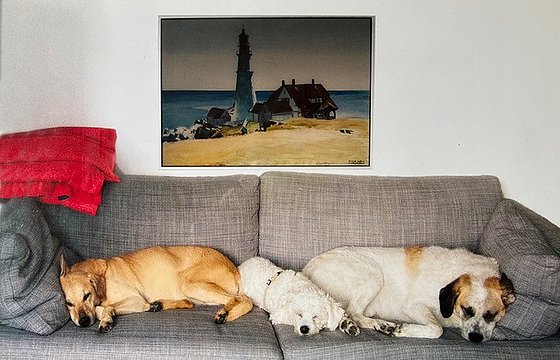
Happy World Dog Day! Photo: Preisfeld
And then there’s the nose …
Dogs have special characteristics that humans also make use of; for example, their sense of smell is many times better than ours. “Dogs are creatures that rely on their noses,” says Preisfeld, “it’s their most important organ. They use it to take in their surroundings, find food, track down their mates and detect danger. This is because they have far more olfactory cells. German Shepherds have over 220 million olfactory cells, whilst we humans have around 10 million. What’s more, dogs have a different breathing rhythm. When sniffing, they can sniff 300 times a minute; their nostrils quiver as they take in various scents. These are then transmitted to the olfactory centre, where they are processed.’ On top of this, there is an even more interesting organ, known as the Jacobson’s organ, a small opening on the roof of the mouth. “Behind the incisors, the palate is connected to the nose. This Jacobson’s organ primarily detects pheromones, but also other substances. What’s special is that the dog doesn’t actually smell these at all; instead, it picks up traces with its tongue – as you’ll have noticed on every walk when the dog licks at whatever it finds – and these are then carried directly via the tiny channels behind the incisors to the Jacobson’s organ and transmitted from there to the brain without passing through the nose. This enables dogs to perceive information about potential mates or enemies directly. Even odours that we humans give off reach the brain via this organ.”
Dog body language, or how to read a dog
Dogs have their own body language, which humans must be prepared to read. And it’s not just the tail that plays an important role. “The dog’s entire behavioural repertoire is a product of the co-evolution of dogs and humans,” says Preisfeld. In addition to tail wagging, there are facial expressions, the position of the ears and general body posture. Tail wagging isn’t always a positive sign, either. “If the dog is tense and its tail is held more horizontally, this tends to indicate insecurity and fear, or even aggression – you have to learn to read that. Dogs are very good at expressing emotions and intentions. We’re all familiar with the so-called ‘doggy eyes’ – those eyebrow movements that trigger our protective instinct. The context in which the dog finds itself is crucial. The ears are an important part of canine communication. When a dog sniffs something out, its ears are pointed forwards, meaning it’s fully alert. If they’re turned to the side or backwards, the dog is often nervous or uncertain and struggles to assess a situation properly.” And then the dog’s overall body language plays a role. A tense body, a raised head and ears pointed forwards indicate alertness and curiosity. “That’s always a good time to teach him something. And he also has signals to avoid conflict – he might yawn, look away or roll onto his back.”
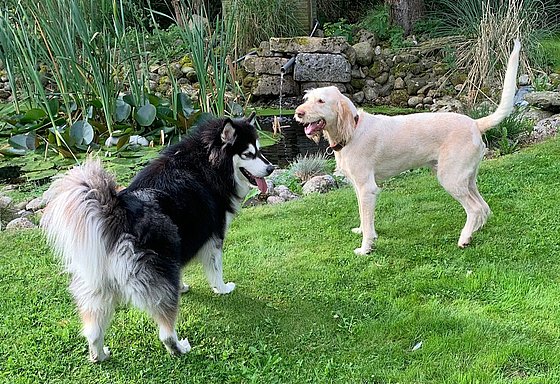
Domesticated for a long time: the Alaskan Malamute ‘Java’ and the Spinone Italiano ‘Pino’
Photo: UniService Third Mission
A perfect day for a dog
10 October is International Dog Day. So what does a perfect day look like for a dog? “I think it should start with a lovely morning walk,” says Preisfeld, “followed by a healthy meal, then some play or other challenges, because dogs want to be kept busy. A second walk – a short one at midday and a slightly longer one in the evening – always with opportunities for play and exercise, which are absolutely essential for a dog. And to ensure a dog can move about freely where it’s allowed to, it’s important that it’s very well-trained so that it obeys commands. This is a basic requirement for letting a dog off the lead, and it requires loving yet consistent training as well as very clear instructions.”
Gourmet food from pet shops
In the past, dogs here were often fed scraps; today, the dog food industry is booming with a wide variety of products. The scientist comments: “We know from research that dogs are omnivores; both plant-based and meat-based diets are suitable for a healthy diet, provided they contain all the necessary nutrients, proteins, fats, carbohydrates and so on. There are many studies showing that even a purely plant-based diet is beneficial, and that dogs on such a diet are often healthier and do not suffer as severely or as quickly from osteoarthritis and joint problems. The key here is a balanced intake of nutrients, regardless of the source of protein, whether it is animal- or plant-based.” You certainly also need to take the dog’s individual tolerances into account; some dogs, for example, cannot tolerate wheat. It is important to have a feeding plan that uses similar food with slight variations. Many dogs also enjoy fruit. “Then there’s also the BARF diet – that is, feeding raw food – which is an option, but you should always use high-quality meat and follow hygiene guidelines, otherwise there’s a risk of parasites. I don’t think the whole range of products you can buy in supermarkets or pet shops is really necessary.”
A friend from abroad?
As well as pedigree dogs from breeders, many dog owners take in animals from overseas animal welfare organisations. However, these animals can also bring diseases with them that we don’t have here at all. “That’s a difficult issue,” Preisfeld admits frankly. “Abroad, dogs live in unspeakably poor conditions and are often killed quite brutally. We don’t want that here, so we’re inclined to adopt animals from such animal welfare organisations. That’s fine, as long as certain things are taken into account. The organisations must be reputable, must ensure the dogs are up to date with their vaccinations, and the dogs must definitely have been tested for rabies and, for example, ‘Mediterranean diseases’ such as leishmaniasis, and must have been microchipped; they may only enter Germany after a period of quarantine, where, following a further period of quarantine, they are rehomed into a stable new home. Should an illness do develop, the new owner must arrange all further matters in close consultation with the vet.”
Bonding hormone unites humans and animals
“The dog, man’s best friend” is a phrase first used in the 18th century by Emperor Frederick the Great. Where does this loyalty towards humans come from? “A dog’s loyalty stems from this mutual emotional bond,” the biologist concludes. “It flows not only from the dog towards the human, but also from the human towards the dog. There is research into this that examines both the biological and behavioural foundations of this special relationship. Over the course of domestication, dogs have adapted to humans and also show a particular attachment to the human caregiver with whom they live. However, it seems that dogs develop a genuine emotional bond with humans, based on something akin to mutual appreciation, rather than being solely about fulfilling human needs.” Psychological studies carried out with humans and dogs have confirmed the release of the hormone oxytocin. “This is what is known as the ‘bonding hormone’. It is released, for example, during childbirth, and influences social interactions as well as emotional development. It helps regulate stress, lowers cortisol levels and reduces blood pressure. In both humans and dogs, its release is triggered by eye contact and physical touch, and this fosters mutual affection.”
Uwe Blass
Professor Dr Gela Preisfeld studied, completed her PhD and obtained her habilitation at the University of Bielefeld. Following short research stays in Australia and a temporary appointment at Goethe University in Frankfurt am Main, she accepted the chair in Biology and its Didactics, Zoology, at the University of Wuppertal in 2006.