Papal election 2025
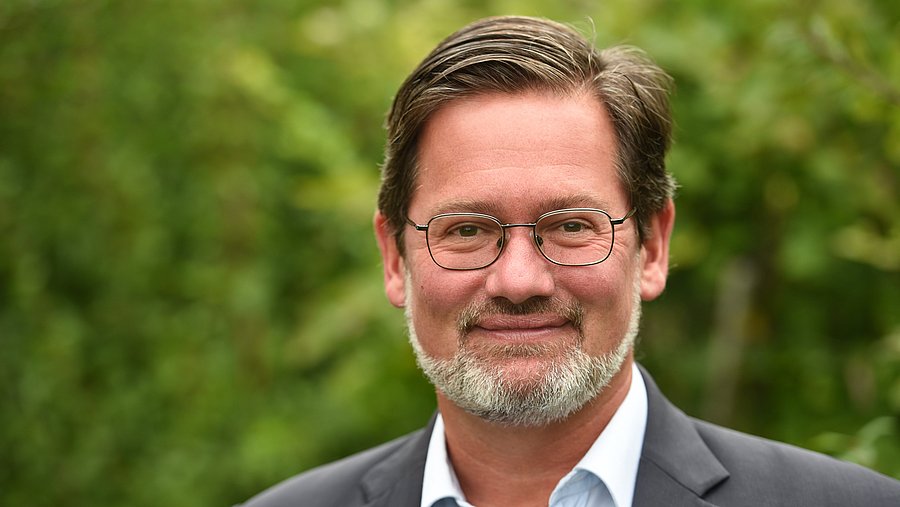
PD Dr Arne Karsten / History
Photo: Sebastian Jarych
”Papal elections are always exciting”
Historian and Rome expert Arne Karsten on the funeral of Pope Francis and the upcoming conclave
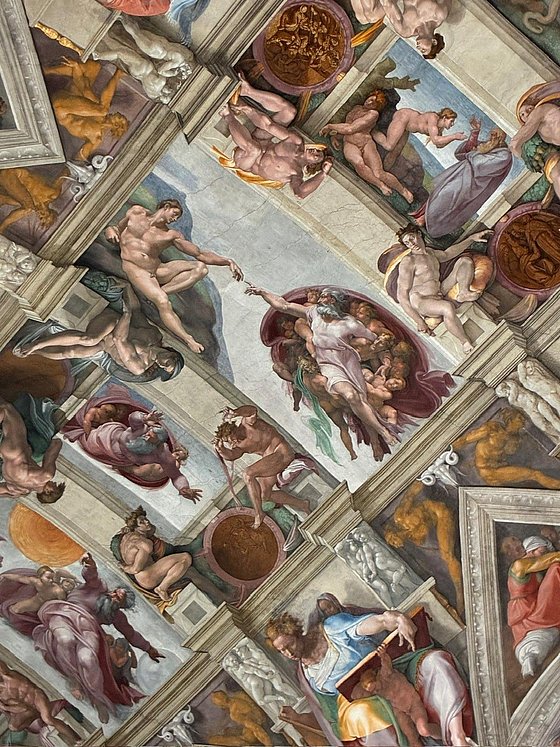
“I call Christ, the Lord, who will judge me, to witness that I choose the one whom I believe must be chosen according to God's will.” With these words, all cardinals vote for their potential papal successor in every ballot. Following the death of Pope Francis, the new conclave begins on 7 May in the Sistine Chapel taking place in camera.
The ceiling of the Sistine Chapel (detail)
Photo: UniService Third Mission
Final resting place not in St Peter’s Basilica
The world’s eyes are once again on Rome. With Pope Francis’s funeral, the location of the papal burial has changed for the first time in over 100 years. His funeral took place in the Church of Santa Maria Maggiore, around five kilometres from St Peter’s Basilica. In his will, he had stipulated: ‘I request that my grave be prepared in the niche in the side aisle between the Pauline Chapel (Cappella della Salus Populi Romani) and the Sforza Chapel of the aforementioned papal basilica, as indicated in the attached appendix. The burial place must be in the ground, simple, without any special decoration and bearing the sole inscription: Franciscus.’ In doing so, the Franciscan broke with the pomp of earlier burials, which, however, certainly had their purpose in the past. “In pre-modern times, the role of the powerful was always staged in a spectacular manner,” says historian Arne Karsten of the University of Wuppertal, adding that this was also important in an era when there were no round-the-clock television or radio reports to inform people who was currently in charge at the Vatican. Karsten himself lived and conducted research in Rome for several years, setting up and leading a research project, as well as writing several books on Roman topics. “The staging of status and political significance was absolutely essential. This went so far that, in the early modern period, desires for modesty clashed with the requirements of state ceremonies,” adds the scholar: “In the wills of cardinals from the 17th and 18th centuries, which I have studied in depth, one frequently comes across a provision stating: ‘I wish to be buried with the pomp prescribed for a cardinal of the Roman Church.’ However, even in pre-modern times there were already cardinals who wished for simple gravestones. Karsten comments: ‘A brother of Pope Urban VIII demanded – and was granted – a gravestone inscribed with the words: “Here lies dust, ashes and nothing”, without a name.’ All the funerals were pompous; that was part of the role, as social status was not left to the discretion of the person holding the office. The funeral rites for the Pope had to meet certain historical standards, although the tombs were, of course, always designed in keeping with the trends of the time.
Traditions make change difficult
In the past, to confirm the death of the Pontiff, one would tap his forehead with a small hammer, call out his baptismal name several times and hold a feather over his face to check whether he might still be breathing. This procedure has now been abolished once and for all. When considering these traditions, one must not forget that the Catholic Church is an institution with a history stretching back almost 2,000 years, the scholar notes, and many traditions have accumulated over that time. “Moreover, it is essential for any human community to continually strike a balance between traditions, which provide stability, and innovations, which enable adaptation. Either one on its own is ruinous: tradition alone leads to stagnation, but an excess of innovation can easily lead to a loss of direction.”

Voting at the 1903 conclave in which Pius X was elected
Photo: public domain
The conclave
All eyes and ears are currently focused on Rome, where from 7 May onwards a new church leader will be elected for the 1.4 billion Catholics in a politically explosive situation worldwide.
The papal elections have always taken place in Rome, since 1878 they were held exclusively in the Sistine Chapel. Until 1978, all cardinals remained locked up there for the entire duration of the election; since 1996, they have been allowed to stay overnight in the newly built guest house next door. Even today, all cardinals involved in the conclave remain without outside contact during the entire election period. Internet, telephone, television, radio, post, or newspapers are not permitted. The cinema film “Conclave” recently showed the procedure of a papal election very well. “The conclave is an institution that was invented in the Middle Ages to shield the papal election from external influences,” Karsten explains. “The head of Catholic Christianity is an institution of European - and since the discovery of the New World - global importance. This is the reason why there have always been all the intrigues, trench warfare, and political negotiations that still take place today in all contexts when it comes to political decisions. The aim of this conclave was to keep them reasonably free from the influence of external power factors, such as the major European powers in the 17th century.”
Voting in the conclave takes place according to a precisely defined ceremony. There are no lists of candidates. Each cardinal writes the name of their favoured candidate on a piece of paper, preferably in a different font but clearly legible, which is then folded twice. Each cardinal then approaches the altar in the order of their ranking, holds the ballot paper up for all to see, kneels briefly in prayer and swears the words mentioned at the beginning. Various candidates compete for the highest office in the church and try to win the votes of the cardinal’s brothers. After each round of voting, the ballot papers are burnt. Via the chimney, the faithful can tell from the colour of the smoke whether a new pope has been elected. “It's pretty weird,” the historian laughs, “but it’s also an example of the survival of old traditions that were completely functional at the time they were created. At a time when there were no mobile phones, no real-time communication, no Internet, this was a comparatively efficient way of letting people - at least in the city of Rome - know what was happening behind the walls of the Vatican.”
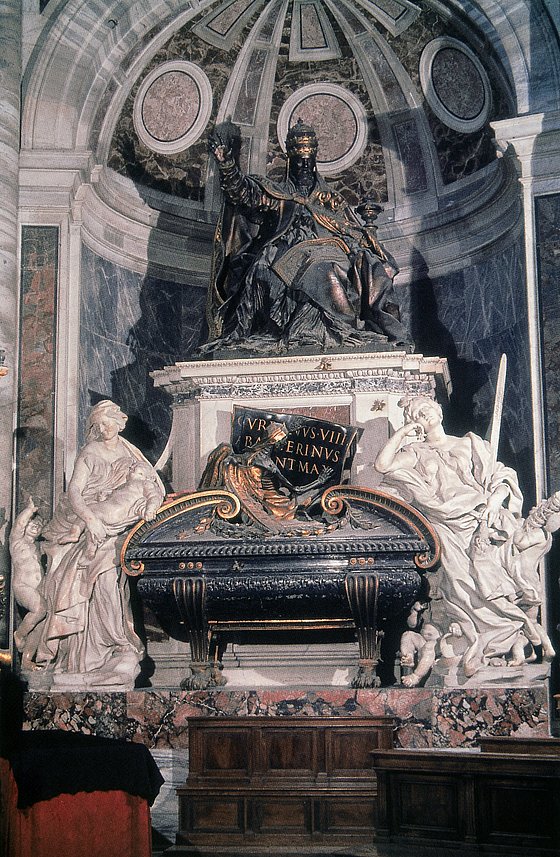
Tomb of Urban VIII, brother of Antonio Barberini. Pompous tomb of the Baroque artist Gian Lorenzo Bernini. Photo: Private
133 cardinals decide on the new pope
There is no time limit on the conclave. The election of Pope Gregory X in the 13th century, for example, took more than two years and nine months.
133 cardinals will decide on the new pope in 2025. Most of them don't even know each other, which means the election will be really exciting this time! “A common saying in modern times is: whoever goes into the conclave as pope comes out as a cardinal,” Karsten says, “the top favourites are rarely successful.” In a politically explosive situation, the results are unpredictable, and it used to be customary in Rome to place bets on the winner. Karsten gives the German cardinals Marx, Woelki and Müller outsider chances at best and argues: "We only just had a German pope from 2005 to 2012 with Benedict XVI, formerly Cardinal Ratzinger." During his term of office, Francis has appointed a total of 108 cardinals who are now eligible to vote, many of them from emerging countries. Therefore, for the first time, there is also the possibility of appointing an African or Asian to the office. “I don't think that's out of the question,” Karsten says, “the importance of non-European cardinals has clearly increased in recent decades, just as the weight of the African and Asian faithful has grown in general. It is therefore quite possible.“
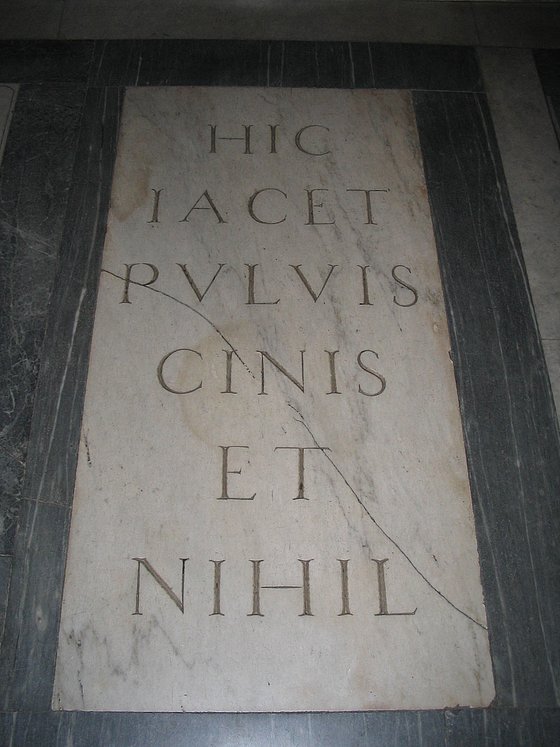
Gravestone of Antonio Barberini: Inscription: "Here lies dust, ashes and nothing"
Photo: CC BY-SA 3.0
Expectations of the new church leader
According to canon law, any Catholic who is male and unmarried can be elected pope. But what qualities should a pope have? The historian says: “He would have to be able to square the circle these days. He would have to be an innovative conservative, he would have to meet the demands of the zeitgeist and at the same time be able to keep the millennia-old tradition alive, an extraordinarily difficult task. A very special task is certainly always that of balance and mediation.”
Pope Francis now rests in Santa Maria Maggiore, by far the most popular church among the Romans. “This is actually the people's church. This is where the celebrations of the common people take place. Not only eight popes lie here, but also cardinals and members of the middle classes. One example is the famous Baroque artist Gian Lorenzo Bernini, who has a simple, plain tombstone near the altar.” The place of his burial is therefore a symbol of Francis' connection with the people. The new representative of St Peter on earth could build on this connection.
Uwe Blass
PD Dr Arne Karsten (*1969) studied art history, history, and philosophy in Göttingen, Rome, and Berlin. From 2001 to 2009, he was a research assistant at the Institute of Art and Visual History at the Humboldt-Universität Berlin and head of the research project “REQUIEM” - The Roman Papal and Cardinal Tombs of the Early Modern Period, www.requiem-projekt.de. He has been teaching as a junior professor since the winter semester 2009 and as a private lecturer in modern history at the University of Wuppertal since his habilitation in 2016.