Conspiracy narratives
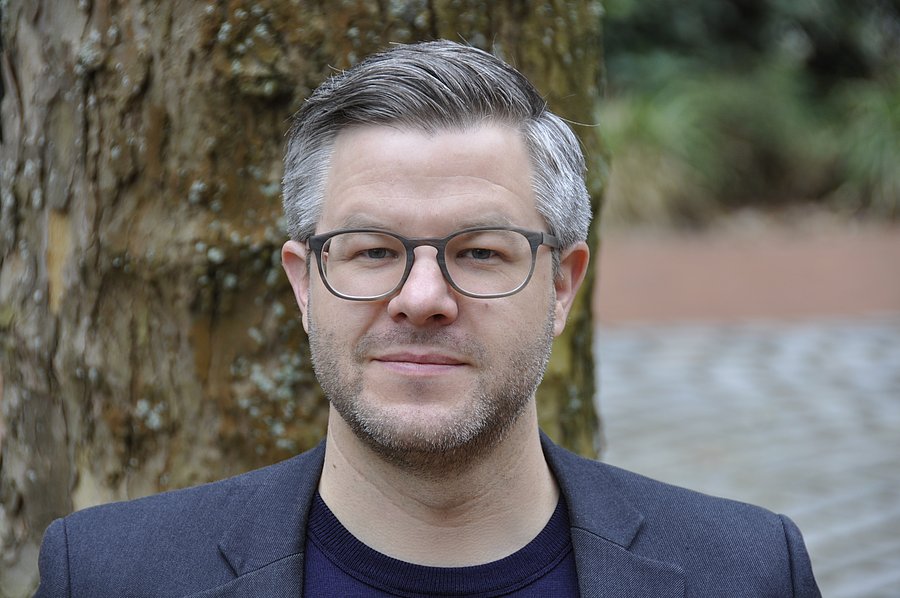
Dr Antonius Weixler / Modern German Literary Studies
Photo: Sebastian Jarych
Too good to be true
Literary scholar Antonius Weixler on conspiracy narratives in the age of social media
The coronavirus pandemic is a hoax, the moon landing never happened and, of course, Elvis is alive. Conspiracy narratives are particularly popular in times of crisis. “It is often claimed that the conspirators are a group operating in secret, trying to control or destroy an institution, a country or even the whole world for base motives,” Antonius Weixler says, a literary scholar at the University of Wuppertal, who analysed the narrative construction of such stories and theories in an article. “Ultimately, we often have narratives that claim that something is happening on a global scale and is not a temporal, localised event.” Weixler likes to quote the Tübingen scientist Michael Butter, a leading researcher of conspiracy theories in Germany, who names three concise characteristics for recognising them: nothing happens by chance, but is deliberately planned, nothing is as it seems, so you always have to look beneath the surface and everything is connected, i.e., people, institutions, and events belong together. “Conspiracy narratives also rely heavily on constructing a problem of justice,” Weixler adds, “in the public sphere and in politics, it is ultimately always about struggles over distribution. Conspiracy narratives always describe this as a problem of justice. And the perpetrators of such a conspiracy are usually always described by conspiracy believers using collective singulars. In other words, a collective singular like ‘the media’, ‘politics’, ’the elite’ or ‘sciences’”.
Consensus in sciences is questioned
Recognising conspiracy narratives is not that easy. “The supposedly ‘true’ knowledge, i.e., the conspiracy, is always hidden beneath the surface and can’t be seen by followers of such stories. Conspiracy narratives therefore always construct the breaking of such a surface, whereby this surface can mean very different things. The surface can generally be seen as the official version of a story, but it can also refer to modernity itself. Other important characteristics that are then added to this are always a strong social hierarchisation of groups and a dualism of good and evil, a so-called Manichean world view. The expectation of conspiracy believers is always that the elites tend to be up to no good.”
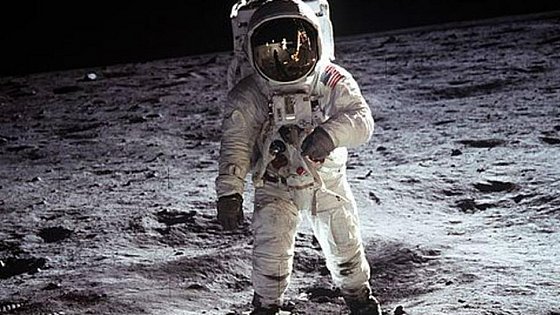
The moon landing: A NASA staging?
Photo: NASA public domain
MAGA - Make America great again
Conspiracy narratives are often summarised in slogans in order to be effective. “In this respect, Trump’s election campaign slogan ‘Make America great again’ is certainly very well done,” Weixler states, “because it calls for a great deal with just a few, very concentrated words. We have a victims’ narrative, a loser narrative and ultimately also a defence narrative. Anyone who is of the opinion that America was once great and is no longer great today almost automatically feels like the loser of this development. And if you feel like the loser of this development, then this development creates the feeling that a problem of justice exists and impulses for defence emerge. The loser and victims’ narrative automatically triggers a defence narrative, and that’s why there’s so much in it.” In addition, this slogan is also ’catchy’, it works so well because it engages people by sending a WE message, making it easy to feel part of this group. And the abbreviation ’MAGA’ is also immediately memorable.
Learning to recognise conspiracy narratives
“Privileged knowledge is knowledge that is staged and merely resembles actual knowledge,” Weixler says, “but there are a few ways to recognise the difference, which is why I also talk about conspiracy narratives or narratives as opposed to conspiracy theories.” This includes the use of the collective singular. So, when it is claimed that ‘the media’ are selling us an official version, conspiracy believers believe that this is merely the surface, under which a somehow constructed, supposedly ‘true knowledge’ can be found. “Beneath the surface, we not only have alternative facts and think we can recognise a conspiracy, but ultimately we also have a different kind of knowledge there. This supposed ‘initiated knowledge’ that is under the surface is often something that could be called our own empiricism. It is often argued on the basis of personal experience, i.e., with a very subjective example in the sense of: ‘I have experienced this’ or 'I have heard that this is the case’, ’I know someone to whom this happened’. It’s based on subjective experience, even if it's often not your own experience at all, but just hearsay.” If you then ask about the specific sources of such information, many people are unable to provide an answer. It is a parallel world with a different kind of knowledge, which is often not described or justified as knowledge, but as faith.
In the future, we want to go back to the past
Conspiracy narratives often construct a past that never existed, but which is romanticised as an ideal state to which we would like to return in the future. They are therefore based on a triadic concept of time: “We have three phases in the calculation of time,” Weixler explains, “a past, a present and a future. In the triadic concept of time, the past is always seen as decidedly positive. Everything was supposedly better in the past, there was a ‘golden age’ in the past, that was what we understand by tradition, however we might define this term. However, such traditions are always mere inventions from the present. Traditions were hardly ever the way we think they were.” For believers in conspiracies, modernisation trends such as immigration or globalisation endanger a tradition seen in this way. “That’s why the present appears as something negative. And the future should not be an open future of development, but in the future, we want to go back to the past. So ‘Make America great again’ is the way to look back.
Media developments are fuelling conspiracy narratives
Major events such as 9/11 in 2001, the financial crisis in 2007, the so-called ‘refugee crisis’ in 2015, but also the Trump election and the Brexit vote in 2016 as well as the coronavirus pandemic in 2020 were accompanied by a flood of false reports, fake news, and, in particular, conspiracy narratives. Media developments favoured this spread. “These events cover a period of over 20 years, so of course a lot has changed in terms of media history,” the expert says. “With 9/11, we only received counterpoints to official statements with a time delay and then partly through traditional formats such as documentaries that were then uploaded to YOUTUBE or even books that were written. With the coronavirus pandemic things developed much faster, precisely because the media has also changed significantly. The ‘newer’ and ‘closed’ social media such as Twitter, Instagram or Telegram evoke much faster reactions and, thanks to their share functions, exponential reproductions than was the case in the comparatively slow ‘old’ and ‘open’ social media such as YouTube or Facebook.” In this context, conspiracy narratives almost always provide simple explanations for very complex phenomena. “People love to hear that. It’s a very strong reduction of complexity. They offer simple explanations for areas that are very ambiguous, i.e., we see a widespread inability or avoidance strategy among conspiracy believers to tolerate ambiguity. We are perhaps increasingly losing this in social media in general with the ever-increasing flood of information. Today, we have an incredible number of media channels that are not operated by trained journalists, meaning, the large area of social media with its influencers. Today, anyone can and does broadcast. As a result, it is often no longer possible to recognise what is an information or opinion channel and what is not, if information has been checked against journalistic standards or not. We need much more training in media skills, fiction skills, and narrative skills. We also need to change a lot in education and teach people these basic skills again.”
The very simple explanations in conspiracy narratives always construct causalities where there are at most correlations or usually only apparent correlations. Conspiracy narratives always construct very clear, simple connections between two events that are far apart in time and space. Serious journalism counters these conspiracy narratives with clarification. “So, when conspiracy narratives are reported in the press, it is usually in the documentary and educational mode. Serious journalism thrives on the fact that every piece of information has to be verified twice –that’s a basic working technique.”
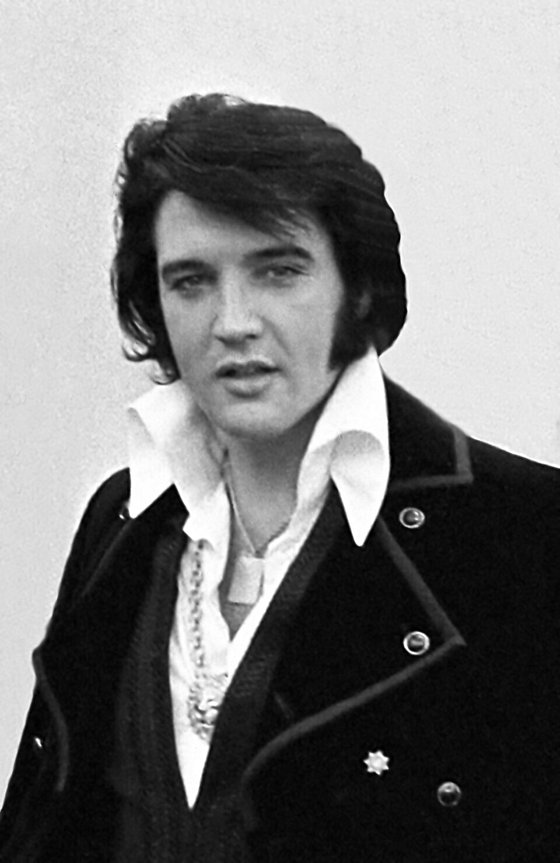
Elvis Presley (1935 - 1977)
Fans still believe he's alive
Photo: public domain
‘Fake news’ has no alternative for conspiracy believers
Since the Trump administration, we have been familiar with the term 'alternative facts', which are supposed to give us inaugurated knowledge. “‘Alternative facts’ appear to have no alternative for the insiders: for the conspiracy believers, the so-called 'inaugurated knowledge' is not just one knowledge among others, it is the ‘one’ knowledge for them. This aspect explains why the followers of conspiracy narratives can hardly ever be dissuaded from their belief in conspiracy by rational argumentation,” Weixler explains. When discussing with believers in conspiracies, you realise time and again that they do not respond to scientific arguments, but answer with their own empiricism, their own views. “There is hardly a conversation possible in which we remain in the mode of argumentation; also, because this dialogue technique of argumentation means that you have to know and accept the rules of argumentation. And if, instead of using arguments and facts, you use your own opinions as a basis, then it’s incredibly difficult to argue against a personal opinion, because your own experiences also have something legitimate, although subjective, about them.”
In contrast to personal opinions, however, knowledge and scientific findings are always falsifiable and are not suitable as a collective singular. “There is simply no thing like ‘knowledge’,” Weixler says, “today’s knowledge may be different tomorrow. Moreover, scientific knowledge does not mean that we can ever determine something with 100% certainty.” In turn, conspiracy believers use the last few percentage points as a gateway for their counter-arguments. An example: “Climate change: We have a consensus among all serious scientists in the world that man-made climate change exists, which is the spectacular thing about climate change research However, even such a consensus is not absolutely reliable. For conspiracy believers, this uncertainty immediately serves as a gateway.” This was also wonderfully evident in the US President’s speech at the UN General Assembly in September last year, when he described climate change as ‘the greatest fraud ever perpetrated on the world’.
Conspiracy believers have a very entrenched world view
Sciences say that conspiracy narratives are finalised, i.e., it is already clear from the beginning how a story will end, so they always seem to be able to give conclusive answers. “Conspiracy theorists or conspiracy believers have a very solidified world view,” the literary scholar explains, which consists of the basic distinction between good and evil as well as a very simple idea of how agency works, for example that very few individuals can control global events. “This ultimately contradicts everything that sciences know about agency and decision-making processes, because global events are never controlled by individual people alone. However, as soon as a large number of individuals are involved in decisions, the probability increases that sooner or later someone will always spill the beans. Conspiracies, on the other hand, are based on the false assumption that a very small circle is planning something and that everyone in this circle is keeping quiet.”
When asked whether the literary scholar has ever believed a conspiracy narrative, Weixler concludes by saying that he is always fundamentally sceptical about narratives that construct global conspiracies. In everyday life as well as in the small, private sphere, however, we are also exposed to conspiracy narratives from time to time, whether we like it or not, especially when it comes to gossip. “Some stories are simply too good to be true, as the saying goes, and what it means is that we should actually distrust the veracity of some stories because they can hardly be true. At the same time, however, the vernacular also knows that we only want to believe this truth because we like the story so much, it triggers strong emotions in us and we are among the initiates of this story, this ‘exclusive knowledge’.”
Uwe Blass
Dr Antonius Weixler works as a lecturer with a specified function in Modern German Literature at the University of Wuppertal.