Translocation - when houses emigrate
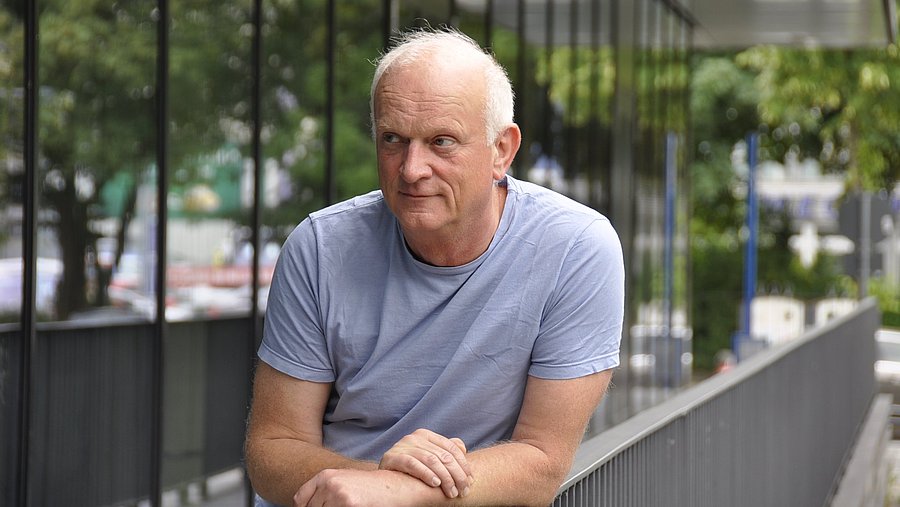
Professor Christoph Grafe / Architecture
Photo: UniService Third Mission
Varresbeck manor - when houses relocate
The architect Christoph Grafe on the process of translocation
On 8 March 1960, UNESCO asked for international help to save the temples in Abu Simbel. They were in danger of being destroyed during the construction of the Aswan High Dam. Among the numerous proposals and plans to save the buildings, a Swedish project was awarded the contract in June 1963. The temple was completely deconstructed and rebuilt on a 64 metre higher level. This process is known as translocation and also affected the so-called Varresbeck manor in Wuppertal-Elberfeld in 1972. Christoph Grafe, professor of Architecture at the University of Wuppertal, knows more about structure relocation.
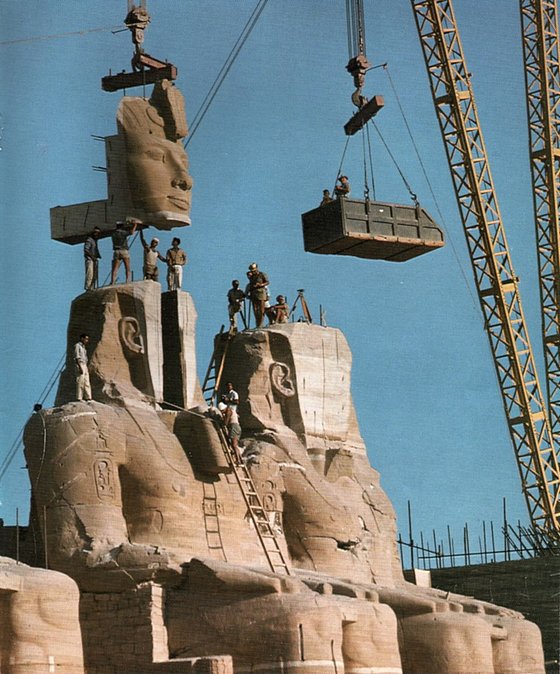
Abu Simbel Temple -
Relocation of the seating pictures
Photo: public domain
Sustainable use of building fabric
“The term translocation is derived from the Latin trans (across) and locus (place),” Grafe begins, “and it has to do with moving a building from one place to another. This is not an entirely new practice. Especially for timber-framed buildings or buildings based on wooden skeletons, this practice has been around for many centuries.” One reason was the reuse of construction elements. “The timber-framed houses and farmhouses, especially in the north, have always been skeletal structures that were then topped with a roof. If a house had to be rebuilt in a different location, this construction was simply used again.” Cultural arguments did not necessarily play a role here, but rather the sustainable use of common building materials. “In the past, everything was more sustainable than today,” he emphasises.
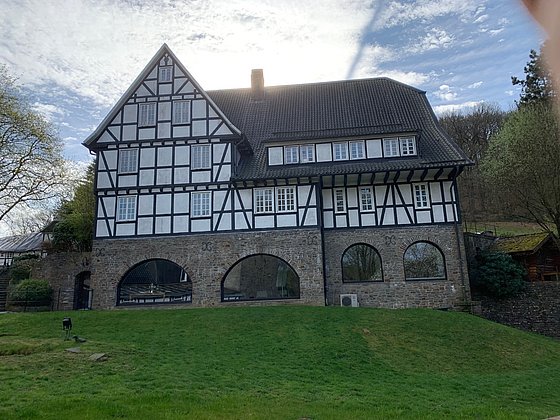
House Varresbeck -
Rear view
Photo: UniService Third Mission
Translocation in the modern era
The structure relocation in the modern era, i.e., since the time of the industrial revolution, has other motives, such as road extensions or the merging of several historic buildings. “Sometimes the individual building has no high monumental value at all, but then islands of remembrance are created. This is how the historic city centre in Hanover was created, for example,” the expert explains. “After the destruction of the Second World War, remaining half-timbered houses or those saved elsewhere in Hanover (and the region) were demolished and rebuilt in the area around the Kreuzkirche and the Ballhof during the reconstruction in the 1950s.” Only last year, the wooden Kiruna Church (Sweden) with its weight of 600 tons was relocated. It had to be moved due to subsidence caused by mining, the media reported. Grafe also knows of a completely relocated village in North Holland. “That’s Zaanse Schans, the most famous open-air museum in the Netherlands. This village consists of classic North Holland wooden houses that have all been brought together because they blocked the way elsewhere.” Between 1961 and 1974, many old buildings and windmills from the surrounding area were transported to the Zaanse Schans, rebuilt, and restored to their original state. “The classic open-air museums,” Grafe states, "“even here in the neighbourhood in Hagen, Lindlar, or Kommern, were all created out of this situation, because otherwise the buildings would have been demolished.”
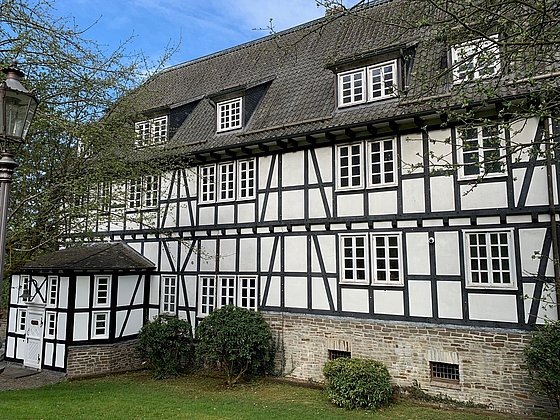
House Varresbeck -
Front view
Photo: UniService Third Mission
Parts of skeleton construction are numbered consecutively
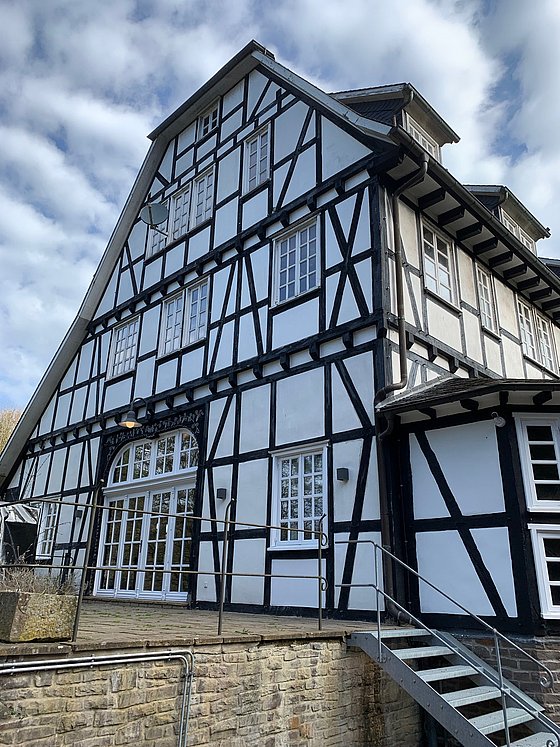
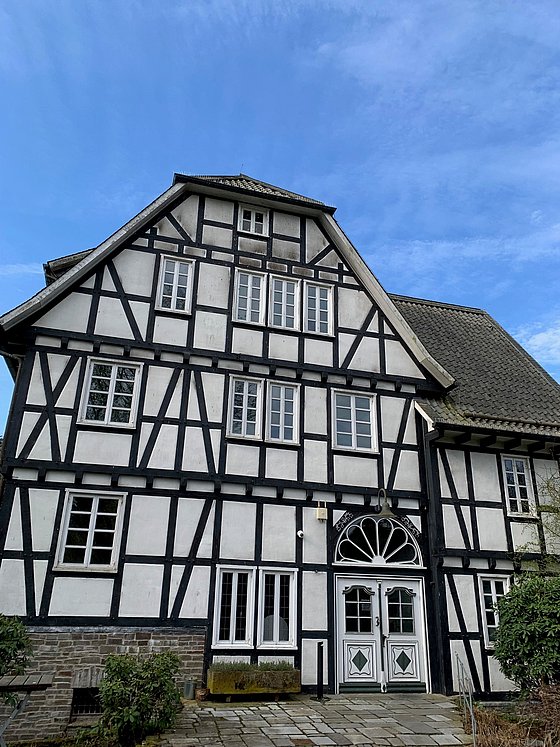
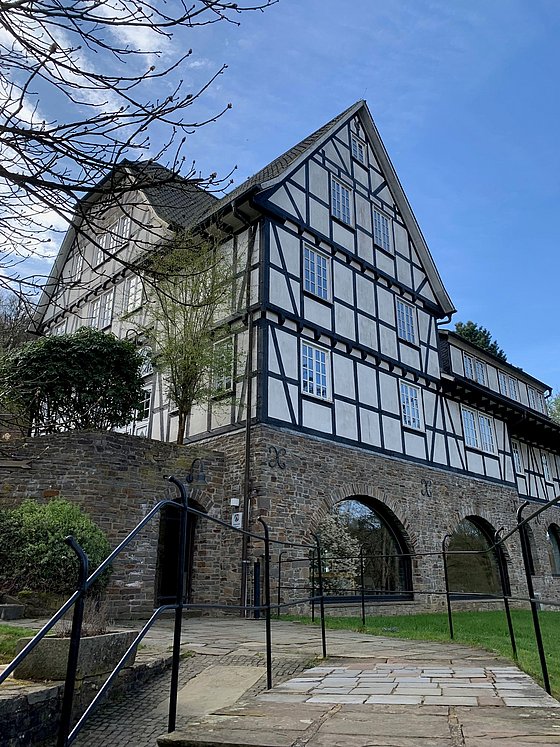
The building from Wuppertal, known by name as the Varresbeck manor, was no small hut, as the imposing structure had a timber frame made of heavy oak beams and topped with a hipped roof. Inside the house, there was a two-storey ‘Herrschaftsdiele’ with two open fireplaces. The house had a total of 25 rooms. And yet buildings of this size could be realised without any problems. “It always depends on the construction. In this case, it was also a skeleton construction, i.e., once the infill panels had been removed, only the skeleton remained. This was then easy to relocate because it is basically a construction kit.”
House Varresbeck -
left entrance
Photo: UniService Third Mission
In August 1972, the old building was dismantled, numbered, and loaded. “When a building has stood in one place for 400 years, the beams have naturally deformed over time. You can’t reinstall the beams in another place, because each individual part naturally bears the marks of time. So, you have to put the beam back exactly where it was before,” the architect explains. And so, a piece of history left the city and was only to be rebuilt after around 30 years.
Sustainable use of building fabric
“The term translocation is derived from the Latin trans (across) and locus (place),” Grafe begins, “and it has to do with moving a building from one place to another. This is not an entirely new practice. Especially for timber-framed buildings or buildings based on wooden skeletons, it’s something that has been around for many centuries.” One reason for this was the reuse of construction elements. “The timber-framed houses and farmhouses, especially in the north, have always been skeletal structures that were then topped with a roof. If a house had to be rebuilt in a different location, this construction was simply used again.” Cultural arguments did not necessarily play a role here, but rather the sustainable use of common building materials. “In the past, everything was more sustainable than what we do today anyway,” he emphasises.
House Varresbeck -
right entrance
Photo: UniService Third Mission
Varresbeck House is rebuilt in Gut Hungenbach
Varresbeck House was dismantled in 1972, eight years before the Act on the Protection of Cultural Property came into force, and, as no suitable location could be found in Wuppertal, it was moved to Gut Hungenbach in the tranquil town of Kürten in the Rheinisch-Bergischer Kreis, where it was to be used as a retirement home. However, the reconstruction was delayed for 30 years because of problems with building law, planning law, and concerning finance, as well as later issues relating to the protection of historic monuments. When work could finally begin, poor storage had severely damaged the oak beams, meaning that the building structure had to be rebuilt. Today, the building is used as a conference venue or for celebrations. The vaulted cellar, which was once underground, is now above ground with bright panoramic windows and is suitable for events for up to 50 guests with its approx. 100 square metres. The former Knights’ Hall is equally impressive and can also be booked for events.
Gut Hungenbach consists of a complex of several buildings from the 18th century as well as half-timbered houses, all of which have been relocated in order to preserve them.
House Varresbeck -
Side view
Photo: UniService Third Mission
Preservation on site instead of relocation to the open-air museum
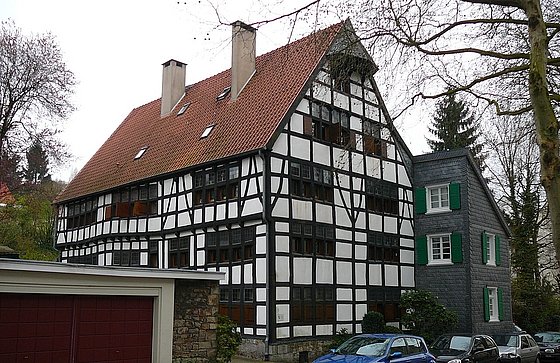
Another half-timbered house in Emilstraße, which is now considered the oldest half-timbered house in Wuppertal alongside the Teschemacher Hof, was actually supposed to be relocated to the Kommern open-air museum. However, the so-called Hofeshaus Lütterkus-Heidt was saved for the 21st century. Built around 1600, the half-timbered house, unlike many other buildings, was not destroyed during the attack on Barmen in 1943 and housed 20 tenants in the 1950s due to the housing shortage. In the 1970s, it was even on the verge of demolition and was no longer habitable. Ideas to relocate the house to the Kommern Open-Air Museum were not realised, as the community of heirs sold the building in 1978 and the subsequent buyer finally carried out a restoration which lasted nine years and costed 1.2 million German mark. A total of five residential units were created. Today, the courtyard house Lütterkus-Heidt is considered the most beautiful building on the square.
Court house Lütterkus-Heidt
Photo: CC BY - SA 3.0
“The practice of relocating is very interesting and has been scrutinised critically for many years,” Grafe concludes. “It has to be said that it is very often modernisations that lead to buildings being relocated, e.g., the widening of a street. Today we’re talking about it again because we’re thinking about reusing buildings sustainably, and the assessment of relocation is also changing. It’s a very old practice that goes hand in hand with the sensible reuse of materials and also has to do with circular construction.”
Uwe Blass
Professor Christoph Grafe has held the Chair of Architecture, History and Theory at the University of Wuppertal since 2013.