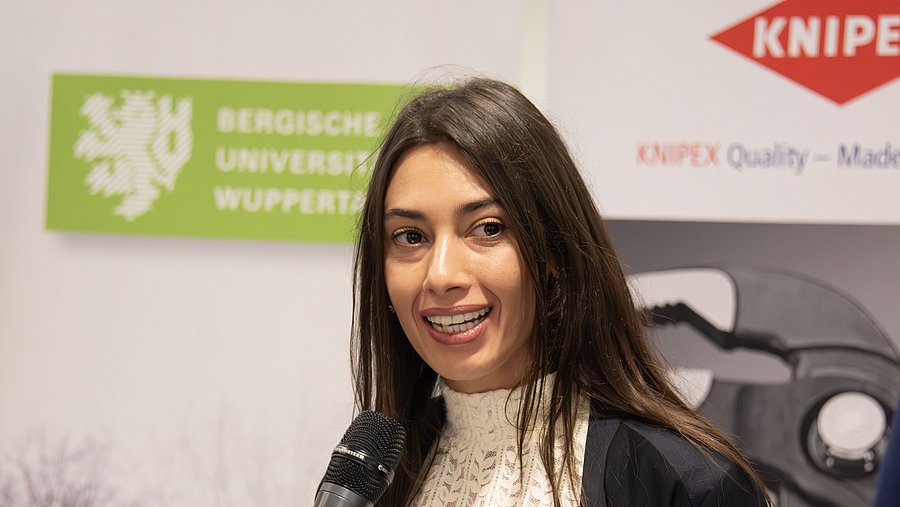
Neighbourhood project StraßenOase
Leila Rudzki / Visual Communication
Photo: Friederike von Heyden
Trust and authenticity - the most important prerequisite for sustainable urban development
Leila Rudzki from the Chair of Didactics of Visual Communication on the successful neighbourhood project StraßenOase! in Wichlinghausen.
“Let’s close a street - and green it up” – this was the initial idea for the participatory research and urban development project StraßenOase! that Leila Rudzki from the University of Wuppertal had along with her later project partner Liesbeth Bakker from Ideaalwerk, an initiative for sustainable urban and neighbourhood development. As a lecturer in the Master’s degree programme in Public Interest Design, she and her doctoral supervisor Axel Buether did not want to teach students mere theory. They wanted them to contribute to an active shaping of the city by means of a specific project.
”So we travelled directly to Wichlinghauser Straße, the place that would later become StraßenOase!,” she says enthusiastically. “It is really special for all senses. In addition, it is characterised by contrasts: the beautiful aqueduct, coupled with the extreme volume of speeding cars that only slow down briefly in front of a fixed speed trap, as well as the flavours of cooking of the adjacent restaurants. I also immediately grew fond of the local people and their passion.”
Different project partners - common goal
The StraßenOase! in Wuppertal-Wichlinghausen was initiated and realised with interdisciplinary participants. In addition to those mentioned above, it also included the city of Wuppertal, BOB Kulturwerk e.V., the initiative “Platz für alle”, students from the Public Interest Design master’s programme and the office of the initiative VierZwoZwo.
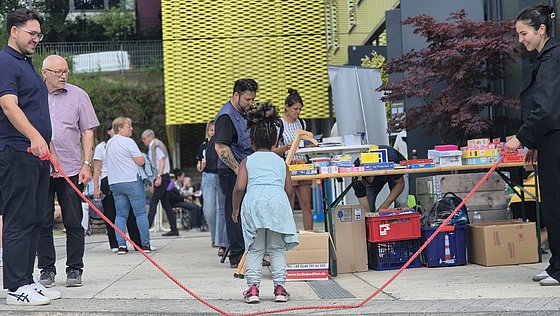
Street festival StraßenOase (detail)
Photo: Jenny Hust
Using a setback as an opportunity
“Originally, we had a plan that seemed too utopian for local politicians: to temporarily calm a 50-metre section of Wichlinghauser Straße and transform it into a green neighbourhood oasis with seating, shaded areas, communal dining, music and cultural life,” Rudzki explains. And although the administration had already approved the idea, it was stopped by local politicians three weeks before it was due to start. “We had actually prepared everything very well with the city council and had even already hired a road construction company,” she continues, “but then at the political committee meeting one party voted against it, even though we had endeavoured to get all parties on board from the outset. At first, this was a real shock, because we hat to start from scratch.” Some of those involved then left the project, disillusioned. However, a quickly arranged crisis meeting made it clear that those who remained wanted to realise StraßenOase! even more. “Everyone sat down together at a table on the BOB campus - initiatives, students, people from the neighbourhood and associations”, Rudzki explains “And at this meeting, so many ideas came from the students. Everyone wanted to realise StraßenOase! from the bottom of their hearts. A creative wave emerged from this honest exchange. Everyone wanted to keep going and see what was still possible.” So, a neighbourhood festival was prepared in Wichlinghausen.
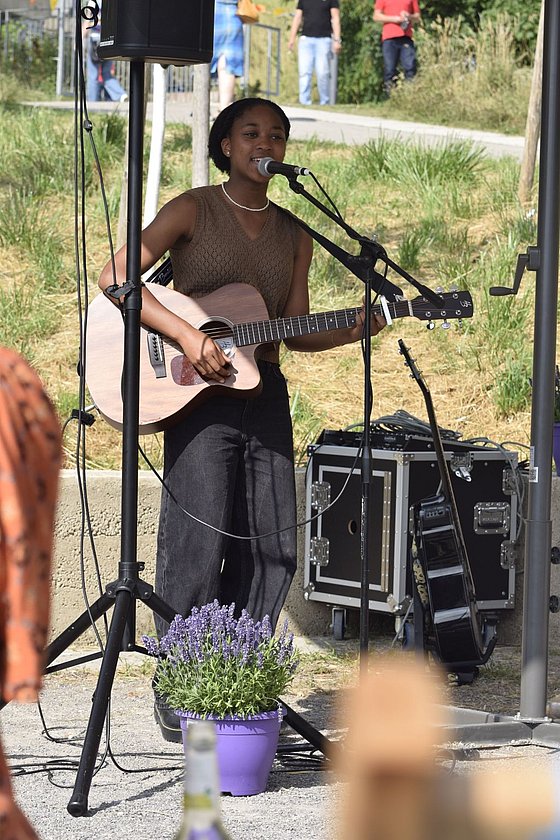
The organisers received spontaneous support from numerous local companies, for example the landscaping company Leonhards, which delivered a large number of trees weighing several tonnes on a heavy-duty transporter at short notice and this way contributed to the extraordinary greenery. “As if out of nowhere, Wuppertal DJ PSPAGEL42 also joined the party, delighting visitors on his own dancefloor. Local organisations provided fantastic food. Residents organised yoga, children’s activities, a live stage with music and a concluding political discussion. All was done in only three weeks!” The ban got everyone moving: as a team, as a neighbourhood, as a democratic community.
66 residents actively participated
Fortunately, there was a lot of interest in a neighbourhood project right from the start, if only because of the office. “Together with the manager, Andreas Röhrig, we thought about what was already happening here, who was already involved and which should be approached. Of course, we also went door-to-door, visited the kiosks and supermarkets and got in touch with the operators. We were allowed to display posters and postcards in their shop windows,” Rudzki says about her involvement during the planning phase. Participation begins with trust. And the success proved her right. “Through the festival and the joint process, we were able to make democracy visible in everyday life in the immediate neighbourhood. The StraßenOase! festival made people feel what democracy means, namely talking to each other, finding solutions, allowing mistakes, accepting and wanting to understand the ideas and opinions of others, remaining curious, meeting each other and still moving forward together.” The festival took place on 13 July 2025 and impressively demonstrated what co-creation in the public sphere can mean. Particularly one sentence stuck in Leila Rudzki’s mind that day: “Democracy was tangible here today”.
Old neighbourhood rethought with the support of the development fund
Various measures are needed to reconsider your neighbourhood in a visible and audible manner. ” Four things are central for me: dialogue, cooperation, openness and joy. The first step is to understand the neighbourhood in its own logic,” Rudzki says, “ When people experience that their ideas are taken seriously, real commitment develops. However, this attitude requires time and the ability to listen, as well as the courage to take unconventional paths. “Together, we did not only shape the city, but also built trust - and that is perhaps the most important foundation for sustainable urban development, because the citizens are the experts in the neighbourhood.” It was also beneficial to receive financial aid from a municipal development fund, which specifically finances small, community-focused projects that have a direct impact on the neighbourhood. “Thanks to this support, we were able to actively involve many people in a relatively short space of time: students, neighbours, local business people, volunteers, politicians, and members of the administration. New networks, collaborations and friendships were formed. New teams were built that are still thinking about what Wichlinghausen could look like in the future, especially with regard to a transport concept.”
Music at the street festival
Photo: Jenny Hust
StreetOasis! Can also be used in many places
The project works with a so-called location-flexible modular principle and can also be used in other locations. “The project is deliberately designed to be open and flexible,” the scientist explains. ”You only have to bear in mind at any time that every neighbourhood has its own residents and needs. StraßenOase! is certainly not a rigid concept, but a collection of tried-and-tested tools that can be used to customise participation. The important thing is to get people on board, involve politicians and take each neighbourhood seriously.” Every neighbourhood has its own dynamics, challenges and dreams. In Wichlinghausen, in this case, it was the desire for traffic calming and a better quality of life. “It is decisive that the method adapts - never the other way round. So, the principle is: listen, adapt, develop, and realise together."
The influence of civil society
StraßenOase! is a role model for participatory urban design, as it creates something new from setbacks and promotes public debate on topics such as mobility, climate and the common good. The influence of civil society in the ongoing process is crucial. "With StraßenOase!, the citizens had almost complete freedom of choice - and that's exactly what made the difference. You get into a totally creative process, like cogwheels that interlock, and then all the parts turn harmoniously like clockwork,” Rudzki notes. There was certainly a formal framework, a financial limit and legal requirements such as fire service access or safety concepts, but beyond that, everything was coordinated, discussed and designed together. “‘The meaning of politics is freedom’', the philosopher Hannah Arendt said. That’s exactly what we lived: freedom through joint action in the public sphere. When decisions on plans are made over people’s heads, frustration and mistrust arise. This is also proven by the Harvard Grant Study. It has been running for 85 years and says that the greatest recipe for happiness is good relationships. Having a say and feeling connected makes you happy in the long term.”
At the end of last year, Rudzki received the first Third Mission Honour Award from the University of Wuppertal, sponsored by Knipex, for her commitment as runner-up. “This is a wonderful recognition for our joint project and shows what happens when commitment, research and passion come together,” the scientist concludes, who now wants to focus on finalising her doctoral dissertation on the planned topic of participation as a design principle.
Uwe Blass
Leila Rudzki has been a research assistant at the Chair of Didactics of Visual Communication since 2022.