Language support techniques
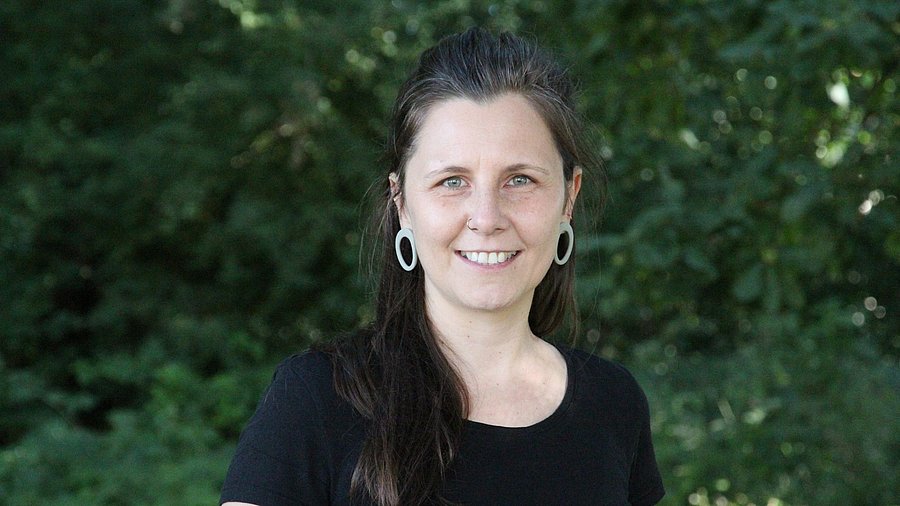
Dr Valentina Reitenbach / Institute for Educational Research
Photo: Lisa Caspar
How can I support language development?
Valentina Reitenbach from the Institute for Educational Research on a project on techniques to support plausible language development for everyone who spends time with children and young people
Language education in the immigration society is a topic that is on the minds of all citizens in many places, at nurseries, schools, at work and among friends, because as a result of globalisation and migration our society is becoming increasingly diverse. There are more and more children in schools who do not speak German as their first language and have to learn specialised content in addition to normal language acquisition. Here, teachers take on the task of integrating selective support of developing specific language skills in a targeted manner. However, there are also extracurricular after-school programmes, e.g., homework support and other forms of assistance, which are often provided by semi-professional helpers who have no academic training in supporting language development. For this target group, Dr Valentina Reitenbach and Dr Anna Nishen developed supportive learning guidance as part of the EQUAL-Net project based at the LMU Munich in collaboration with Dr Margot Belet and Eva Somrei from the foundation ‘Stiftung Ein Quadratkilometer Bildung’ for their nationwide educational workshops for educationally disadvantaged children and young people.
Everyday integrated language education with scientifically based techniques
In order to find out what distinguishes scientifically based language support techniques from other language support techniques, the researchers first conducted research and searched nationwide for studies and in psychology and educational sciences databases that focussed on the target group of multilingual children. “It's very specialised,” Reitenbach says, “which is why there isn’t a study that proves this exactly in this constellation. But we have found studies that provide an overall picture for the tips we have chosen. That’s why we speak of scientifically plausible tips.” Everyday integrated language development is therefore not based on complex language development programmes, but on easy-to-use techniques that can be integrated into everyday reading, conversation or play situations. The term actually comes from kindergarten, where this everyday integrated language education was widely promoted throughout Germany. “It is a pedagogical approach in which educational processes, including language education processes, take place directly in everyday life and not separately in small groups, the researcher explains. “Any everyday situation can be an opportunity to support language development. In a day-care centre, for example, it could be at mealtimes or in times when body care takes place. In our context of learning support, it is all learning and care situations, even when the learning support is playing with the children. We are in dialogue with each other. It’s charming that it’s very low-threshold. Any situation can be used as an opportunity to support language development.”
One square kilometre of education - one foundation
“The ‘Stiftung Ein Quadratkilometer Bildung’ itself operates throughout Germany and endeavours to set up educational networks in neighbourhoods affected by poverty,” Reitenbach explains. The neighbourhoods we are focusing on are actually located on roughly one square kilometre, hence the name of the foundation. “They then act and network primary schools and after-school care centres, for example. Here in Wuppertal, this concept exists as well. The Pädagogische Werkstatt (pedagogical workshop) is located at the Alte Feuerwache (old fire station) , which is located at the old fire station. Primary schools are also members of the network.” In Wuppertal the focus lies on promoting language acquisition and reading skills. Children and young people are supported with their homework, and there are individual learning support and reading programmes. Reitenbach and her colleague Anna Nishen were networked with the foundation via the Munich-based EQUAL-Net project.
The card system
In order to convey the methods of learning support in a practical way, the team developed didactic cards that present scientifically based language support techniques in a clear, visual, and appealing form. They are designed in a way that they can be used directly in everyday life without any prior didactic knowledge. This is a low-threshold approach that combines theory and practice. The prototype of the cards has already been trialled by the learning guides in the pedagogical workshop at the Gathe. “We gave the prototype to six employees of the workshop and then asked them for feedback. Our questions were whether the cards were understandable, whether they were useful, whether they were perhaps already implementing some of them, how helpful they were, or whether something was missing?” The very positive and appreciative feedback inspired the project team to further improve the card system. One piece of feedback regarding singing songs with the children and young people was promptly integrated into the card catalogue as a further tip with follow-up research. The final version is currently being finished, both as a freely available digital format and as a sustainable printed A5 card set with five techniques and introductory tips for getting started. “The cards are not yet printed, but you can already download them online,” Reitenbach says.
University expertise helps shape transformation processes
Using the cards can unobtrusively reinforce everyday learning. “Our cards, if I now take up the topic of singing songs, are about singing songs with the children in various situations when appropriate” Reitenbach explains. “Vocabulary and sentence structures can be learnt through this song singing, whereby the aim is not to precisely define a sentence structure, but to increase the language output through language practice.” Verbalising processes can also support the development of language skills. “This way the children’s language input increases. I simply tell them what I’m doing while I’m preparing the learning material.”
The project on ‘Wissenschaftlich plausiblen Sprachfördertechniken’ (‘Scientifically plausible language development techniques’) can become a model with a signalling effect beyond the region. A scientifically sound, practical, and socially effective third mission initiative demonstrates how university expertise can actively shape social transformation processes.
For further information, please visit https://sif.uni-wuppertal.de/en/school-intervention-research/sprachfoerdertipps/
Uwe Blass
Dr Valentina Reitenbach is a research assistant in the area of school intervention research at the Institute for Educational Research (IfB) at the University of Wuppertal.