
Recycled gold – an environmentally friendly alternative
Prof. Dr Fabian Mohr / Inorganic Chemistry
Photo: Sebastian Jarych
Recycled gold – an environmentally friendly alternative
Fabian Mohr on scientific methods for the sustainable extraction of high-purity gold from scrap
Gold extraction normally involves the use of toxic substances such as cyanide salts or mercury, which have a significant impact on the environment. However, gold has also been used in all manner of electrical appliances since the 1960s, and these appliances end up as electronic waste once they are no longer in use. In 2022 alone, around 62 million tonnes of electronic waste were produced, but only 22.3 per cent of this was recycled, as there has so far been a lack of efficient and sustainable methods. Yet one tonne of electronic waste typically contains a higher proportion of gold than one tonne of ore. Now, an Australian research team has developed an environmentally friendly method for recycling gold from electronic waste. Chemist Professor Fabian Mohr from the University of Wuppertal has examined this and other methods for the sustainable use of gold and says: “What is certainly remarkable about this method is that it uses substances which are available in large quantities at low cost and are completely harmless. The method is based on an everyday chemical that is known as a disinfectant but also, in particular, as a substance used in swimming pools to chlorinate the water without having to use chlorine gas.” However, the interdisciplinary team of scientists at Flinders University in Bedford Park has also developed a special polymer (polymers are large, chain-like macromolecules consisting of many small, repeating building blocks, known as monomers, Editor’s note), adds the Wuppertal-based researcher, which absorbs the gold particles like a sponge and separates them from the other metals. This, he explains, is the real challenge in recycling precious and base metals: the separation of the different types.
Mercury method actually banned in almost all countries
With this new method, the Australian team avoids the release of highly toxic mercury vapours, which used to be a constant problem. Mohr comments: “It must be said that the mercury method of extracting gold is no longer applicable on an industrial scale and is banned in almost all countries. The problem today is gold extraction using mercury in illegal mines, a practice still carried out by private individuals, typically in Central and South America and in some parts of Africa.” There, mercury is readily available at low cost and there are no significant safety precautions in place. “Mercury in its gaseous state, in particular, is highly toxic to humans and the environment,” warns the expert, explaining: “In this process, the alloy of gold and mercury – an amalgam – is heated to separate the mercury from the gold. In the process, the mercury turns into a gas. Eventually, it ends up in the environment, in water bodies, in the food chain and ultimately in humans.” The method that dominates gold mining worldwide to this day is the so-called cyanide leaching process. This involves the use of sodium cyanide, another highly dangerous chemical, which has the economic advantage of being dirt cheap and not being very stable in the natural environment. “If cyanide waste is left exposed to sunlight and air for a prolonged period, the highly toxic cyanide is oxidised into non-toxic cyanate. And that is why this process is by no means as dangerous as the mercury amalgam process.”
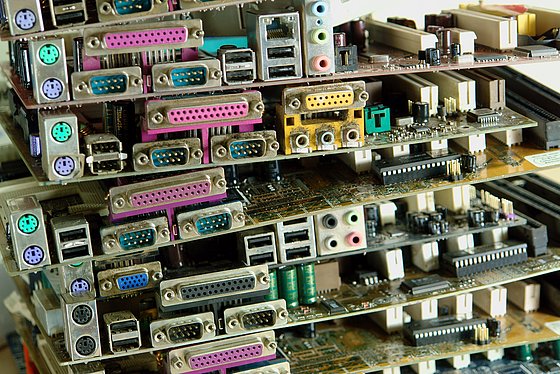
Electrical waste
Photo: Colourbox
3.9 milligrams of gold from 30 grams of electronic waste powder
What makes the Australians’ method particularly sustainable is that they use memory modules from discarded computers to extract both gold and copper. According to the study, circuit boards and other components from discarded electronics can contain between 200 and 900 milligrams of gold per kilogram. According to United Nations estimates, the annual volume of electronic waste generated is equivalent to around 125 discarded laptops or PCs per second. In the test, the researchers extracted 3.9 milligrams of gold from 30 grams of electronic waste powder. “Given the current very high gold prices, such recycling methods are naturally becoming increasingly attractive. As soon as you can recycle gold using substances that are readily available at low cost, it can become economically viable,” explains Mohr. But which parts of electronic waste actually contain gold? “Gold has very, very good electrical conductivity,” says the chemist, “which means that wherever components are connected to one another, wherever electricity has to flow, you’ll also find gold. The gold connectors on chips and the conductor contacts on circuit boards are actually made of gold.”
Gold lies unused in our drawers
As there is no difference between recycled gold and mined gold, one might favour recycled gold for purely ethical reasons alone. And when you hear that, according to expert estimates, a good tonne of gold is contained in the approximately 167 million old mobile phones alone that lie unused in drawers across Germany, the resources for a circular economy are actually there. However, the greatest chemical and environmental challenge remains the selective separation of gold from the more than 50 other metals used in these devices.
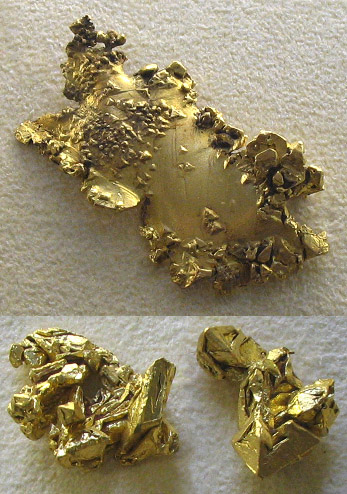
Gold nuggets: Top: California (USA), bottom: Victoria (Australia)
Photo: public domain
More than 50 precious and base metals are used in electrical appliances
“Copper and nickel make up the majority of the base metals in our electrical appliances, and separating them from the precious metals is difficult,” says Mohr. “Some hard drives still contain platinum group metals, such as ruthenium, but tantalum will certainly also be an important resource. Tantalum is a very hard and corrosion-resistant metal, which is found in each of the small capacitors used in electronic components. Tantalum is also a very rare metal, and global reserves are limited. The US Geological Survey (a scientific agency of the US Department of the Interior, editor’s note) estimates that global tantalum reserves will last for another 50 years. So, before we run out of gold, recycling tantalum is actually a much more interesting topic when it comes to sustainability.”
Switzerland is experimenting with whey
Researchers at the Swiss Federal Institute of Technology in Zurich are also investigating the extraction of gold from electronic waste and, in this context, presented another interesting method in early 2024. They used a by-product of the cheese-making process to produce sponges from whey. “The scientists have produced what is known as an aerogel from this by-product of cheese production. You have to imagine it as a gelatinous, porous material, similar to a firm jelly. And the gold particles can be trapped in these pores and separated from the other metals,” explains Mohr.
China uses chemical leaching
No developments without China. A Chinese research team has developed a particularly cost-effective chemical leaching method that extracts gold from old mobile phones, computers and circuit boards in less than 20 minutes. As the price of gold now stands at over 4,000 US dollars per ounce, recycling has become extremely lucrative. “To dissolve gold, you need an oxidising agent and a ligand (a ligand is a molecule or ion that binds to a central target molecule, editor’s note), something that can grab hold of the gold. The Chinese researchers have found a combination that is extremely cost-effective and actually works very well.”
Establishing new methods takes time
“Attempts have also been made to further develop the potential of substances that can selectively dissolve gold on an industrial scale, in order to find an alternative to cyanide,” explains Mohr, “but so far, nothing has been found that is quite so cost-effective.” New concepts on an industrial scale simply take time, he says. “A company needs to be found that is bold enough and has enough money to invest in this to make use of this method.” What could certainly happen is that, using these technologies, universities might set up start-up companies specialising in recycling gold from electronic waste. “This might not be a method used in mining, but I can well imagine it being used for electronic waste. Things like this always start small. If it were commercially successful, there would certainly be others following suit. We simply need to see how feasible it is to scale up from the laboratory scale to a small-scale industrial operation, and whether it would still work just as efficiently and cost-effectively.”
Uwe Blass
Prof. Dr Fabian Mohr studied chemistry in Melbourne (Australia) and obtained his PhD there. Following posts in Canada, the USA and Spain, he has been professor of inorganic chemistry in the school of mathematics and natural sciences at the University of Wuppertal since 2014.