
Recruiting Day 2026 on the Grifflenberg
Dr Anja Kluge / UniService Third Mission
Photo: Friederike von Heyden
Strategically dealing with your own future
Dr Anja Kluge, Head of Career Services at the University of Wuppertal, on the Recruiting Day on Grifflenberg campus
This year’s Recruiting Day will take place at the University of Wuppertal on 20 May. Ms Kluge, you are head of the Career Service in the UniService Third Mission team. Why does the university actually offer this service for students?
Anja Kluge: The Career Services is one of the central advice centres at many universities in Germany and throughout Europe. We provide advice and information on current topics in the world of work and career guidance and we support in strengthening your own profile and starting a career. Our services are based on a holistic approach to studying together with other advice centres. This means that the services offered by the Career Services of the University of Wuppertal are an aspect of the “student life circle” and enable students and alumni to enter the labour market successfully after graduation, ideally with all the personal potential they have. We therefore support the development of educational biographies and raise awareness of the need for students to think strategically about their future at an early stage. For many students, the final exams are usually a long way off and they start thinking about the question "What do I actually want? In which working environment or team do I see myself? What will I gain from a master’s degree or what place will I find in the world of work with my degree? These are complex questions that can be unsettling and we support the decision-making process. In concrete terms, this means that we offer individual and group counselling for students and alumni, we provide support in the search for suitable positions for work placements or work contracts, we optimise application documents and explore career opportunities after graduation, and, in cooperation with other counselling centres, also with a view to career paths after or as an alternative to a doctorate. Discovering your personal profile and getting to know yourself in various team and work situations are also key objectives of our counselling and workshop services. In order to facilitate contact between students, alumni, and companies, we also organise regular networking events and company visits. At the Recruiting Day - the job fair on campus – , companies present themselves directly at the university. These formats are the perfect opportunity to experience companies up close and make valuable contacts for your professional life. We also operate a job portal where, in addition to jobs as a working student and work placements, we also offer practice-orientated theses and job advertisements for direct entry into the job market after graduation.
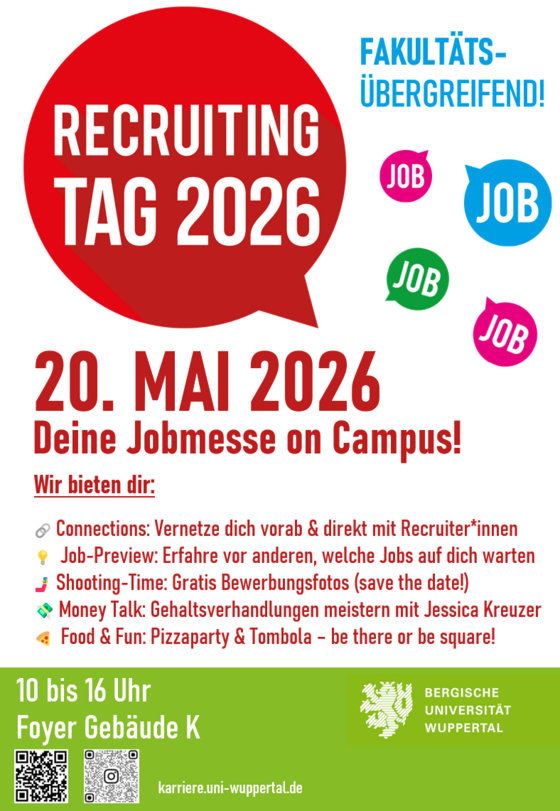
Event poster
From 10.00 a.m. to 4.00 p.m., more than 28 companies and institutions from the region will be presenting themselves at Grifflenberg in Building K on Gaußstraße and providing an insight into their fields of activity. What are the main areas in which you can work in the Bergisch Land after graduating?
Anja Kluge: That’s one of the most frequent questions we get every day and that’s exactly why we organise the Recruiting Day and our other formats once a year. Why do we do that? Simply because the fields of activity are very broad and can be customised. From the so-called hidden champions to municipal employers, nationally based providers and classic family businesses in the manufacturing industry, everything is covered at first glance. However, the most important question in preparation should always be: In which field of activity do I want to work later? And which work placements and practical experience could be useful or essential for this field. Openness and curiosity are also important. Take, for example, a traditional family business from the Bergisch Land region that manufactures tools. A sports sciences student would probably not expect to work there directly. With a view to their company health and prevention management, however, perhaps the student would consider a position there. What I’m trying to say is that looking at companies and what they produce, do, or process is simply not enough., A direct dialogue with the recruiters and owners is essential in order to understand which company is right for me and where I can best contribute my (professional) potential and interests. To achieve this - and this brings us back to our programmes - you need to know your own skills and profile.
Students gain an insight into the work of companies and institutions. Can you give us a few examples?
Anja Kluge: An overview of all companies, municipal institutions, service centres, and schools can be found on our Career Services website and at the Recruiting Day. So perhaps I’ll just talk about our new network partners, i.e., companies that are taking part for the first time this year. These include, for example, Die Autobahn GmbH des Bundes for the construction sector, Leister Technologies for the mechanical engineering sector and DSS Engineering for the safety technology/work safety and fire protection sector as well as Rheinmetall from the defence industry. I can’t list all the companies and municipal partner organisations here, but it’s important for me to mention that from this year onwards, all interested parties - students, alumni and young professionals - will not only be able to view all the companies and vacancies in advance, but will also be able to get in touch with them in advance and thus expand their network.
So now I come here as a student and want to find out more. Should I simply work my way round all the stands, or what is the best way to proceed?
Anja Kluge: Ideally, the students, alumni, and young professionals will be well informed about all the companies and their current vacancies via our website. Perhaps an appointment can also be arranged in advance so that you can meet and exchange ideas directly at the stand without having to wait a long time. From a strategic point of view, I would suggest the following approach: I come to the job fair with (preferably) or without an appointment and go specifically to the companies first and contact persons that are my priorities one and two. It’s best to have prepared my profile digitally as a business card in advance or I can call up my digital profile on site to connect with the recruiters. If there is still availability, I go to a professional photo shooting (subject to registration) and then visit other companies. I stay curious, practise networking, and look beyond the boundaries of my degree programme to see what other jobs there might be that would suit me. At 4 p.m. I would then go to the keynote speech and the workshop on salary negotiations, as this is by far the most difficult part of the entire application process. I might even stay until the pizza party and watch the raffle. But everyone can decide for themselves.
Event logo
You also offer an attractive range of fringe events to ensure that the “fun factor” is not neglected.. A highlight of recent years has always been the photo shoot. How crucial is it to pose for an application photo be
Anja Kluge: Yes, it’s always exciting for everyone and we’re delighted to be able to offer this service free of charge again this year, because the first impressions are very important. Even though application photos are generally optional, we actually advise you to send one, as it consciously or unconsciously gives the recruiter a first visual impression. It is important that it looks friendly and authentic. But nobody needs to worry. Our photographer is an absolute professional. The photo can then be used directly for the application, which will be sent to interested companies after the job fair.
A workshop on salary negotiations is also on the programme. Who have you been able to attract for this offer?
Anja Kluge: We are very pleased that our extensive network allowed us to recruit Jessica Kreuzer, a former professional footballer. After her active career in sport, she decided to share her knowledge with young people as a professionally qualified coach and negotiation specialist, since fair compensation is unfortunately still not a matter of course everywhere. It can be challenging to correctly assess and confidently present your own performance - whether you are only starting out in your career or you are already employed. This is true for people of all genders. Jessica Kreuzer therefore shows us in a practical way how career starters and young professionals can use scientifically sound strategies to start salary negotiations with confidence and avoid typical mistakes.
This is not the first time the Recruiting Day is being held. What aspects has changed and what feedback have you received from students and companies so far?
Anja Kluge: It is typically challenging to find out what advantages the job fair has provided for students. But I assume that with the range of companies on offer, this cross-faculty event will once again attract many interested parties this year. We are much more digitalised than we were in the past. The vacancies are published in advance via our new online tool and you can schedule appointments with the recruiters in advance. This year, we are also targeting alumni and young professionals of the university, as it is not just a job fair for students, but a format that aims to support job seekers and gives them the opportunity to talk to experts.
Further information at: https://karriere.uni-wuppertal.de/de/veranstaltungen/recruiting-tag-2026/ (in German available only)
Uwe Blass
Dr Anja Kluge heads the Career Services in the UniService Third Mission team at the University of Wuppertal.