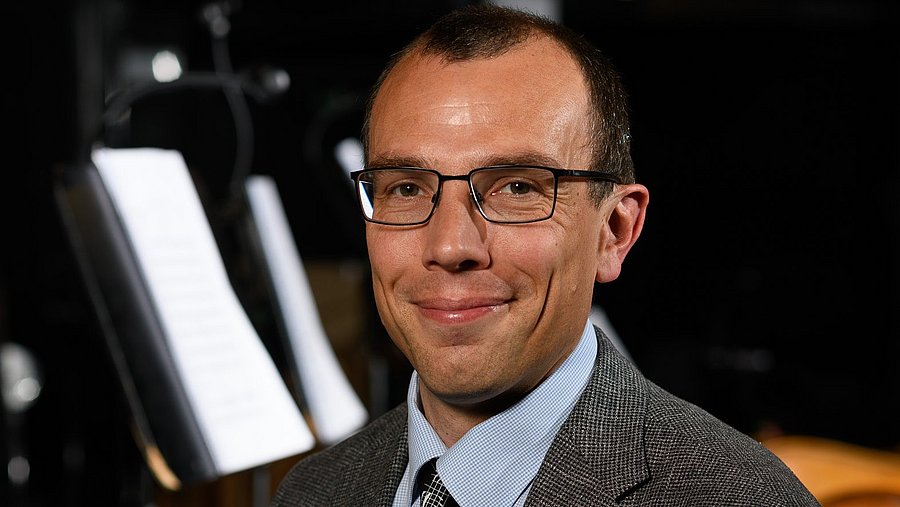
The Research-Oriented Rector
PD Dr Georg Eckert / History
Photo: Mathias Kehren
Rainer Gruenter: The Researching Rector
Historian Georg Eckert is compiling a biography of Rainer Gruenter, the founding rector of the University of Bergisch, for the *Neue Deutsche Biographie*, one of Germany’s most important reference works.
Mr Eckert, how did you come to write a biography of Rainer Gruenter for one of Germany’s most important reference works, the Neue Deutsche Biographie?
Georg Eckert: First of all, it is important to explain how the *Neue Deutsche Biographie* came to be involved in this. The work is a national biographical dictionary dedicated to particularly influential ‘figures from the entire German-speaking and cultural sphere’ and consists of short scholarly biographies. Now continued online, this major scholarly undertaking is supported by the Historical Commission of the Bavarian Academy of Sciences – recent articles have included, for example, pieces on the entrepreneur Melitta Bentz (who invented the coffee filter of the same name), the eminent mathematician Kurt Gödel, the GDR dissident Robert Havemann and the former Federal Minister for Foreign Affairs Klaus Kinkel. One does not apply to be featured in such a scholarly work. Rather, the editorial team decides which figures are historically significant enough to warrant an article (and also who is a suitable author). Rainer Gruenter is now included among them: incidentally, this is an important recognition for our University of Wuppertal today. In view of Gruenter’s significance, the editorial team asked me to write an article about him. I was happy to agree; a few years ago, I had co-authored the commemorative volume marking the 50th anniversary of our university together with the now-emeritus historian Prof. Dr Gerrit Walther and the former university archivist Dr Joachim Studberg.

Rainer Gruenter and Johannes Rau at a reception (1977), BU University Archives
Photo: Wilfried Bell
Rainer Gruenter was the founding rector of the Wuppertal Comprehensive University, now known as the University of Wuppertal. Johannes Rau, then Minister of Education and Research and later Federal President, campaigned strongly for him to take up this post. Why?
Georg Eckert: Rau never specified the exact reasons; perhaps he regarded this information as ‘knowledge of power’. The new rector was to be someone who could be held up as a model, as Rau explicitly emphasised: but he never revealed exactly to what extent. Nevertheless, some of the motives are understandable. The most important might be that Gruenter made a trustworthy impression on Rau in their direct, face-to-face encounter, which was always an important factor for Johannes Rau: He viewed politics in terms of individuals, not abstract programmes, and Gruenter, whom Rau had met on several occasions, for instance through the Wuppertal industrialist couple Stella and Gustav Adolf Baum, was able to be regarded as very committed. Johannes Rau relied on the advice of a wide-ranging network he had at his disposal in and around Wuppertal, including in in particular upper-middle-class circles in which Gruenter had long been a regular. This made the appointment easy to ‘sell’ outside Social Democratic circles, not least in academic circles: Gruenter enjoyed a certain prestige; he was a recognised scholar in his field. This reputation was intended to rub off on the new ‘comprehensive university’, so that it would be taken seriously in academic circles and not derided as a teacher-training college that had merely been given a new nameplate. Yet Gruenter was also a plausible candidate for Social Democratic education reformers; after all, he had spent several years at the Freie Universität Berlin, which was regarded as particularly progressive, critically addressed the nationalist past of the subject of German studies and had even examined Max Horkheimer, one of the leading figures of the ‘68 movement’, from a German studies perspective. Furthermore, Gruenter had made a name for himself as a higher education reformer in various popular publications and had demonstratively resigned from his post as rector of the University of Mannheim after just one year, amidst a massive dispute over the constitution of the institution, which had only been elevated to university status in 1965 – in this dispute, Gruenter and the ‘left-wing’ students stood on the same side against the Baden-Württemberg Ministry of Education and Cultural Affairs. He was therefore a figure of note on a personal, social, political, and academic level.
What exactly did he set in motion during his term of office (1972–1983) in Wuppertal?
Georg Eckert: First and foremost, Gruenter implemented a shrewd division of labour – and sought to focus on the ‘big picture’; he tended to leave the laborious day-to-day administrative tasks to others, in particular his vice-president for administration and finance, Dr Klaus Peters, who knew the Wuppertal scene very well. The Vice-president for Administration and Finance was something like the ‘Minister of the Interior’ of the comprehensive university, whilst the rector was more like the ‘Minister of Foreign Affairs’ – someone who actively mobilised widespread social support, impressed with elegant speeches, and championed the concept of the comprehensive university through the strength of his scholarly personality. This is not to say that the rector was not interested in the mundane details of higher education policy, e.g.,, he vigorously championed the appointment of Bazon Brock and others, through whom he succeeded in attracting an avant-garde to Wuppertal. But what was more important to him was creating an inspiring atmosphere and leading by example as a professor who, during his unusually long period as a rector – which was unusual by the standards of the time – pioneered research into the cultural history of the Enlightenment and even established a dedicated research centre for this purpose in Wuppertal: the fact that a rector was also a researcher sent a signal both internally and externally.

Rainer Gruenter in an armchair (autumn 1985/86), BU University Archives
Photo: Petra Zöllner
He was very close to the Wuppertal industrialist couple Gustav Adolf and Stella Baum, who, at the start of his term of office, also helped to integrate social life into university life. There were some interesting gatherings, weren’t there?
Georg Eckert: Some contemporary witnesses who have left accounts of these gatherings recall, almost with rapture, eventful encounters that sometimes took on the character of happenings. They must have been lively, inspiring events. The close personal relationships that developed as a result were in keeping with Gruenter’s self-image. He wrote comparatively few books, but many witty essays. Gruenter, who lived in an old mill on the River Erft (and was married to a member of the nobility in his second marriage), presented himself somewhat like a sociable 18th-century British country gentleman. Incidentally, for contrasting reasons, both those who held Gruenter in high regard and those who accused him of a vain penchant for self-promotion could agree on this perception.
Where did you gather your information on the subject?
Georg Eckert: Gruenter’s significance as a German scholar can be gauged by where his estate is held. The correspondence of “Euphorion”, an important journal of literary studies which Gruenter edited for over thirty years, is now housed in the Palatinate State Library in Speyer. However, the bulk of Gruenter’s estate – ranging from his diary from the Second World War through his lecture manuscripts to numerous letters – can be viewed at the German Literature Archive in Marbach. It is a striking testament to his stature. His work as rector can, of course, be examined primarily in the Wuppertal University Archives: whether in his speeches, in the minutes of countless committee meetings, in numerous files on topics in which the rector was somehow involved or in which he intervened personally, in the extremely fascinating interviews with contemporary witnesses conducted in the run-up to the university’s anniversary, in his personnel file, or in many other sources.

Rainer Gruenter at his desk in the Vice-Chancellor’s office (1977), BU University Archives
Photo: Rainer Haldenwang
So, how useful was the material from the University Archives?
Georg Eckert: The sources just mentioned give only a first impression of the extensive holdings in the University Archives, the development of which is to the great credit of Dr Joachim Studberg. If one wishes to focus primarily on Gruenter’s role as rector, this is the key point of contact – and one that provides researchers with excellent support. The highly knowledgeable and helpful team led by our dedicated university archivist, Dr Friederike Jesse, offers excellent conditions for those studies and many others.
How did Gruenter influenced the development of higher education in North Rhine-Westphalia?
Georg Eckert: The overall development in North Rhine-Westphalia was of little relevance to Gruenter. In Düsseldorf, he tended to make his presence felt in matters that directly concerned Wuppertal. Whilst he continued to comment on fundamental issues of higher education development, he did not engage in politics at the state level; the relationship between the established universities and the newly founded ‘comprehensive universities’ was not entirely without its problems, and there was certainly a clash of interests here. Gruenter rather pursued his own agenda in Wuppertal, much as had been done by conservative circles who, in the late 1960s, had worked specifically towards the establishment of a university. Social Democratic promises of social mobility, which, by contrast, emanated from the comprehensive universitythat was subsequently founded, were of secondary importance to him – his priority was to turn ‘his’ Gesamthochschule into a particularly distinguished university. He succeeded in this endeavour; from 1983 onwards, it was officially known as the ‘Comprehensive University of Wuppertal’. It did, however, become considerably larger than Gruenter had intended: his idea had been to offer an alternative to the ‘mass university’. Gruenter was a staunch advocate of the ‘law of small numbers’; in his view, there should be no more than 8,500 students. By the time he stepped down from office in 1983, this figure had long since been exceeded.
What significance does he hold for the Bergisch Land?
Georg Eckert: Looking back on Gruenter’s work from today’s perspective and using today’s terminology, one aspect worth mentioning is the networking effort in which he played a leading role; Gruenter was able to forge and strengthen connections, and he succeeded in persuading influential people to put their resources and contacts at the service of the comprehensive university. Above all, he gave the very vague and, to some, rather threatening-sounding idea of the ‘comprehensive university’, which, particularly among the middle classes, tended to sound rather like the unpopular comprehensive school (Gesamtschule), an extremely friendly face and made people forget the peculiar name. Gruenter simply had the all-round air of a university about him. As he himself once put it, drawing on Max Weber: a university should be led by a ‘personality who truly embodies scholarship as a profession’. Gruenter did just that, and this was important for the Bergisches Land: quite concretely, because it meant that qualified future workers could be retained in the region or even attracted to it; and, somewhat more abstractly, because the University of Bergisch has long been part of the identity of a region that sees itself as innovative.
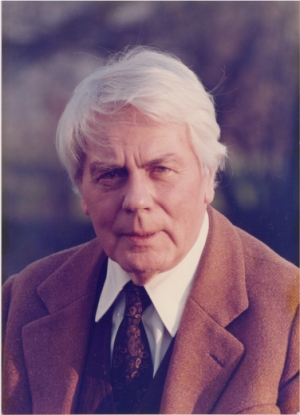
Portrait of Rainer Gruenter (1983), BU University Archives
Photo: Petra Zöllner
What did you find most interesting whilst researching his life?
Georg Eckert: Perhaps the most fascinating finding is a rather paradoxical one: namely, that Gruenter actually did not fit in with the idea of the comprehensive university at all. Yet, for that very reason, he was the most suitable, the best choice for the post of founding rector. It was precisely his cosmopolitanism that outshone the staid appearance of a higher education institution that was initially not meant to be a university at all. However, Gruenter ensured that it became just that. He thus realised the comprehensive university without further ado by effectively abolishing it.
Now that you have written his biography for the Neue Deutsche Bibliothek, which has been online since 1 April, how would you describe him as a person?
Georg Eckert: Historians are not character analysts: what we read in the sources are often projections and constructions, which in turn are linked to specific perspectives and interests. However, for a rector of the 1970s, Gruenter, for all his elitism, which, incidentally, he believed was and had to be an integral part of the university, was extremely liberal and approachable. Not even his critics – and there were some – denied that he carried himself with confidence. Gruenter was an elegant figure, yet also an edgy one: a career such as the one he enjoyed would scarcely be possible today.
The link to the article in *Deutsche Biographie*: https://www.deutsche-biographie.de/dbo058501-5.html#dbocontent
Uwe Blass
Dr Georg Eckert studied history and philosophy in Tübingen, where he was awarded a doctorate for a thesis on the early Enlightenment around 1700, with a focus on Britain, and completed his habilitation in Wuppertal. In 2009, he began working as a research assistant in the Department of History and now teaches as a private lecturer in Modern History.