
Nuts – Powerhouses for the cardiovascular system
Prof. Dr Julia Bornhorst / Food Chemistry
Photo: Sebastian Jarych
Little powerhouses for the cardiovascular system
Food chemist Julia Bornhorst on the many nutrients found in nuts
Ms Bornhorst, people who eat nuts live healthier lives! Is that true?
Julia Bornhorst: In principle , I’d say yes, because numerous large observational studies and several meta-analyses show that people who regularly eat a handful of unsalted nuts have, on average, a lower risk of, for example, cardiovascular disease. Furthermore, eating nuts also supports weight management and brain health. The risk of chronic conditions such as type 2 diabetes can also be reduced by eating nuts. However, this does not automatically mean that nuts alone are responsible for this. There is a wide range of scientific evidence supporting all of this. Whilst nuts are not a miracle cure, their benefits and nutritional content make them an important part of a balanced diet.
Nuts are packed with nutrients. They contain plenty of healthy unsaturated fatty acids, plant-based protein, fibre, as well as numerous vitamins, minerals and antioxidant plant compounds.
Nuts contain many nutrients that humans need, but they are also considered to be fattening. So how many nuts are actually healthy for us to eat each day?
Julia Bornhorst: The German Nutrition Society (DGE) recommends eating a small handful of nuts (approx. 25 grams) every day. This amount provides valuable nutrients without overloading the body with too many calories. You should always mix different types of unsalted and unroasted nuts, as each type contains varying amounts of different nutrients. Nuts can therefore have a positive effect on fat metabolism and cardiovascular health. Although nuts are high in calories due to their high fat content, numerous studies show that people who eat nuts regularly are no more likely to be overweight. On the contrary: thanks to their combination of healthy fats, protein and fibre, nuts are particularly filling.
So which nuts are the healthiest for us?
Julia Bornhorst: There isn’t just one ‘healthiest’ nut – every type of nut has its own strengths and weaknesses. If you combine different types of nuts, you’ll benefit from a particularly wide range of nutrients. Almonds, for example, are particularly rich in vitamin E, which protects cells from oxidative stress, whilst walnuts are an excellent source of plant-based omega-3 fatty acids, which are important for the heart and brain, amongst other things. Pistachios, in turn, provide important dietary fibre as well as the carotenoids lutein and zeaxanthin, which contribute to eye health. Hazelnuts contain plenty of vitamin E as well as monounsaturated fatty acids, which are good for the heart and blood vessels, whilst cashews are rich in magnesium and support the normal functioning of muscles and the nervous system. It’s all about the healthy mix.
Almonds, walnuts or pistachios – they all contain nutrients that help prevent disease.
Julia Bornhorst: It’squite interesting to note in this context that walnuts are the only nuts to have an officially approved health claim. This states that 30 grams of walnuts a day help to improve the elasticity of blood vessels. So this isn’t just a general claim that ‘nuts are healthy’; there is a specific, scientifically proven link.
As a vegetarian or vegan, you can also meet your iron requirements quite well with nuts, can’t you?
Julia Bornhorst: Yes andno . Whilst nuts are a good building block for your iron intake, they aren’t the main source. Particularly with a vegan diet, you should rely on various plant-based sources of iron and ensure you combine them well with foods rich in vitamin C. The European Food Safety Authority (EFSA) classifies nuts as a natural source of non-haem iron, but at the same time points out their low bioavailability. In other words, iron occurs as haem iron in meat and is absorbed relatively well by the body, but in plant-based foods such as nuts it occurs as non-haem iron, meaning it is found in a different environment. As nuts contain significant amounts of phytates and polyphenols, iron absorption in the body is severely inhibited. Nevertheless, they remain a good source of iron for a plant-based food. It is therefore important to combine foods wisely: vitamin C significantly improves the absorption of plant-based iron. It therefore makes sense to eat nuts alongside fruit or vegetables rich in vitamin C. An even simpler option is to have a handful of nuts with a glass of orange juice.
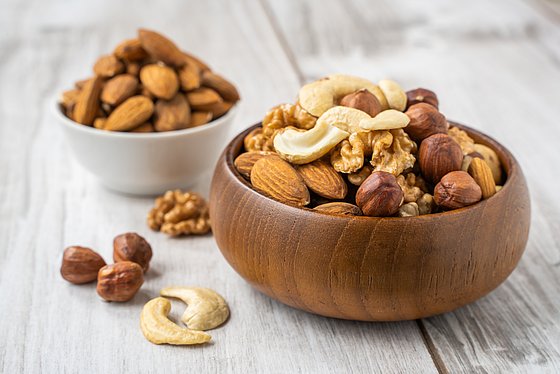
Nuts – nature’s powerhouses
Photo: Colourbox
However, when it comes to many of the nutrients found in nuts, the saying ‘too much is nonsense’ also applies. For example, if you eat too many Brazil nuts, which contain selenium, you could end up with an overdose, couldn’t you?
Julia Bornhorst: That’s right ; when it comes to Brazil nuts, the rule is quite clear: the dose makes the poison. Brazil nuts are very rich in the trace element selenium, which is important for our thyroid, and contain valuable fats, but it is easy to have too much of them. Long-term high consumption can lead to a harmful selenium overdose and thus to symptoms of poisoning (selenosis), including hair loss, brittle fingernails and gastrointestinal problems. Brazil nuts are susceptible to mould (aflatoxins) and, due to their deep root system, can also naturally absorb radium from the soil. They therefore accumulate radioactive substances at a rate around 1,000 times higher than other foods. For this reason, the Federal Office for Radiation Protection (BfS) recommends that adults consume no more than two nuts per day. Pregnant women, breastfeeding mothers and children should avoid Brazil nuts entirely, as radium is deposited in growing bones. This illustrates the point very clearly: a substance can be essential for life, yet still become harmful if consumed in excessive quantities.
Nuts can even be used as medicine. In which areas are they used?
Julia Bornhorst: Nuts are not medicines, but they contain a whole range of bioactive compounds that are beneficial to health. Their effect on the heart and blood vessels has been particularly well researched. However, a handful of nuts is, of course, no substitute for necessary medical treatment
Eating nuts can lead to fewer migraine attacks. How does this work?
Julia Bornhorst: Nuts may help to prevent migraine attacks, mainly because they are rich in magnesium and – particularly walnuts – in plant-based omega-3 fatty acids. These nutrients can influence processes that play a role in the development of migraines. It is important to note, however, that the studies predominantly examine individual nutrients or specific diets, rather than simply the effect of a handful of nuts. Nuts are therefore not a treatment for migraines, but can form part of a balanced diet.
In professional circles, the almond is also regarded as a ‘poly-pill’. What exactly does that mean?
Julia Bornhorst:
When we refer to the almond as a ‘poly-pill’, we mean that it combines many different bioactive compounds in a single food, all of which are believed to have health-promoting effects. It provides healthy fatty acids, fibre, vitamin E, magnesium and phytochemicals. Of course, this doesn’t mean that almonds are a medicine – but they are a rather impressive little nutritional powerhouse.
However, nuts need to be stored properly, as they can go mouldy. Where’s the best place to keep them?
Julia Bornhorst: When it comes to storage, the fridge is best! They should be kept in a dry, dark place in a well-sealed container, preferably unpeeled rather than peeled. If you do notice any mould, you should throw away all the nuts from that container, as a type of mould can form in nuts which in turn produces a so-called mycotoxin called aflatoxin B1, which is carcinogenic and increases the risk of liver cancer. There are also frequent product recalls in the EU of nut products because they contain excessive levels of aflatoxin B1. There is a maximum permitted level for aflatoxin B1 in the EU, which must not be exceeded in food. Any member of the public can now read these reports for themselves on the European Rapid Alert System for Food and Feed. The so-called RASFF (Rapid Alert System for Food and Feed) issues warnings about food, food contact materials and animal feed that pose a health risk.
Salted or roasted nuts are not recommended. Why not?
Julia Bornhorst: I wouldn’t recommendsalted nuts as a daily snack, because nuts don’t actually need any extra salt. We already consume a relatively large amount of salt through our diet. The simplest option is therefore: natural, unsalted nuts – these provide us with the full range of nutrients without any unnecessary additives. Natural nuts are a superfood for the heart and blood vessels – but salting and industrial roasting negate this positive effect. At high temperatures, the healthy omega-3 fatty acids oxidise, heat-sensitive vitamins are lost, and harmful substances such as acrylamide can even be produced. Furthermore, the salt coating provides enormous amounts of sodium, which can cause blood pressure to rise. The nuts are often also deep-fried in cheap fat. So, anyone wanting to do something good for their health should always opt for the raw, unsalted variety.
Despite all their beneficial properties, many people have an allergic reaction to nuts. What alternatives are available in that case?
Julia Bornhorst: If you have a genuine nut allergy, you shouldn’t try other nuts on your own initiative; instead, you should have an allergy test to find out exactly what you can tolerate. So, if you can’t tolerate nuts, you don’t have to go without their valuable nutrients. Seeds such as pumpkin seeds, sunflower seeds, linseeds or chia seeds can be a very good alternative. Pulses are also excellent options, with the exception of peanuts, which are technically a type of pulse but often trigger allergies.
Uwe Blass
Julia Bornhorst studied and completed her PhD at the University of Münster. She worked for five years at the Institute of Nutritional Science at the University of Potsdam. Since January 2019, she has been a professor of food chemistry at the University of Wuppertal.