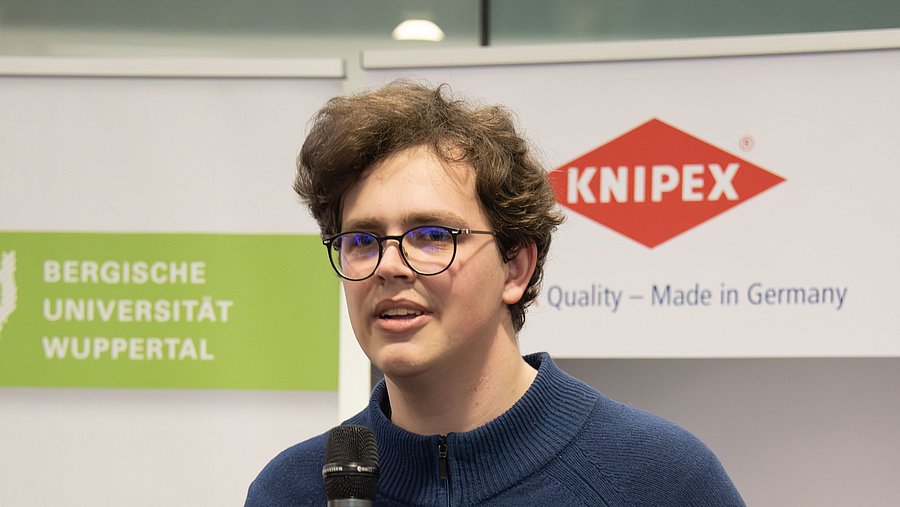
Particle world network
Lukas Kretschmann / Physics
Photo: Friederike von Heyden
Quarks, electrons and co
Student Lukas Kretschmann on his involvement in the nationwide Network Teilchenwelt
He is 21 years old, is studying for a Master’s degree in physics at the University of Wuppertal and is active as a nationwide fellow speaker in the Network Teilchenwelt. He has also been working for several years in the Experimental Particle Physics working group on research into the ATLAS experiment (ATLAS is a particle detector at the Large Hadron Collider (LHC), a particle accelerator at the European nuclear research centre CERN in Geneva). He was recently honoured with his university’s Third Mission Honorary Award for his voluntary work. When asked what a particle physicist actually does, he humorously replies that his research is not about doughnuts and pudding pretzels, but about the fundamental building blocks of matter.
The building blocks of matter
“You might recognise it from your chemistry or physics lessons at school,” Kretschmann explains. “Atoms are not big spheres, but consist of a nucleus and electrons. This nucleus consists of protons and neutrons. We know that these protons and neutrons consist of smaller particles called quarks. To make them visible, you actually need the largest machines that people can build,” the Master’s student says. Basically, particle physics is the study of these smallest fundamental particles, and sciences aim to understand these building blocks of matter and thus the structure of the universe. “That’s what experimental and theoretical particle physics is all about. Then there are areas close to particle physics, such as nuclear physics, which deals with atomic nuclei, and astroparticle physics. This in turn researches how particles propagate through the universe or interact with the Earth’s atmosphere.”
The Network Teilchenwelt
“The Network Teilchenwelt is a nationwide education and science communication project that has been bringing current research in particle, nuclear and astroparticle physics closer to pupils and students for many years,” Kretschmann says. This project does not intend to set up just another curriculum, but an external programme with various workshops to familiarise students with the subject. “There is a kind of step-by-step model with a basic programme. These are the so-called masterclasses, where teachers can also come with their courses. Besides, there are more specialised courses for people who want to delve deeper into the subject." The Network Teilchenwelt links universities and research institutes across Germany that work in this field. “There is also CERN in Switzerland (CERN, the European Organisation for Nuclear Research, is a major research facility near Geneva, editor’s note), which bundles such offers from this field to give people a close connection to current research and also to the people who carry out this research.”
3,500 young people take part every year
Every year, around 3,500 young people take part in projects offered by the Network Teilchenwelt. “It actually always starts with these masterclasses. The idea is that we invite pupils and students in their first semesters to come to us at the university and learn more about our work. In the mornings, we lay the theoretical foundations together, explain what we do and the processes behind it. In the afternoons, students themselves analyse real experimental data from the ATLAS experiment.” The results are discussed on site, but the findings and experiences are also shared in video conferences with other national and international locations. “That’s the lowest level, which these 3,500 people take part in every year,” the budding physicist says and continues: ”And then there are more advanced programmes. For example, you can build your own small detectors at the universities or take part in workshops, for example the CERN workshop. Every year, around 30 students can visit CERN in Geneva for a few days and watch the experiments. And the highlight of everything is basically the CERN project weeks, where we have around 10 students every year who can realise their own research projects at CERN for a fortnight in collaboration with university and institute groups. Based on these project weeks, there is then the Fellow Programme, where people who have gone through these stages can then take advantage of even more specialised opportunities.”
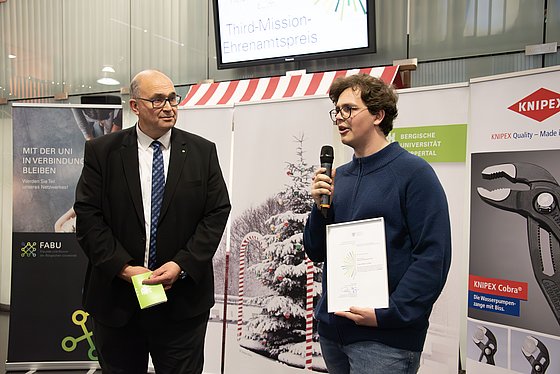
Presentation of the honorary award by the Vice-Rector for Third Mission and International Affairs, Prof. Dr Peter Gust
Photo: Friederike von Heyden
Kretschmann’s research group motivates Wuppertal schools to take part
The Experimental Elementary Particle Physics research group has been involved in the Network Teilchenwelt from the very beginning and motivates Wuppertal schools to take part in the so-called Masterclasses of Particle Physics. At this point, Kretschmann takes on the role of a teacher by helping the pupils to understand how to analyse the experimental data. "Normally, everyone sits in a room at the computer and looks at it, and we discuss it with the students. Of course, we also pursue the aspect of recruiting young talent. I help with the organisation and technical support and always explicitly introduce the Network Teilchenwelt." He also shows the teachers what they can do themselves at the schools. "The masterclasses are also possible at the schools and we are happy to come there ourselves to do them. Teachers can also borrow experimental set-ups from the university."
Supervisor in the Fellow programme
Lukas Kretschmann is the site spokesperson for Network Teilchenwelt and also supervises the Fellow Programme. “I am the national spokesperson along with a colleague from Dresden. The Fellow Programme is the pinnacle of this programme idea, where people who are really committed are practically accepted as members. There are currently a total of 150 students throughout Germany who are particularly interested in particle physics. We want to continue to support them and encourage them to study physics later on.” The expert lectures organised with renowned scientists are also exciting. “This direct contact with the experts, I can say from my own experience, is very motivating. You learn about their careers and experiences,” Kretschmann says enthusiastically. His personal highlight was meeting Professor Reinhard Genzel, who won the 2022 Nobel Prize in Physics together with an American scientist for discovering the black hole at the centre of the Milky Way. “He is Director at the Max Planck Institute for Extraterrestrial Physics. That was a special meeting, because Nobel Prize winners rarely cross paths here in Wuppertal. I was particularly impressed by how enthusiastic he was about this topic. He took a lot of time and was also available to answer the students' questions afterwards. More recently, it was Ranga Yogeshwar who I was able to successfully invite. He spoke about his career as a science journalist.” Once a year, there is even a nationwide Fellow meeting at one of the locations. “This year, that will also take place in Wuppertal, where around 30 members will come and discuss the future of this programme.”
Natural scientists are needed
Physics in particular is often a school subject that few pupils are enthusiastic about. However, Kretschmann shows how exciting physics can be, because the next generation is needed! "Frighteningly, the number of students in the natural sciences is generally declining, although it is clear that good specialists are needed in these fields,” he says, explaining the versatility of the subject. “You learn physics here, of course, but what can be all the more useful for later life is this analytical and problem-orientated thinking. In times of AI and a very data-driven society, critical thinking is becoming increasingly important." You don't have to have been a physics genius at school, but programmes like the Particle World network can inspire students. “I didn’t have a physics course as a main subject in my Abitur, I just studied the subject.” And the possible applications in the teamwork-orientated subject are constantly expanding. “Today, we always work together in large teams, which is of course an important skill later on in industry, in large companies. After studying physics, many choose to go into data analysis, take up programming-oriented tasks, or work for an insurance or consulting company. But hardware development is also a field of work, such as here in Wuppertal at the company Aptiv, where you can work on the development of autonomous driving.”
The Network Teilchenwelt naturally has its own website. All locations, including Wuppertal, are represented there, and you can contact the people involved directly via the respective EMAIL addresses. “We are always available,” Kretschmann laughs, “you can write to us or simply drop in.”
Uwe Blass
Lukas Kretschmann is studying Experimental Elementary Particle Physics at the School of Mathematics and Natural Sciences at the University of Wuppertal.