
Sustainability in sport
Franziska Hilger (M. Sc.) / Economics
Photo: Samuel Stracke
Stabilised structures and simplified processes
Economist Franziska Hilger thinks about sustainability in sports
Sustainability in sports! Does that even exist? In the case of sports that utilise natural areas for sporting activities, this statement is understandable. However there are connections between sustainability and sport that are less obvious., including respect, tolerance, team spirit, and cosmopolitanism. Furthermore, you can act more sustainably in these areas through campaigns, club festivals, events, or even team trips if you know how!
Franziska Hilger, voluntary referee in the Rhineland Football Association and research assistant at the Chair of Entrepreneurship, Innovation, and Transformation at the University of Wuppertal, is trying to implement the topic of sustainability more intensely in football through scientific expertise, sporting commitment, and social responsibility.
Using refereeing experience scientifically
“I have been a volunteer referee for the Rhineland Football Association since 2010 and have officiated matches in this role for many years up to the highest men’s league, the Rhineland League,” the doctoral student of Economics. “From 2020, I was also active as a DFB referee throughout Germany - both as an assistant in the 2nd Women’s Bundesliga and as a referee in the B-Junior Bundesliga. During particularly intense periods, I refereed up to 80 matches per season. I've refereed on practically every pitch in Germany,” she laughs. “Through many years as a referee, I got to know football in all its facets and felt the social power that this sport can unfold.” With the start of her doctorate, the dedicated sportswoman may be taking a step back on the pitch, but her enthusiasm for the ball game is undiminished. She is now using her newfound time to contribute her expertise to sport as a research assistant at the University of Wuppertal. She is a member of the Social Responsibility Commission of the Rhineland Football Association, where she focusses on the topic of sustainability. She is also a competent citizen in the environment and sports committee of the city of Wuppertal.
Intrinsification, or: How do I act sustainably out of my own conviction?
With her commitment, Hilger tries to transfer the findings of her academic work to the structures of voluntary work in non-profit sport. “In my position at the chair and as part of my doctorate, I am working intensively on the question of how sustainable behaviour can be promoted in a way that people show it out of their own conviction and not just because of external guidelines. In other words, it is about how internal motivation can develop from behaviour that is initially triggered externally. In scientific terms, we speak of “intrinsification” here. This question is particularly urgent and at the same time very complex when it comes to sustainability issues. Many measures have a deep impact on very individual areas of life and affect habits, routines, and personal freedom of choice, e.g., in the areas of consumption, housing and mobility. This impact makes it a challenge to implement measures, but the implementation is also susceptible to resistance. Social changes are very clearly reflected in sports. Hilger cites the decline in voluntary work as a key example. “Fewer and fewer people are willing to take on long-term responsibility, even though this is exactly what non-profit sport thrives on.” Yet sports are particularly suitable to shape transformation processes actively. “Sports clubs and associations reach almost all social groups –regardless of age, social background, or level of education. They are places of encounter, enjoy trust, and have an enormous reach. It is precisely these characteristics that make sport so relevant for my research,” Hilger explains. They are not abstract, but can be experienced in practice. Sustainable behaviour succeeds when it can be established as a natural part of the club and association culture. Both sides then benefit from this development. “Sport strengthens its volunteer structures and its future viability, while at the same time social issues such as climate protection, social justice, and education can be effectively communicated to a wider audience. Sports really bring everyone together: people of different ages, backgrounds, and educational levels.” Sports must therefore be used to shape social change.
As part of her work at the Chair, she therefore also incorporates the perspectives of a wide range of stakeholders in the sustainability transformation. Along with members of the department, Hilger regularly organises excursions to companies to give students an insight into specific transformation processes. She currently says: “In this context, we will also be organising an excursion to the DFB in Frankfurt. So, the students will have the opportunity to experience how one of Europe’s largest sports organisations deals with its social and ecological responsibility. In this way, I try to link my voluntary work in sports with my work at the Chair.”
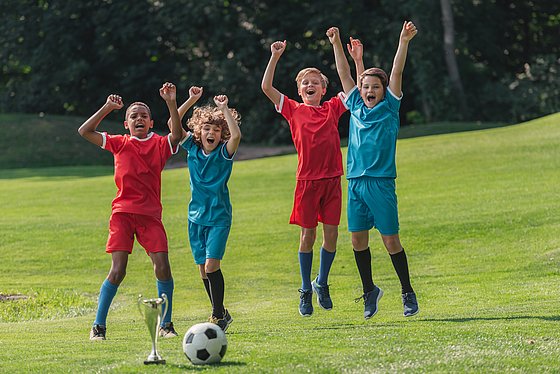
Playing football at a club is fun
Photo: Colourbox
Volunteering is based on voluntary participation, motivation and a sense of identification
Change is always difficult, but possible, as Hilger knows, if you build on what already exists. “The insights from transformative economic policy show very clearly that change processes only work if they can be integrated into existing structures and are supported by the stakeholders involved. If we apply this perspective to non-profit sport, it quickly becomes clear that voluntary structures cannot simply be changed ‘from above’ or controlled by regulations. Volunteering is based on voluntary participation, motivation and a sense of identification – that is precisely what makes it valuable, but also vulnerable.” It is therefore important that measures should not be perceived as an additional burden, as volunteers are often already working at their limits because match operations naturally always take priority and must be maintained. Hilger therefore states quite clearly: “Transformation can only succeed here if sustainability and social responsibility are understood as supporting this core task, for example by stabilising structures, simplifying processes or creating new forms of recognition.” Although non-profit sport is strongly shaped by structures that have evolved over time – meaning that change processes proceed very slowly and resources are always limited – the PhD student sees enormous potential in this. “Sporting organisations have a wide reach, enjoy trust and have well-functioning networks. If volunteers are involved at an early stage and measures are designed to build on existing values and practices, transformative approaches can certainly have an impact. In my view, the greatest challenge lies not so much in the ‘whether’ but in the ‘how’.”
The concept of sustainability often meets with resistance
Hilger is aware that sustainability is frequently associated primarily with sacrifice or additional demands; it therefore often carries negative connotations and meets with resistance.
However, on closer inspection, one realises that sport is already making a significant contribution to sustainable development. Health and wellbeing, gender equality, high-quality education and social participation, as well as integration and the development of resilient participation, are already part of this. “If sports organisations recognise the social value they are already creating, they can deal with new requirements with greater confidence, make targeted use of funding opportunities and remain attractive to volunteers in the long term.”
Sustainability can be a guiding principle for organisational development in sport
Hilger hopes that sustainability can be a guiding principle for organisational development in sport, but only if it grows organically from within the clubs or federations themselves. A comprehensive sustainability strategy is therefore not directly effective; small but regular measures are more likely to be so. “A concrete example of this was a digital carbon footprint assessment in sports clubs, which we carried out in collaboration with the DFB. Contrary to expectations, a whole host of clubs took part – clubs that had already organised themselves and were keen to address the issue of their own accord. Signals like these are hugely important. They show that there are already intrinsically motivated individuals and that it is the association’s role to recognise this development and provide targeted support.” Further plans for sustainability projects, such as round-table discussions between volunteers and external experts, training sessions for club advisers, or accessible information and exchange platforms, are currently in the pipeline.
Sustainability aspects in the university sports centre
“The university sports centre has great potential not only to implement sustainability at an organisational level, but above all to bring it to life by encouraging engagement,” says Hilger. This already works when student trainers integrate sustainability aspects into their work, for example when organising events, using equipment or managing transport. “For further development, I see particular potential in stronger links between research, teaching and practice. The university sports centre can serve as a real-world laboratory here, in which new approaches to sustainability are tested and further developed,” explains the expert. In practice, this means above all creating conditions in which people have scope for creativity and recognise the value in their involvement.” Hilger is certain: “Whether at the university sports centre, in sports associations or in teaching modules: when sustainability becomes a tangible experience and ties in with existing practice, it can become part of one’s own mindset. This does not place an additional burden on commitment, but rather enhances it. Sustainability is not seen as an obligation, but as something that provides guidance and creates meaning. For me, this is precisely the crux of successful implementation: people should not feel they have to do something, but should experience that acting sustainably benefits both themselves and the organisation in the long term.”
Uwe Blass
Franziska Hilger (M.Sc.) is a research assistant at the Chair of Entrepreneurship, Innovation and Transformation in the Faculty of Economics at the University of Wuppertal.