Drug residues in our waters
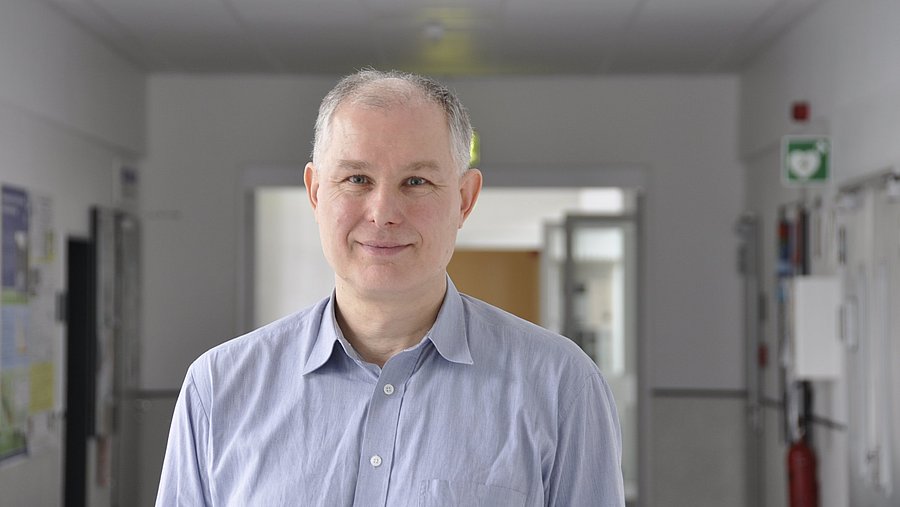
Univ.- Prof. Prof. mult. Dr.-Ing. agr. Jörg Rinklebe / Soil and groundwater management
Photo: UniService Third Mission
"We always find trace substances"
Jörg Rinklebe, professor of soil and groundwater management on drug residues and germs in our waters and the fourth treatment stage in German sewage treatment plants
The quality of the Wupper water is good, but ...
When asked, would you agree with the sentence: "The quality of the Wupper water is good", the renowned scientist Jörg Rinklebe promptly says: "Yes, the quality is basically good, but there are still improvements towards very good and excellent." And this is mainly due to Wuppertal's industrial history. With the founding of the Wupper Association in the 1930s and the development of modern wastewater treatment plants, the water quality has improved considerably over the past decades, when all kinds of industrial wastewater still discoloured the Wupper blue, green or red. "The problem back then was that many of these substances were first absorbed and retained by the soil. Then you didn't notice these effects for a long time. We call this the soil acting as a sink for pollutants because it absorbs them like a sponge. And now, thanks to policy and good technologies, the discharge of harmful substances into the Wupper has been minimised, which has significantly improved the water quality." But this also has consequences, because, the expert explains, we now have the phenomenon of clean water flowing through these dirty soils, so that the soils suddenly act as a source of pollutants. "Many pollutants that are still in the contaminated soil are now being released and are then back in the water."
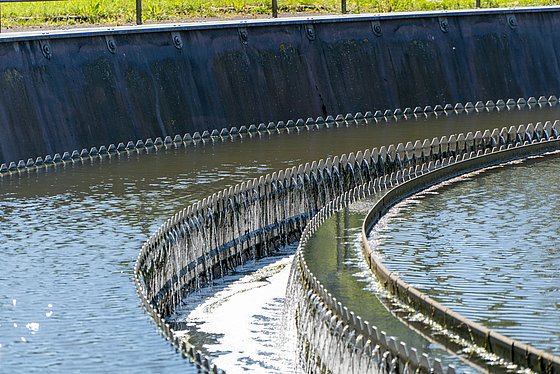
Basin, sewage treatment works
Photo: Wupperverband
German sewage treatment works – the fourth stage of treatment
Around 85 per cent of pharmaceutical residues entering the environment originate from human excreta. As early as 2024, the Rheinische Post ran the headline: ‘Sewage treatment plants at their limit – water in North Rhine-Westphalia contaminated by medicines and germs’. Rinklebe knows the reasons why the sewage treatment plants are unable to get the problem under control and says: “Sewage treatment plants were, after all, designed many decades ago. Back then, we simply weren’t yet confronted with these problems on such a scale. There were three treatment stages, and these dealt very effectively with the problems of the time.” But society has also evolved, and the consumption of medicines has risen. “Added to this are antibiotics, hormones and hospital-acquired germs, as well as effluent from the chemical industry – in other words, a whole host of harmful substances entering the wastewater,” he explains, “which is why work is underway on a fourth treatment stage at the sewage treatment works.”
The cycle of disease
To understand why a fourth treatment stage is so immensely important, Rinklebe describes the potential consequences of ignoring the situation. “If the pollutants are simply released into the environment unfiltered, they end up in surface waters, in groundwater, in plants and animals – and ultimately enter the food chain, eventually finding their way back into us humans, which would have devastating consequences for human health.” These substances are often also metabolites that can cause damage to the human body. And the spiral continues, as these pollutants can also bind to water, soil, plants and animals in the environment.
Results of long-term research take years to gain approval
To date, there are no binding standards for pharmaceutical substances, even in the Surface Water Ordinance, although it is known that substances such as the painkiller and anti-inflammatory drug diclofenac and the anti-epileptic drug gabapentin, in particular, have an impact on living organisms. The difficulty with all laws or regulations, explains Rinklebe, is that rules can only be established once we are in a position to comply with them. Yet promising projects are already underway. The researcher comments: “There are now over 50 pilot treatment plants in Germany that have implemented the fourth treatment stage. We’re already well on the way. There is also a great deal of research and conferences on the subject, which primarily ask: How can we get all these trace substances and trace elements under control?” Various techniques are already being tested. These include membrane technologies and projects using activated carbon, as well as so-called ozonisation (ozonisation is a process of sterilisation and disinfection through the addition of ozone, editor’s note). However, the scientist emphasises: “Knowledge alone is not enough to turn this into legislation. First of all, you need a scientific basis so that you can even formulate a law and limit values. And that basis must then apply across the whole of Germany. That is why such laws take so long. I know this from soil and groundwater legislation; it sometimes takes 10 to 20 years. Of course, we also need a certain amount of time to derive sound limit values, because this issue of limit values must always be scientifically sound, and not everything that is toxicologically valid is necessarily feasible in practice. But even once this scientific basis is in place, the bureaucratic process still takes far too long. And we definitely need to speed up these processes.”
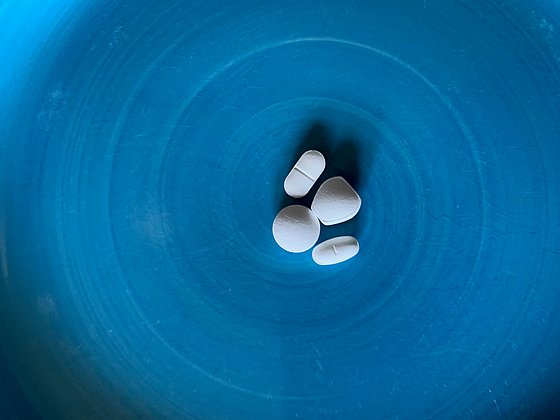
Various solid tablet forms
Photo: UniService Third Mission
Hospital wastewater – an unspoken source of danger
Hospital wastewater is a significant source of antibiotic-resistant or multi-resistant bacteria. Yet to this day, there are no legal requirements governing wastewater from hospitals. “In my view, this is long overdue,” says Rinklebe, knowing that the costs cannot be borne by the hospital alone. “But perhaps there are other political solutions, because we’re doing neither our own health nor the health of the environment any favours by allowing such harmful substances to be released into the environment unchecked. In my view, this is an urgent global priority, as demonstrated by examples from China and India, where many of our medicines are produced. In India, there are many areas where it is already known that the environment is being disrupted on a massive scale by hospital wastewater.” And here too, X-ray contrast agents, antibiotics, hormones and even germs, as well as anti-cancer drugs and disinfectants and cleaning agents, find their way into the environment via hospitals’ normal wastewater. “In my view, hospitals need separate regulations and separate technology,” the expert insists.
Taking action against pharmaceutical companies
The polluters – that is, the pharmaceutical companies and the chemical industry – appear to have no awareness of the problem. However, the soil and groundwater expert sees a shift taking place. “There are now Europe-wide initiatives in this area. There is a desire to hold the polluters liable, or at least to make them contribute to the resulting costs. This is an essential step that has so far been missing in our society. Often, assessments are made purely on business grounds, rather than considering whether natural resources are being used that should also be paid for. As a rule, it is the taxpayer who ends up footing the bill.” This can be seen in the examples of nuclear power stations or the environmental damage caused by large corporations. In fact, these resulting costs should always be passed back to the polluter. “The product will certainly become more expensive as a result, but this is the only way to achieve a circular economy and sustainability if I’m serious about it. Of course, the big corporations will resist, as it means reduced profits, but this will be the way forward; of that I am certain.”
Long-term studies despite no safety concerns?
The concentration of pollutants in the water poses no risk to humans. Nevertheless, long-term studies are being carried out. “Long-term studies are always important, particularly in the field, because problems are often underestimated when only short-term studies are conducted,” explains the scientist. Long-term studies then focus, for example, on the effects on the genome, adaptation within the human body, or the impact on functional relationships within the ecosystem. “One thing is linked to another, but this may not have been researched before. That is why long-term studies are hugely important for identifying new connections and also for ruling out risks.”
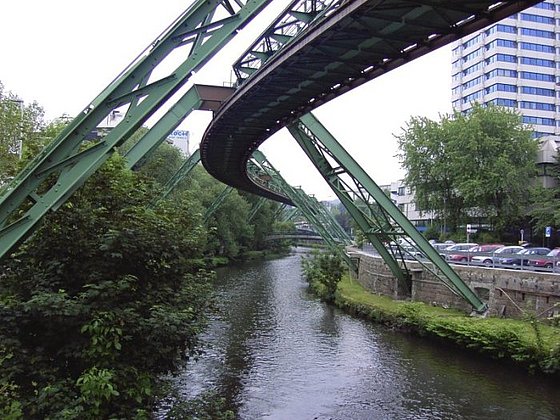
The Wupper under the route of the Wuppertal suspension railway
Photo: public domain
Resource priorities are changing in world affairs
The upgrade of sewage treatment plants with a fourth purification stage is planned by 2039. The long timeframe is explained by the fact that cities with a population of over 100,000 are first in line. "But it's still taking far too long," emphasises Rinklebe and says: "The problem is that a lot of resources are being channelled into other areas. We have it in front of our eyes. Many resources go to war and not to education and research or to such important environmental problems. We now have over 50 pilot plants, but we need to be even faster." The researcher does not want to be frustrated by the many processes that take too long and concludes: "I am already a few years older and can see the progress that has been made in recent decades. When I was young, I was very frustrated, but then I also realised that our own work, for example in the amendment of the Federal Soil Protection Ordinance, sometimes takes 10 or 20 years before it is established. But in the end they are established. And then I enjoy the positive things. The staying power has paid off and that is always my hope. I am sure that in 20 years there will be many more hospital wastewater treatment plants or plants for treating hospital wastewater, that we will then have established the fourth stage of wastewater treatment plants."
By the way...
The introduction of the fourth treatment stage at the Wuppertal-Buchenhofen wastewater treatment plant is planned as a long-term project to reduce trace substances.
Uwe Blass
Univ. prof. mult. Jörg Rinklebe has been Professor of Soil and Groundwater Management at the University of Wuppertal since 2006. He is recognised worldwide as one of the most influential scientists in his field. His work is cited very frequently, which is why he was named a "Highly Cited Researcher". He is ranked 4th in the world rankings for environmental sciences and 1st worldwide in the field of soil contamination research, although only a few German scientists have ever been listed in the top 100. From 1997 to 2006, he worked as a scientist, research assistant and project manager in the Soil Research Section of the UFZ Environmental Research Centre Leipzig-Halle GmbH in Halle. He studied ecology for a year at the University of Edinburgh in Scotland (UK). He studied agriculture at Martin Luther University in Halle-Wittenberg, specialising in soil science and plant nutrition.