
Fairy tale journeys
Dr Laura Wiemer / Romance Studies
Photo: © Susanne Kurz
There is no male counterpart to the fairy godmother
Romance philologist Laura Wiemer is organising a conference at the University of Wuppertal that will focus on the centuries-long transmission of fairy tale themes and motifs through different languages and cultures.
When we think of fairy tales, we immediately think of the Brothers Grimm, who published their fairy tales as of 1812 and are internationally recognised. However, the fact that the fairy tale tradition was already popular in France in the 17th century, initiated by women in the Parisian salons, were forgotten. Laura Wiemer, a Romance philologist in the School of Humanities at the University of Wuppertal, is now organising an international conference to examine the geographical, cultural and linguistic border crossings of fairy tale materials, motifs and characters, starting in France.
The fairy tale journey begins in France
The international conference from 10 - 12 June is entitled ‘Fairytale Journeys’, and even if one immediately thinks of Sinbad the Sailor from 1001 Nights, the focus of the conference is on Europe. “However, there are even points of contact with the Arabian Nights,” the Romance philologist explains, “because it was the Parisian orientalist Antoine Galland (1656 - 1715) who first translated and edited the stories from “The Arabian Nights” into a European language - namely French.” Starting in France, the researchers will focus primarily on fairy tale traditions in Spain and Italy. However, the focus will also remain on Belgium and Germany, and looking overseas and to other cultural areas will also broaden the scope. “The conference arose from my teaching,” Wiemer says, “because I always try to combine research, teaching, and knowledge transfer.” In the summer semester, she therefore also offers students two seminars on fairy tale. “Together with my students I would like to take a look at the fairy tales of their cultures of origin. There are sure to be students from Poland, Russia, or Turkey, for example, so that we can also think beyond the Romance-speaking countries and Europe.” This transnational and transcultural approach should lead to the identification of recurring narrative patterns that have been repeated over the centuries and are similar in all fairy tales.
“Regarding the conference, I am interested in the forms and functions of fairy tale journeys with the question: How do fairy tale themes and motifs travel through the centuries in different languages and cultures?”

Beauty and the Beast, illustration by Walter Crane (1874)
Photo: public domain
Grimm’s fairy tales mostly come from France
When asked what influence the Romance stories had on the fairy tales, Wiemer explains that all these stories, often passed down orally, were carried through Europe for a long time before they ended up with the Brothers Grimm. “Many people don’t realise that most of the Grimm fairy tales originated in France and were written down by Charles Perrault (1628 - 1703).” The Sleeping Beauty is a good example of how long this fairy tale has been told until now. The Brothers Grimm adopted the story from Perrault in the 19th century, who in turn knew it from Giambattista Basile (1583 - 1632) from Italy, where it was written down in the 16th century. Basile’s fairy tale even makes allusions to Greek mythology. “France had its very own fairy tale tradition with these fairy tales by Perrault, which were published under the title ‘Contes de fées’,” Wiemer says.
In Spain, on the other hand, the Brothers Grimm’s fairy tales were widely disseminated in the national language translation. “The rather small fairy tale tradition in Spain was primarily founded by Fernán Caballero”, Wiemer explains. “Today we know that he was actually a woman, namely Cecilia Böhl de Faber (1796 - 1878). Faber is a German name, so she had German roots and of course she grew up with Grimm’s fairy tales, so she spread this German cultural heritage in Spain.”
Little Red Riding Hood is not rescued in France
The ‘Fairytale Journeys’ conference focuses on the travelling movements of fairy tale characters, using the example of the story of Little Red Riding Hood to illustrate once again which target group should actually be addressed. “Little Red Riding Hood originally comes from France, again it was written down by Charles Perrault,” Wiemer says. “We also know how it came to the Brothers Grimm in Kassel, because Kassel was under French occupation at the time. This means that, of course, the French language and culture were very present in the living environment. We also know which French women told the Brothers Grimm this story. They were the Hassenpflug sisters, and that shows that the text or the motif were carried to other locations.” And Little Red Riding Hood also travels within the text, as she sets off to visit her grandmother, walks alone through the forest and then goes on a little journey, so to speak. The ending is particularly interesting. Wiemer comments: “The wolf asks Little Red Riding Hood to lie in bed with him, but undressed. There is a clearly erotic, sexual component to it, and then a moral one at the end. These stories were also written for young women, so there is a moral of the French version, namely: don’t get involved with strange men.In this case the wolf is the man who leads the woman astray and then seduces her in the version so that she loses her virginity.” So, we see in the motif of the journey that she leaves her protected home, takes the path of growing up and then goes astray because of the man. The ending is also drastic. “In the French version, there is no hunter, the wolf eats Little Red Riding Hood and her grandmother, and the fairy tale is over.” The fairy tale ‘Beauty and the Beast’ also conveys a similar moral, as the quintessence can be formulated quite simply: Lock the woman up, you have her to yourself and she falls in love with you. “That’s what the Beast manages to do in the end,” Wiemer says. “You can read a lot into the fairy tales in terms of social criticism.”
Many materials, characters and motifs can be found internationally
You might think that every country has its own fairy tales, but there are themes, characters and motifs that can be found everywhere. “There are so many themes,” the expert says, listing a few: “The battle of good against evil, poverty against wealth, hard work and laziness, trials, adventure and often a marriage at the end.” Animals also always feature, as well as clear symbolism. The profound visual language transforms abstract concepts into tangible objects. The mirror, for example, stands for self-knowledge, truth or vanity. The number three often plays a role and the forest as a place of trial and danger zone or a castle for security or isolation are often mentioned as places. And there are also characters that appear again in all fairy tales. “One very specific example is the fairy,” Wiemer explains. “She appears as a character in many fairy tales, regardless of whether it’s a German, French, or Spanish fairy tale. The special thing about the fairy, which never changes, is the fact that the fairy is always female. There is no male counterpart to the fairy. There is a sorceress and a magician, there is also a witch and a sorcerer, but the fairy is uniquely female, usually a positive character, a helper with magical powers.”
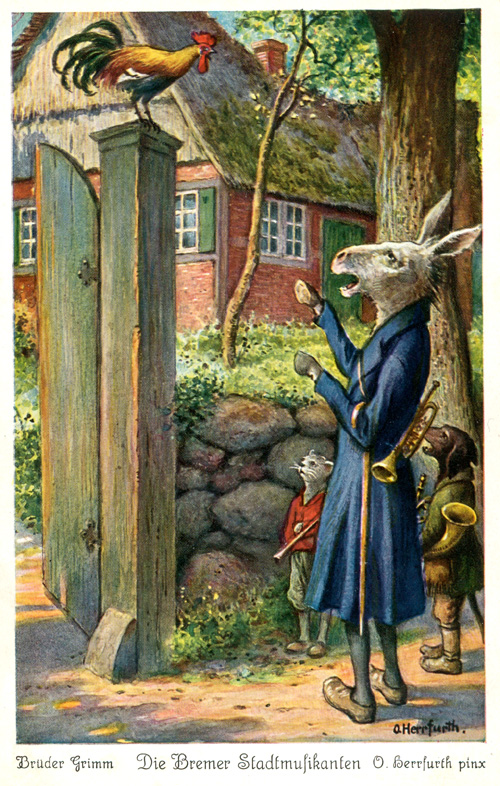
Bremen Town Musicians, illustration by Oskar Herrfurth around 1920/30
Photo: public domain
The literary life of women in French salon culture
At the end of the 17th century in France, fairy tales became the entertainment of the social elite and an integral part of salon culture. Since publishing as a professional activity was often considered unseemly for women or there were legal restrictions, such as the consent of the husband, publications under ‘as the wife of (husband’s name)’ offered the opportunity to participate in literary life. “There is a very well-known author of fairy tales, Marie Catherine d’Aulnoy (1652 - 1705), who published under the name Madame d’Aulnoy. This shows that she was married, otherwise she would have published under Mademoiselle.” Another example is the fairy tale ‘Riquet with the tuft’, which demonstrably comes from the collection of stories by Catherine Bernard (1626 - 1712), but which has fallen into oblivion today. The story is therefore attributed to the author Charles Perrault, who, however, adopted it. In her postdoctoral thesis, the researcher is focussing on these female authors, who are often unknown today, as well as the fairy-tale heroines they developed, and says: “I am interested in texts by women, whether published under a pseudonym or their own name. And there are many female authors in France who have established a great female fairy-tale tradition.”
The Aarne Thompson Uther Index
Like many of her academic colleagues, Wiemer works with the so-called Aarne-Thompson-Uther Index. “It’s a very ambitious project, which I really admire,” she explains. “Three researchers continued the project one after the other. The first one was a Finnish fairy tale researcher, Antti Aarne. He started classifying fairy tales at the beginning of the 20th century. Then, in the middle of the 20th century, Stith Thompson from the USA continued this model and at the end of the 20th century it was finally completed by Hans-Jörg Uther from Germany. The aim was to systematise these diverse fairy tales.” The fairy tales were therefore divided into different categories, for example animal tales, magic tales, religious fairy tales or novella-like fairy tales. Although the index is internationally binding, there is one major criticism of it, as it only deals with fairy tales from Europe.
International fairy tale researchers meet in Wuppertal
Laura Wiemer organised the event with her colleague Dr Selina Seibel, who works at the universities in Cologne and Stuttgart. The two women utilised their respective contacts and also published a ‘call for papers’, which they placed on an international platform in all languages covered in fairy tale research. “A lot of colleagues from different universities got in touch. We now have Morocco and Tunisia represented, as well as Italy, Spain, France and Belgium. Proposals for contributions came from everywhere.” The conference is also taking place in Wuppertal because one of the greatest fairy tale researchers in the German-speaking tradition was based here at the University of Wuppertal: Professor Dr Heinz Rölleke.
Fairy tales also represented in social networks
Fairy tales, originally intended for adults, were first consciously adapted for children in the Grimm’s Children’s and Household Tales by the Brothers Grimm and have changed over the course of history through adaptations for theatre or film, just think of Walt Disney adaptations. “My personal impression is still that even today fairy tales are the texts with which children have their first literary reading experiences,” Wiemer explains. “They are read the stories to them, or even read them themselves. Later on, they also appear at school and are taught in German lessons.” Although studies show that the interest in reading is declining among many young people and that the desire to read is no longer there because of social media, fairy tales are also present in other media, just think of Walt Disney films. “They have even evolved from the original animated films to real-life adaptations. If you think of ‘Beauty and the Beast’ from 2017 in the live-action adaptation with Emma Watson as Belle, it was of course also a reference to Harry Potter for young people (Emma Watson played the role of Hermione Granger in the Harry Potter films, editor’s note).” In France, rap culture has even taken up fairy tales.“ There is a very well-known and successful rapper called MC Solaar, who has a rap called 'La belle et le bad boy', which is about a young woman going astray and then giving herself to the man.” A look at social media also shows a lot of memes, i.e., images that pick up on fairy-tale characters, i.e., where many young people are active.
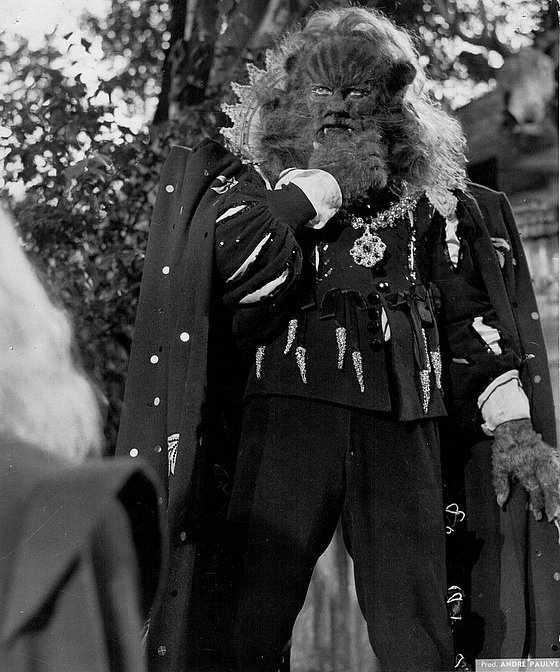
Jean Marais in the 1946 film version of Beauty and the Beast
Photo: public domain
The long fairy tale journey of the little lion
When asked which fairy tale has made the most impressive journey, the Romance scholar promptly answers with ‘Beauty and the Beast’. “It starts in Roman mythology with Apuleius, who wrote down the myth of Cupid and Psyche. Roman mythology was then taken up again by the Italian Renaissance. And we find this narrative structure again in ‘Il re porco’ (The Pig King) by Giovanni Francesco Straparola (1480 - 1558) in the 16th century.” The typical route from Italy to France can then be traced and there are even two versions. The first version was written by Mme Gabrielle-Suzanne de Villeneuve (1695 - 1755) and is almost a small novel. “Then the story was shortened and edited into a main plot by Mme Jeanne-Marie Leprince de Beaumont (1711 - 1780). And that's the version we know today, which was also made into a film.” The story was then carried from France to the Brothers Grimm, where it can be found in the Children’s and Household Tales in ‘Das singende, springende Löweneckerchen’ (‘The Singing, Springing Lark’). “So, we have a Grimm fairy tale that tells the story of Beauty and the Beast in a German way, so they adapted it. In the Grimms’ tale, the beast is a lion and the lion is a bird (a lark, editor’s note). There’s the merchant’s daughter, who doesn’t want a rose, but a lion. The whole plot is the same.” And the cinema also recognised this fairy tale early on. Jean Cocteau, the great French author and filmmaker, was the first to produce a black-and-white-film in 1946. By 2017, there were a total of eight more film adaptations .
For three days, researchers from eight nations will be devoting themselves to the stories with the famous opening formula “Once upon a time...”.
Uwe Blass
Dr Laura Wiemer is a postdoctoral researcher in Romance Studies at the School of Humanities at the University of Wuppertal.