Literature Biennale - 'Anger' meets free space
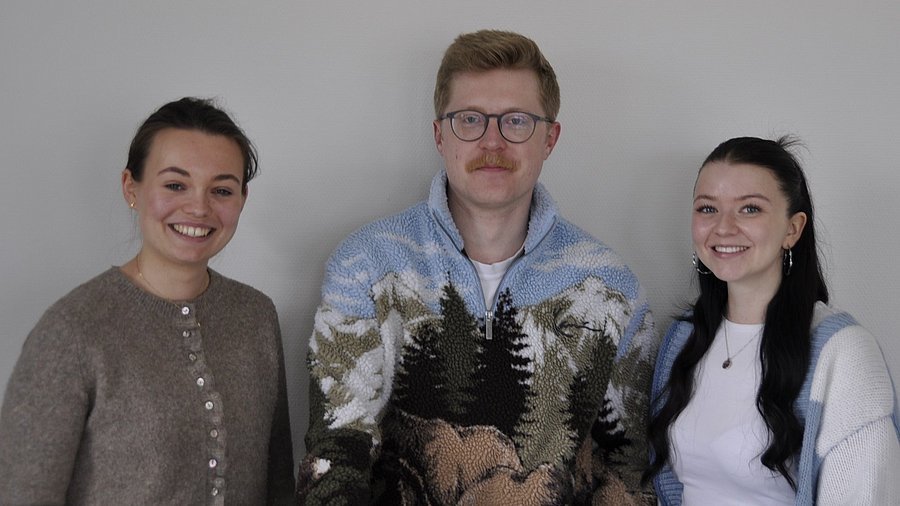
f.l.t.r.: Julie Osenberg, Felix Wittmeier, Victoria Witzel
Photo: UniService Third Mission
‘Anger’ meets free space
Students from the University of Wuppertal complete an exciting work placement as part of the 2026 Wuppertaler Literatur Biennale
The Wuppertaler Literatur Biennale is taking place in the valley axis for the eighth time. From 7 to 16 May, this year’s festival for contemporary literature is dedicated to the theme of ‘rage’. Three students from the University of Wuppertal have a very special, responsible task as part of a compulsory work placement.
Compulsory work placement at the municipality of Wuppertal
Julie Osenberg, Victoria Witzel and Felix Wittmeier, students of General and Comparative Literary Studies (AVL) at the School of Humanities, are designing a meeting space for visitors at Galerie 46 in Wuppertal Elberfeld under the direction of the festival organiser, Julia Wessel, who is responsible for literature, theatre, film, and policy issues at the cultural office of Wuppertal.
Felix Wittmeier and Victoria Witzel report that they came into contact with the cultural office during an introductory seminar organised by Julia Wessel. “As part of this seminar, we asked if we could start an work placement at their cultural office, and it was a coincidence that the literature biennial was taking place at the same time," Wittmeier says. Julie Osenberg, who is pursuing a master’s degree with multiple subjects, became aware of the project through an advert in the AVL’s Moodle course (Moodle is a widely used free open-source learning management system that is primarily used for online courses, blended learning, and the management of educational content in schools, universities, and companies, editor’s note) and applied to Julia Wessel.
A space concept is created
“The space we are allowed to design will be a meeting point, biennial café and festival centre at the same time,” Wittmeier explains, “which will lead to very different contacts. A space will be created where urban society and the literature biennial can come together to exchange ideas away from the main readings. We want to bring people into contact with both literature and the theme of the Wuppertaler Literatur Biennale.” Galerie 46 in Neumarktstraße regularly hosts exhibitions, readings, music performances, and receptions across three floors. The students’ task now is to fill the ground floor and first floor with life. “Texts are created here as part of planned writing workshops, while other projects are also planned to be shown in the rooms,” Witzel explains and continues: “Anything is possible for our visitors. Last year, Wuppertal citizens were able to apply for a creative contribution to the Literature Biennial as part of an open call. Literary artist Yasemin Bertel successfully applied with her project “Wut-Archiv der Stimmen“ (“Archive of Angry Voices”). Visitors can cut up texts from poetry, music and newspapers and assemble them into a poetic collage. It will therefore be an important part of the WTF.” The design of the space will also include space for a small library presenting the works of the authors represented at the literature biennial. “The gallery has large window benches where you can withdraw for a while. We also want to offer drinks to create an atmosphere similar to a café. Tables and chairs offer the opportunity to get creative in the writing workshop.”
Interesting books at the Wuppertal Literature Biennale
Photo: UniService Third Mission
Anger - a topic that can also be emotionally moving
With this year’s topic of ‘anger’, things can also get emotional in a community space like this. “We take this emotional component into account when planning our project,” Osenberg says. The three placement students approached the topic together. “At the beginning, we did an open brainstorming session and asked ourselves what activities were conceivable on the subject of anger. We started by collecting everything and quickly realised that not everything would be feasible due to the socially explosive nature of the topic.” For this reason, they also put ideas on the back burner that would have proved too sensitive, as the walking public should feel comfortable. Tensions should not be artificially created. “There are the two big elements of literature and anger in our considerations,” Wittmeier adds. “During the planning stage, we asked ourselves which kind of formats and opportunities for interaction the category of literature offer and what types of anger are there. And then we thought about how we could combine the two. In this sense, literature in the form of writing workshops is the place to incorporate this subjective feeling. We keep everything open-ended, of course, because we don't want to dictate anything to the visitors. That’s why they can also contribute their own personal ideas.”
Professional support from the festival management
Of course, the three students are not left to their own. “Our direct contact is Julia Wessel, who runs the Wuppertaler Literatur Biennale. We are in lively dialogue with her, both via Signal Messenger and in weekly meetings,” Witzel reports. All three also take part in the biennial committee’s planning meetings, where they can also talk to university lecturers and artists. “We’ve also attended the meetings of the cultural office, which weren't primarily about the literature biennial,” Wittmeier adds. “It was important for us to get an impression of the people we work with and how decision-making processes work in such a municipal office. This is also part of the work placement, regardless of the actual planning. An insight into how municipal cultural policy works.” The placement students also receive important feedback for their ideas at the joint meetings. Osenberg comments: “This resonance room is very important to us, as we had to find the title and a functional name for this room, for example. That was our independent task, whereby a certain operational blindness developed over time. That's why it was also great to get feedback from this biennial committee and the cultural office and to hear what is possible and what is not. After all, the name is ‘WTF’, i.e., Wut Trifft Freiraum. (Anger Meets OpenSpace)”
Artist contacts and personal incentive
Guests at the 2026 Wuppertaler Literatur Biennale include Navid Kermani, Anja Kampmann, Helga Schubert, Jehona Kicaj, and Susanne Kaiser. “We are currently in contact with four authors and hope, depending on their availability, that they will also spend time with us at the WTF, enliven the event or give short readings,” Osenberg says, as Galerie 46 should ideally also bring writers and readers into contact during this time. All three are enthusiastic about the format of this compulsory placement. “Overall, I found the concept of the placement very convincing. Although it is formally a compulsory placement, it actually allows you to gain very personal experience and opens up new perspectives. You make contacts with publishers and authors, work in a practical way and are directly involved in what’s happening at the event. You can also play an active role in shaping the programme and see a concrete result at the end,” Witzel sums up and Osenberg adds: “I thought it was great to read in the advert that a community space is being planned to accompany the Wuppertaler Literatur Biennale for the first time and that you can get actively involved as a student. You get your first insights into a potential professional life and the range of people you get to know is extremely diverse and enriching.” Felix Wittmeier was also enthusiastic about the specific topic. “Personally, I consider the whole task interesting because anger is something that affects everyone on very different levels. And it is often concealed. Anger is usually seen as something very negative, and that is perhaps the main aim of the whole project: to show that there is also a productive relationship and a productive way of dealing with anger.”
The entire programme of the eighth Wuppertaler Literatur Biennale can be found at:
https://www.wuppertal.de/microsite/kulturbuero/projekte/literaturbiennale/literaturbiennale-neu.php (in German available only)
https://wlbiennale.de/ (in German available only)
Uwe Blass
Julie Osenberg, Victoria Witzel, and Felix Wittmeier are pursuing a Master degree in General and Comparative Literature at the University of Wuppertal.