Light pollution - a serious threat
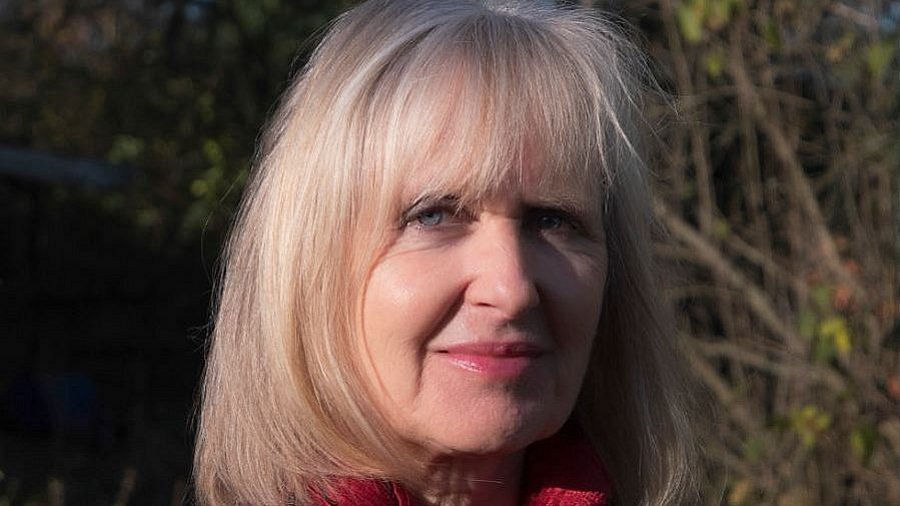
Professor Dr Gela Preisfeld / Biology
Photo: Private
Light pollution - a serious threat
Biologist Gela Preisfeld on the effects of light pollution on animals and humans
Light pollution is the increasing illumination of the night sky by artificial light sources and a serious threat, as biologist Gela Preisfeld briefly summarises it, which does not make sense to us humans at first glance.
And yet it is indeed a still underestimated type of environmental pollution that is a threat to our biodiversity and has far-reaching consequences for our ecosystems. In Europe and the United States, light pollution is almost 99%. Gela Preisfeld studied the topic and says: “Outdoor light and also indoor light shining outwards change the number of photons, i.e., the light particles that are on earth and which then affect organisms or other structures.” This effect is also intensified in humid air and on all water surfaces, as the light is reflected again. Thereby the photon content further increases.
Light conditions on Earth have existed since time immemorial
To explain why artificially created light sources change life, Preisfeld describes the original situation on the blue planet. “The light conditions on Earth have existed since time immemorial. For example, we have the 24-hour solar cycle. The living environment with all organisms and the non-living environment, i.e., the water or the temperature, are adapted to this. They have all developed adaptations that allow them to benefit as much as possible from the light intensity available to them. This is the process of evolution.” As examples, she cites the light and shade leaves of the lime tree or the highly sensitive photoreceptors of animals in the deep sea. If the conditions in the habitat are disturbed, this has an impact on the organisms. “If the organisms are exposed to large amounts of artificial light - there is also the nice acronym ALAN (Artificial light at night) - the conditions to which they are adapted change.” Not only does every single organism react individually, artificial light also disrupts the level of species communities and ecosystems. This can also be substantiated. “There is a special issue of Philosophical Transactions with 16 studies on the influence of ALAN on organisms and ecosystems, in which German scientists are also significantly involved”; the scientist explains “Not only the bees in the meadow were examined here, but large areas were examined over a longer period of time and it was found that the diversity of species and the size of the populations actually decrease over time. And this also has an effect on other participants in the food web. If the insects are missing, the amphibians and birds have nothing to eat, etc.” The negative effects of light are also the subject of intensive research in Germany, including at the German Centre for Integrative Biodiversity Research (iDiv).
What do biorhythms and light have to do with each other?
All mammals and humans perceive visible, natural light, i.e., the spectral range that prevails on Earth. “This is the range that influences us the most,” the biologist explains. “The light that is visible to us is absorbed by the retina using receptors.”
Throughout evolution, e.g., in mammals, sunlight has synchronised the biological clock in the nuclei of the hypothalamus (the hypothalamus is a section of the diencephalon in the area of the optic nerve junction, editor’s note) with the solar 24-hour cycle by reacting to light impulses from the retina.
We call this internal synchronisation with the external sunlight, or the 24-hour day-night rhythm, the circadian rhythm, which is the body’s internal, approximately 24-hour clock that controls physiological processes such as the sleep-wake rhythm, hormones and body temperature, commonly known as the biorhythm (editor’s note).
Artificial light disrupts this process. Research in this field is still very young, Preisfeld says, as these receptors were only discovered at the end of the 1990s.
Cold white light changes the biorhythm
The receptors in the eye react most strongly to short-wave, relatively high-energy cold white light, also known as blue light. Unfortunately, this is also the light that shines most artificially at night. “The LEDs are often cold white and they stimulate the receptors in the retina. The receptors then ensure that certain hormones are released. This blue light ensures that melatonin, the sleep hormone, is not released. Instead, cortisol, the alertness (and stress) hormone, is released.” The body gets really confused, so light can influence biological and psychological aspects. “We know about these consequences from the Nordic countries,” Preisfeld explains. “People there use daylight lamps because they can otherwise be prone to depression.” If the body is unable to rest at night due to light pollution, cognitive performance is also lower. “Even weak blue light, such as from computers, laptops or tablets, is massively disruptive. Many children are also allowed to watch a story on their laptop in the evening, or watch TV in their bedroom. All of this emits blue light.”
Humans can do something about this, at least for themselves. However, animals are defenceless in the face of changing light conditions. “In adaptation to the light conditions on earth, there are diurnal, nocturnal or crepuscular animals. The nocturnal and crepuscular animals become active when the light falls below a certain level, which does not happen when this artificial light pollution is present. And that can have consequences.”
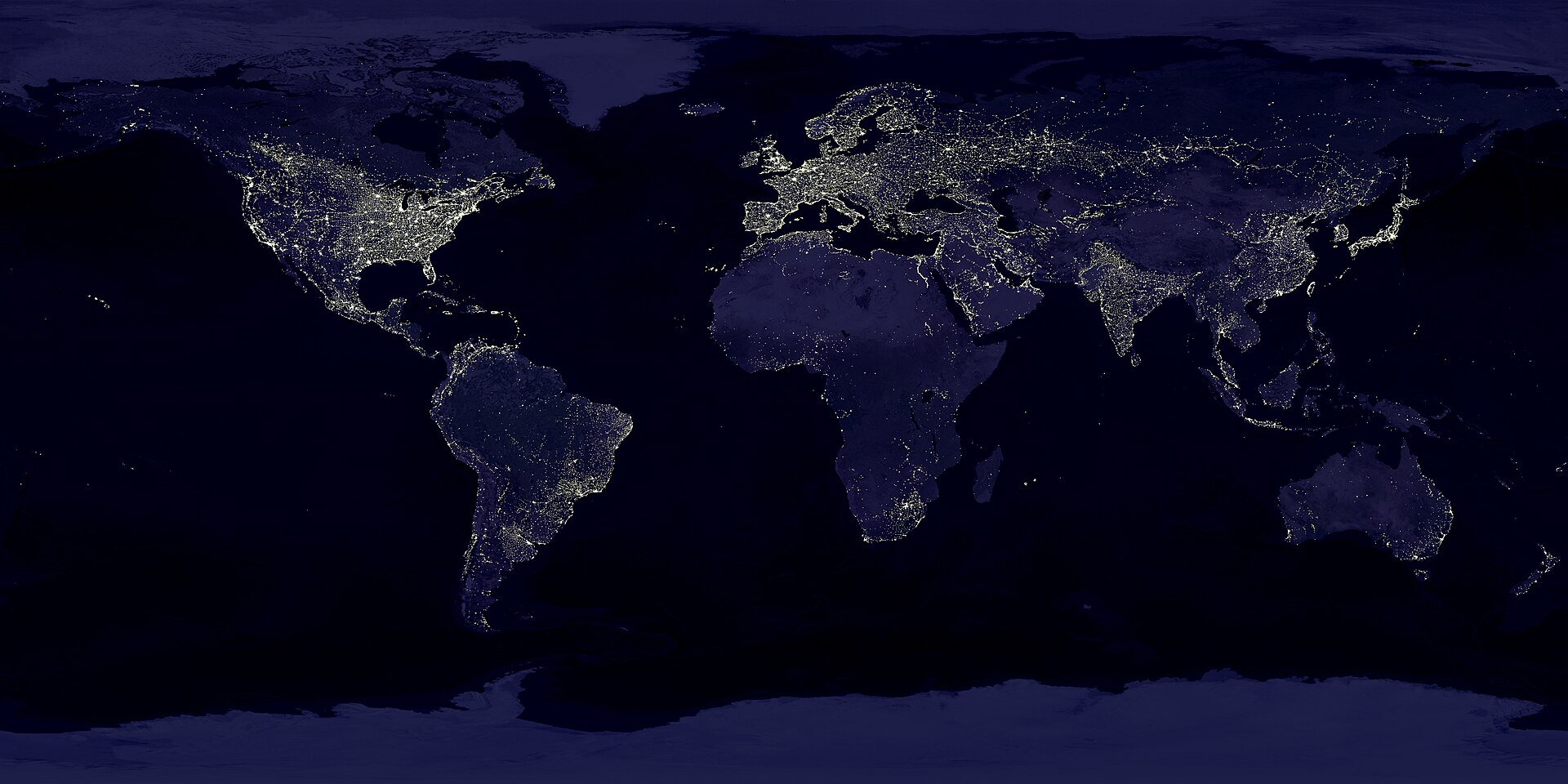
Light pollution, Earth at night,
Photo: public domain
(Click to enlarge!)
The lack of darkness at night
Many animals, i.e., mammals, birds, insects, fish, but actually also those that you wouldn’t think, namely soil organisms, are influenced by light, i.e., by the lack of darkness at night. Preisfeld illustrates this with the example of insects. “Insects need to orientate themselves. At night, moonlight is usually enough. If that is not there, then starlight is enough. However, unnatural light is brighter, and that's the problem. This means that the insects are attracted to a street lamp and they normally fly at right angles to the light source. However, if there is such a cone of light, it causes them to circle round and round. The blue components are the most dangerous because they react extremely strongly to them and lose their orientation.” Studies conducted in the year 2000 show that in Germany, an average of 150 insects die from a single street lamp every summer night. If this is extrapolated to the approx. 6.8 million street lamps on German roads, this results in over one billion dead insects every night. This does not even include other light sources, such as those in industrial areas. However, if the animals do not die directly on site, they lose their day and night rhythm, their reproduction rate decreases and the risk of death increases. “The light suggests to diurnal insects that it is still daytime and they can't rest,” she says, describing the further development. “Their metabolism is still ramped up, they need more food, which they can’t find at night. This missing food leads to a decrease in their fitness and defences, possibly coupled with impaired egg-laying because they can’t really see where they are laying their eggs or can’t find any mates at all. A side effect of this disorientation is that night-blooming plants are pollinated less frequently, which in turn affects the plants."
Corals, for example, produce their offspring depending on the moon, which today often does not emit the brightest light. For migrating fish, brightly lit bridges are an obstacle and send the wrong signal. “Birds, for example, often start singing at night because it’s not dark enough. They are active and mistake the artificial light for twilight, prolong the day and then need more food, just like insects. They are then often encouraged to lay their eggs too early because the day seems longer to them, as it would be in spring or early summer. However, then it is still too cold for the clutches, there is not yet enough food for the young and the young die.”
Many other animal species are affected. Sea turtles can’t find their way into the water when the beaches are illuminated and the orientation of migratory birds is also jeopardised. There is already a term for this occurrence, the so-called tower kill phenomenon. Preisfeld explains: “Migratory birds usually fly at night and orientate themselves by the starry sky. If they come close to cities where there are large light bells, they are diverted from their path over long distances and fly into the cities. And if there are tall, illuminated buildings there, they fly into them and die on impact, i.e., tower kill.”
Less light at night - directing street lighting downwards
Simply dimming the lights could save many animals, but it is much more complicated than that, the scientist concludes. People talk about sustainability, but whether they want to implement it if it doesn’t promise a direct profit is another matter. “Comprehensive dimming would require a complex balancing process between environmental protection and sustainability, but safety and road safety and, of course, costs also need to be taken into account. Subsidy guidelines usually focus on energy efficiency and not on environmental or animal protection. They don’t use ecological light colours, but what is cheapest.” Although less blue light would generally be a good thing, citizens would often be against reducing it, as people also perceive night-time light as a safety factor. In addition, our streetlights are generally too old to be dimmed, which means that technical hurdles would involve enormous costs. On the Canary Island of La Palma, for example, the streetlights were directed downwards many decades ago because of the research telescope located there. “Here, many things still shine up into the sky, and that could help,” she suggests as a small measure.
Plant repair systems are disrupted by artificial light
Night-time lighting also disrupts the growth cycle of our plants. Natural light is an important information carrier, explains the expert: “Plants, algae, cyanobacteria, all those that can carry out oxidative photosynthesis are dependent on normal light, because they also use this light information for flowering and leaf development. In addition to the 24-hour rhythm, there is also a monthly rhythm and an annual rhythm. These normal changes in the quality and quantity of light indicate the seasons to the organisms, which then react by reproducing or shedding leaves.” However, plants react to artificial night light with delayed leaf shedding. This reaction is clearly noticeable in cities, where the leaves cling to the trees for longer than in the surrounding area, but this is accompanied by an increased risk of frost, which weakens the tree. In concrete terms, this means: “The plants react with reduced flower formation and a reduced reproduction rate, also because the insects no longer pollinate them. Their internal metabolism is disrupted, they breathe more heavily at night, produce moreCO2 than normal, store less energy and produce less biomass. This development also has consequences for the biocoenosis and the ecosystem. In addition, the plants’ repair systems are switched on during the night-time dormancy phase. If there is no darkness, regeneration is also disrupted.”
Scotobiology (dark biology) - a new field of research
In humans, increased exposure to artificial light often results in a disturbed sleep-wake rhythm. Israeli researchers even saw a link to breast cancer in people who were unable to protect themselves sufficiently from light exposure at night. But there is also something going on here, as there is now even a specialised field in biology that deals with darkness on living beings, the relatively young discipline of scotobiology. “It’s an exciting field,” Preisfeld begins. “Scotobiology investigates the essential importance of real darkness, meaning natural darkness for living beings and the question: What happens when it’s dark and what happens when it’s not? It also investigates the negative effects of artificial light at night on biosystems, biorhythms, and hormone balance and also develops protective measures.”
There are indeed indications that the risk of cancer increases in humans, as artificial light also disrupts our body’s regeneration. “We know that a low melatonin level can lead to cardiovascular diseases, depression, an increased risk of obesity and impaired fertility, among other things. Gastrointestinal diseases can also occur. Light or lack of darkness during the nightly regeneration phase has major physiological consequences.”
No usage of electronic devices 1-2 hours before going to sleep
The effects of light pollution on humans and animals are considerable. However, we can also do something about it ourselves. “Individually, we can of course try to keep devices such as laptops and televisions away from our bedroom and stop using them an hour or two before we intend to go to sleep,” advises the biologist. “This is particularly important for children so that they can get their rest. Children are even more involved in the learning process than adults, although they are also lifelong learners. What they have learnt is consolidated at night when they sleep, that’s when the learning effect happens.” You can also use ecologically adapted lighting systems in your own garden, which would save many animals. “I did some research on what the German Federation for the Environment and Nature Conservation (BUND) recommends,” concludes Preisfeld. “We should use more insect-friendly light sources, we shouldn’t use short-wave blue light in outdoor lighting and then also fit a timer, because when we go to bed, nobody looks into the garden from their room. The housings containing these fluorescent materials should avoid unnecessary light leakage.. This means that they should not be accessible to insects, especially at the top, and should be positioned low so that the animals are not burnt. As a general rule, you should also set up dark zones around an area in nature reserves or at places where you know there is a high diversity of species in order to produce as little artificial light as possible.”
Uwe Blass
Professor Dr Gela Preisfeld studied, obtained her doctorate and habilitated at Bielefeld University. After short research stays in Australia and a temporary position at the Goethe University Frankfurt, she accepted an appointment to the Chair of Biology and its Didactics, Zoology at the University of Wuppertal in 2006.