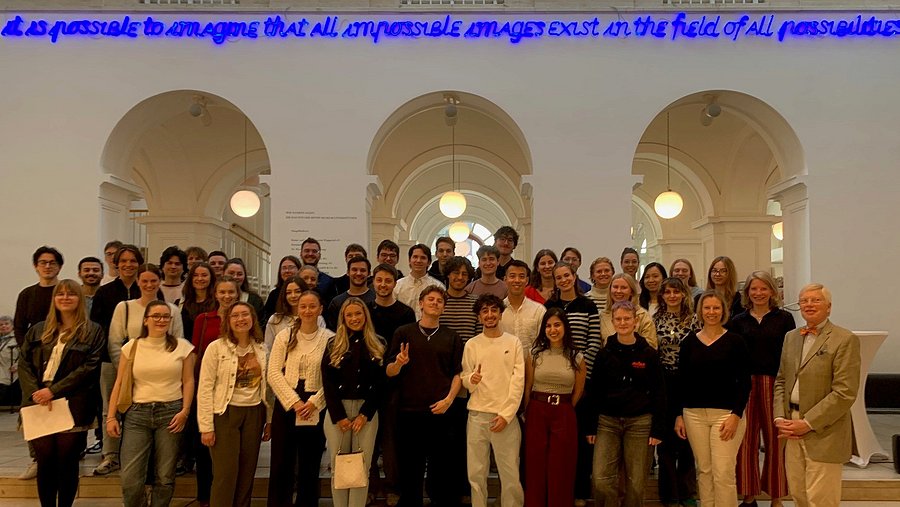
Cultural service for Germany Scholarship holders
Organised museum tour of the Brennscheidt Foundation for Germany Scholarship holders
Photo: UniService Third Mission
Cultural service for German scholarship holders
Brennscheidt Foundation invited students of the University of Wuppertal to the Von der Heydt Museum
The Deutschlandstipendium - financial support for studies
For 15 years, the Foundation & Cooperation Management section of the University of Wuppertal's UniService Third Mission has been addressing all companies, foundations or interested private individuals who would like to enter into a cooperation with the university. This also led to its involvement in the Deutschlandstipendium scholarship programme in 2010. "As part of the Deutschlandstipendium programme, we are responsible for assigning the scholarship holders to the sponsors, organising the events in the scholarship year, including the award ceremony, summer party and mentoring programme, as well as around 4-5 excursions," says Mareen Dusi, a member of the section. This area of responsibility also includes advising scholarship holders, communicating with sponsors and acquiring scholarships.
The funding usually comprises a monthly financial grant for two semesters, which does not have to be repaid and does not count towards BAföG/student finance services or parental income. Scholarship holders also benefit from the close contacts with the business world at the events on offer.
Thanks to the extensive support of regional donors, the Deutschlandstipendium has now helped almost 300 students from all disciplines to successfully complete their education. Dusi comments: "This is a very high number, which is rarely achieved by universities of our size in Germany. Applicants therefore have a good chance of receiving a scholarship."
Any student who is studying in Wuppertal, is in the standard period of study and has grades that are generally better than 2.3 can apply from the first semester and also in the Master's programme. Although these criteria can vary slightly depending on the subject and the associated demand from sponsors, the expert explains further, social and societal commitment as well as hurdles in the CV are also evaluated and can optimise grades a little. In general, however, the Deutschlandstipendium is merit-based and designed for long-term support. "In the best case scenario, scholarship holders can receive funding from the first Bachelor's semester right through to their Master's degree. Stays abroad during the degree programme are also supported and usually count towards the standard period of study."
The Brennscheidt Foundation alone supports 14 German scholarships and invited all scholarship holders to a lecture and guided tour of the Von der Heydt Museum for the first time. Almost 50 students accepted the invitation and learnt about the work of the foundation and the exciting work with works of art from the 17th to 21st century, with lots of background information.
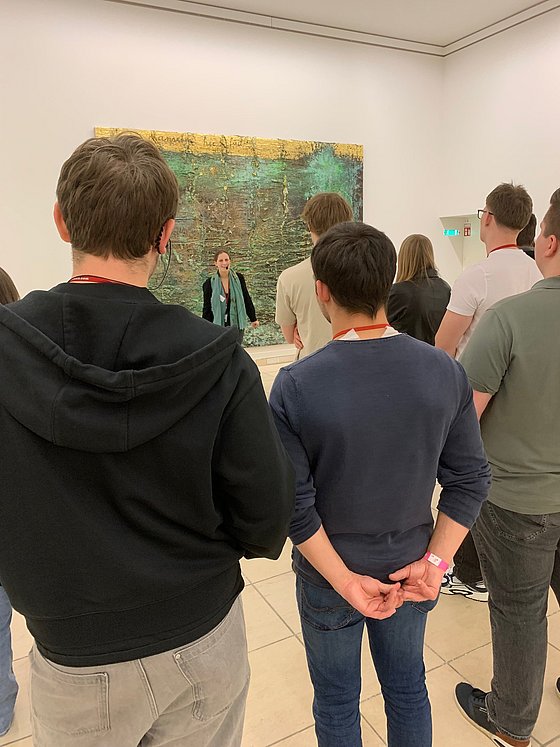
The guided tour on the theme of "Times and Spaces. Classics of the Collection" was moderated by the artist Cara Wilmanns
Photo: UniService Third Mission
Fast-paced guided tour with a time reference
After the lecture, the students were divided into two groups and took part in different guided tours with the titles 'Museum A to Z. From Beginning to Future' and 'Times and Spaces. Classics of the Collection', which either provided background information about the changing work with artworks or explained the development of art.
Anyone who thought they were about to yawn at the technical information was proved wrong by the lively moderation. The second main topic was explained by freelance artist Cara Wilmanns, who delighted the audience with amusing background information on paintings from the 17th-20th centuries. She explained the historical painting techniques from four centuries to young students of the 21st century. She also referred to modern techniques that are available to us in mobile phones and laptops, for example. Images that appear sharp at a distance but pixelate on closer inspection were already used in art at the beginning of the 20th century.
From opulent still lifes with the head of a wild boar and exotic fruit, which hung in state rooms as a status symbol, to nature paintings, which were all made from sketches in studios because the colours were not available outdoors, to paintings that show the entry of psychoanalysis into art. Wilmanns also promoted an understanding of the works, which are sometimes not immediately obvious to the viewer. "Only by explaining the paintings do you learn to appreciate the works," was the opinion of some students afterwards.
Come together
At the end, all visitors came together again in the muluru museum café to exchange ideas, ask questions and network. Not for the first time, many students realised that the museum collection is of a high international standard, is internationally renowned and has often presented works of art that only became world-famous much later. In 1911, for example, the Von der Heydt Museum was the first museum ever to acquire a Picasso painting for its collection. Unfortunately, the work "Acrobat and Young Harlequin" (1905) is no longer in the possession of the Wuppertal museum. It was confiscated by the National Socialists in 1937 as "degenerate art" and later sold. The exact whereabouts of the original are unknown today.
The question of what influence art could now have on their own field of study was taken home by the participants that evening for further consideration.
Uwe Blass
Annika Grübler (Head) and Mareen Dusi are the contact persons for the Foundation & Cooperation Management of the UniService Third Mission section of the University of Wuppertal. Applications can be submitted at stipendium[at]uni-wuppertal.de