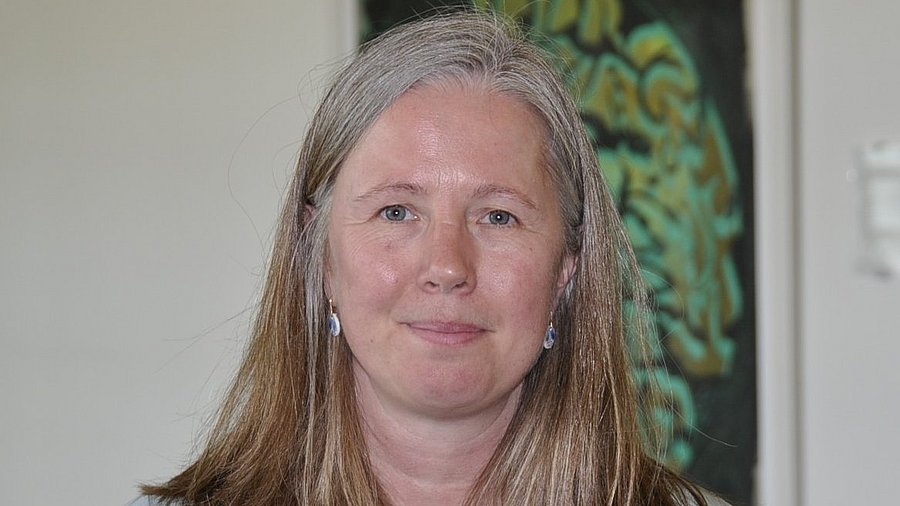
Fire salamander offspring in the archaeological project
Dr Sabrina Bleidißel / Biology
Photo: UniService Third Mission
Project “Fire salamander offspring”
A conservation and breeding project led by university biologist Sabrina Bleidißel is building up a reserve population of fire salamanders to protect against a deadly fungus. The project cooperates with the Wuppertal Zoo and the Lower Nature Conservation Authority in Wuppertal.
Batrachochytrium salamandrivorans, better known as Bsal, is a deadly fungus that dramatically decimates fire salamander populations. Dr Sabrina Bleidißel, a biologist at the University of Wuppertal, has been leading the nationwide unique ex-situ protection and conservation breeding programme for the native fire salamander, known as the “Archeprojekt Feuersalamander“ (“Fire Salamander Ark Project”)' for short, since March 2021. She reports that salamander populations are declining because the habitat is becoming smaller and smaller, e.g., due to the development of new housing estates or road construction. However, a major problem is the fungus, which has been spreading more and more in recent years and is bringing the population to its knees. The infected fire salamanders are very likely to die and as a result the populations are collapsing. In some places, entire fire salamander populations are disappearing and areas are suddenly devoid of these amphibians.
There are almost no fire salamanders left in the Burgholz arboretum
The decline of the animals is also noticeable here in the Bergisch city-triangle of Wuppertal, Solingen and Remscheid. “Around Müngsten, for example, there was a huge population of fire salamanders,” Bleidißel says, “as well as here in Burgholz. Since the fungus arrived, you hardly find any animals when you’re out at night in the rain or humid weather. Old reports by the late Wuppertal herpetologist Joachim Pastors, who mapped the fire salamanders in the Burgholz arboretum in 1981, speak of 30 animals per 100 metres in good cases. “We often don’t find any fire salamanders during our inspections in the Burgholz,” the biologist says. “It’s also evident from the fact that you can hardly find any larvae in the streams.” During mapping in recent years, the scientist and her students were often only able to find individual larvae, which is too few to keep a population alive.
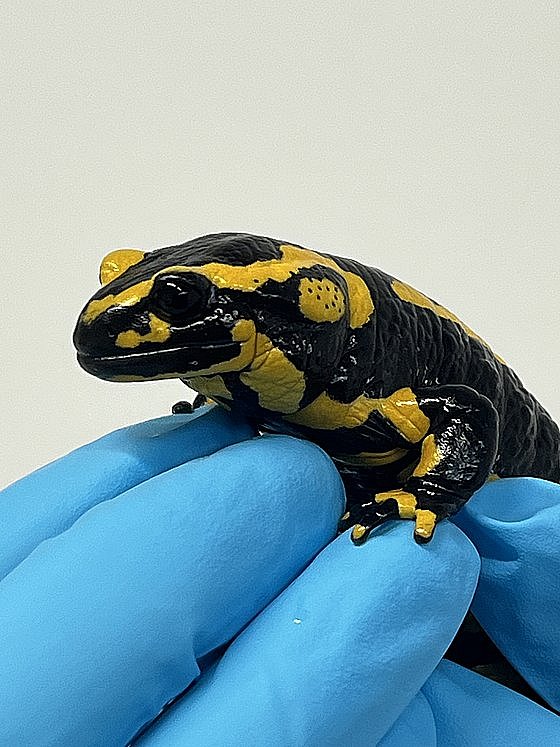
Fire salamander under investigation
Photo: University of Wuppertal
Fire Salamander Ark Project: unique in Germany
In the ‘Fire Salamander Ark Project’ – the only pilot project of its kind in Germany – several organisations have joined forces to save the native fire salamander. “This is a collaboration with the Green Zoo and the Local Nature Conservation Authority of the City of Wuppertal. Within the Environment Department, special mention must be made of Karin Rikono, who initiated the project and supported it wholeheartedly right up until her retirement.” In addition, several private entrepreneurs have also been enlisted to support the project, such as the Iseke family from the Oetelshofen lime works, who provided the premises. “Without the support of numerous other stakeholders, such as the Zoo Association, NABU Wuppertal, the Mittlere Wupper Bio-Station and many others, the project could not have been implemented in this form,” explains the scientist.
The project is also made unique by the involvement of students in the care and maintenance of the fire salamanders. Biology students are involved in the project as part of their courses and final-year projects. Bleidißel explains that the students learn everything they need to know to be able to keep fire salamanders themselves later on. “With these skills, they can be put to good use in schools with animal-keeping programmes. A good example is so-called ‘vivarium schools’ such as the Wilhelm-Dörpfeld-Gymnasium in Wuppertal. There, pupils are involved in the care of the animals and look after them as part of extra-curricular clubs.”
Animals are taken from the wild
To protect the fire salamanders, animals are collected from the wild under special precautions. “We do this by paying close attention to hygiene,” says Bleidißel. “When we go into the forest, our shoes are disinfected, and when we come out again, we disinfect them once more. As part of the Ark Project, we collect fire salamander larvae or adult specimens from the wild in Wuppertal. They are first placed in quarantine at the Grüner Zoo.” There, the animals are then tested for the fungus using a molecular biology method involving a swab taken with a cotton bud. If this swab test is negative, they are placed in quarantine at the university for 60 days. After quarantine, they are tested for the fungus once more. “If they are healthy, they are then moved to a suitable room on the grounds of the Oetelshofen lime works for long-term care.” The room in Oetelshofen is full of terrariums and enclosures for the fire salamanders. The enclosures feature various structures, including moss, tree hollows and stones. Soil is used as substrate, and water bowls are also provided. On site, the students look after the animals’ welfare under the guidance of the project partners. The facility can accommodate up to 100 animals.
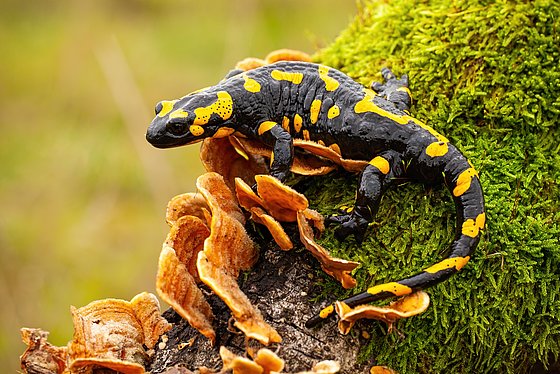
Fire salamanders in the wild
Photo: Colourbox
Animals from Scharpenacken have had offspring
So far, the scientists are looking after around 50 animals at the rescue centre in Oetelshofen. “The animals from Scharpenacken have already had offspring at the Ark. We now have 18 young animals,” says the biologist happily. The scientists also regularly test the area on the Wuppertal Südhöhen for Bsal. “We do this by taking water samples and using eDNA to check whether the fungus is present. Fortunately, we haven’t been able to detect it there yet.”
Protection against Bsal almost impossible
Last autumn, a large, healthy population of fire salamanders was discovered on a 30-hectare site in the Passau district. When asked whether it is therefore possible to keep the fungus out of a healthy habitat, Bleidißel replies: “I’d say no!” It simply comes down to luck, he explains, as even in Wuppertal there are still areas not far from Bsal outbreak sites that remain Bsal-free. “The Scharpenacken is still unaffected.” As long as the fungus is rampant in Germany, all we can do is try to contain the outbreak. “I think our ex-situ measures – that is, measures where the animals are moved from the wild into institutional care – help to maintain local reserve populations,” explains Bleidißel. Equally important, he adds, are public awareness and education campaigns to raise public awareness, as well as habitat improvements for the amphibians. “Only then will specimens still living in the wild have a chance of survival.”
A fire salamander crosses the footpath
Nature lovers can also support the ‘Fire Salamander Ark Project’. So, if you spot a fire salamander, the biologist says, the first rule is: “Don’t touch it. Feel free to take a photo and report it to the relevant biological station (in North Rhine-Westphalia only) or the nature conservation authority. My preferred method is to document the animals found using the Obsidentify identification app. The sightings are entered into the database and are subsequently freely accessible.” So if a walker on the Scharpenacken finds an animal and records it, the researchers can later check whether there are any further sightings and then document the results for the project.
Support the project via the donation page:
https://kooperation.uni-wuppertal.de/de/bergischer-feuersalamander/
Further information at:
https://www.lanuk.nrw.de/fileadmin/lanuvpubl/4_arbeitsblaetter/Anlage_1_-_Liste_der_regionalen_Bsal-Ansprechpersonen.pdf
https://nabu-naturgucker.de/reporting-portal/report-nature-observations/bsal/
https://observation.org/bioblitz/17625/bioblitz-Grifflenberg campus-2025/
https://www.lanuk.nrw.de/topics/nature/species-conservation/amphibian-diseases
Uwe Blass
Dr Sabrina Bleidißel works as a Senior Lecturer in the Zoology and Biology Education Research Group at the school of mathematics and natural sciences, University of Wuppertal