Research into the world’s strongest biological material
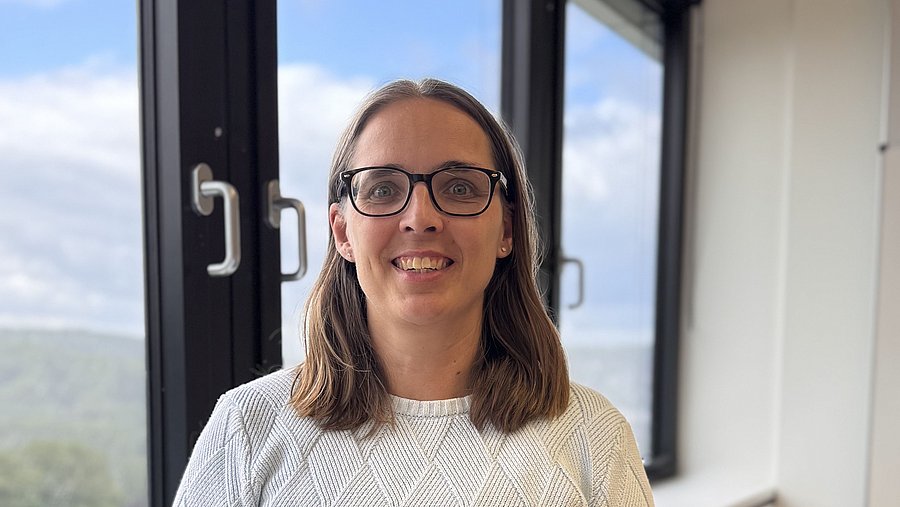
Prof. Dr Swantje Bargmann / Computer-aided modelling in product development
Photo: Melanie Bremer
"If s always about learning from nature"
Basic researcher Swantje Bargmann is conducting research into the world's strongest biological material
What do cows, kangaroos and limpets have in common 1 Their teeth are exceptionally hard and are idea l for use in research to generate suitable synthetic materials in simulations. Swantje Bargmann is a professor at the University of Wupperta l and conducts basic researc h into these biological materia ls with in the Department of Computer-Aided Modelling in Product Development. Experiments with the biological material are carried out by collaborative partners in South Korea and Austria. The results of the experiments and simulations are then analysed in collaborati on with further partners from the USA, the Netherlands, South Africa and Singap ore. "lt's al ways about learning from nature. We're interested in the structure's composition; in other words, we're interested in how to replace the materia ls."
The hardest material in the world
Just under two years ago, Bargmann drew international attention to her field of expertise when, together with scientists from the USA, Singapore, Austria, the Netherlands and Germany, she discovered that the teeth of the limpets are the stro ngest natura l material found on Ea r th. "Whelks can be found all over the world's oceans," she expla ins. ''They're about 4x4 cm in size and have tiny teeth that
you can't see with the naked eye. These teeth are slightly curved, and they use them to scrape their food off rocks. That's why they have tobe so hard." Bargmann and her team are examining the microstructure of these teeth - that is, their precise internal structure - and then app lying their findings to other engineering materials.
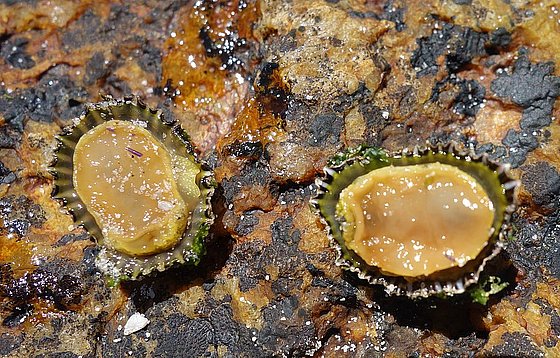
Limpets
Photo: Swantje Bargmann
Research into limpets began in the UK
Fora lang time, spider silk was considered the strongest natural materia l in the wor ld. Bargmann explains that the first scient ifi c stud ies on limpets began in the UK in 2015, as British re searc hers had already been studying the teeth of these animals - both those found in the region and those from the sea - for some time. lt was already suspected, based on the limpets diet, that their teeth might be particularly hard. They are almost im possible to pry off the rocks, as their suction power is also enor mous. "We began our investigations here in 2018 and took a closer look at the st ru cture of the teet h," explains the scientist. After numerous tests, the team discovered another, previously unknown property of the teeth that seems inexplicable to the layman. "The material is auxetic," says Bargmann.
Auxetic material
"lf I pu ll something in one direction, it usually shortens in the other direction. This is how the vast majority of materials in the world be have, and that is also the picture we have in mind. However, this does not apply to the teeth of the cup snail. When I pull on them, the materia l expands in both directions," explain s the researcher. What sounds like magic only becomes clear to even experts once they have seen several images and gained an idea of how the material moves. "This wasn't known before, and we hadn't expected it either," reports Bargmann, continuing : ''That's what research is like. You look at things, you try to understand them, and then you discover things you didn't expect. Naturally, when you discover something that isn't usually there, you check the experimental setup several times to make sure you haven't made any mistakes. When you find genuinely new things at a high level, you have to verify them first, be cause you need to be certain. We subsequently published our findings in *Science Advances* (*Science Advances* is a multidisciplinary open-access journal founded in early 2015 and published by the American Association for the Advancement of Sci ence. The journal's scope covers all areas of science, edito r's note), and that's no small matter, so it natura lly takes langer."
A slightly larger example, and one closer to human experience, is that of a cow's teat, which has the same auxetic properties . So when the calf suckles, the teat is subjected to tension. As the teat widens in the process, the milk can flow unhindered.
The overriding research principle: the material must be strong and hard
Many materials found in nature have already been adapted and used in product development. "But every material breaks at some point," says Bargmann, "and here at the department we general ly focus on very strong structures . We're interested in materials that last a very lang time, can withstand heavy loads and are sustainable." Nowadays, materials should also be as light as possible, as this re duces the financial burden of transporting the products. Bargmann pulls out a piece of packaging waste from a Swedish furniture man ufacturer and says "In the past, when you bought a cupboard, a drawer or anything eise from this furniture shop, you'd get wooden pal lets with polystyrene protection for the materia ls, so that nothing would get damaged du ring transport. And for the past few years, they've been using paper. lt's a recycled material, and it can also be composted. lt's lighter than polystyrene, made from a renewable raw material and is therefore environmentally friendly."
As weil as the teeth of the limpet, however, the basic researchers are also looking at the teeth of other animals. "We started with cows because cow teeth are relatively easy to come by. A cow's tooth consists of two different materia ls, which in a synthetic material would be replaced by completely different ones. For us, it's not about which specific material is used, but rather we prov ide guidance to materia ls scientists on what properties this material must have ."
The tooth material of an Aust ralian kangaroo has also already been examined. The scientist explains: "A teaching laboratory had a kan garoo skull that had fallen and could no langer be used for their purposes. However, they kn ew I was interested in it and gave me the skull." Many materials have cracks of their own, including our teeth. However, it is rare for a tooth to crack through. Bargmann also stud ies the outer protective layer of mussels, particularly mother-of-pearl, because this layer is also extremely hard. Simulations have even been carri ed out using human muscles, as we perceive the tiniest micro-cracks in muscle tissue as painful muscle soreness, which, how ever, subsides of its own accord after a few days. These materials are therefore of great interest for practical applications. "So we always try to understand the biological structures so that we can then design new materials based on their structure."
Product development benefits from basic research
The findings generated from the sim ulations are passed on by the basic researchers to the materials scientists. Bargmann comments: "In the case of the limpet, for example, we altered the material parameters and observed what happened as a result. So can I retain the material properties of the limpet's tooth structure if I vary those parameters1 And the answer is usually: yesi Variation is permit ted. Sometimes the variation is very small, because otherwise l'd suffer lasses, and then the question is whether I can tolerate those lasses. We then pass this information on to materials scientists and publish it." Bargmann's basic research is, so to speak, at the top of the food chain, as the findings she shares are what lead to the production of the alternative material in the first place. "To make a prod uct, 1 need a material. The next step is for t he materials scientist to produce the material. Then it still needs tobe designed and put into use. That's where the product developer comes in."
Things are already moving forward when it comes to periwinkle teeth. The fine structures of the teeth were arti ficially replicated in 2022 at a laboratory at the University of Portsmouth in England. The scientists are now working on optimising these artificial periwinkle teeth, as the material is suitable, amongst other things, for the manufacture of bulletproof vests, which are current ly still made from Kevlar - a materia l that is toxic during the manufacturing process and cannot be recycled.
Bargmann concludes by emphasising that she is not tied to any particular material in her research, saying: "As lang as the materials are fascinating and complex, and can do something particularly weil, 1 find them exciting."
Uwe Blass
Prof Dr-Ing Swantje Bargmann heads the Computer-Aided Modelling in Product Development group within the school of mechanica/ engi neering and safety engineering at the University of Wuppertal.