
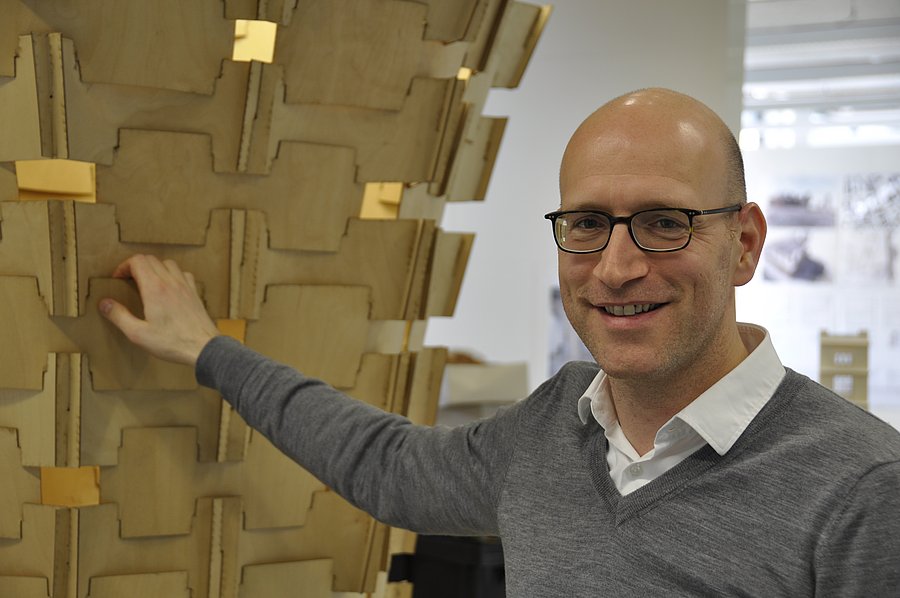
Architecture exhibition on the value of teaching
Prof. Dipl.-Ing. Holger Hoffmann / Architecture
Photo: UniService Third Mission
Student projects are always a reality in their own right
With the exhibition “W / H / O / W we are”, an exciting glimpse into architecture in the making, featuring drawings, renderings and photographs of models by some 420 students from the past 15 years.
Mr Hoffmann, you head the Chair of Representation Methodology and Design. What do you teach your students?
Holger Hoffmann: Our teaching and research area, Representation Methodology and Design (DME), teaches and develops techniques for computer-aided conceptualisation, design, representation and materialisation of architecture. These themes lie at the heart of contemporary architecture. Over the past 15 years at the University of Wuppertal, a focus on three key areas has emerged:
1. Digitality. The methodological basis of our projects is the research-based application and exploration of ‘computational design’ processes. Planning and building have been fundamentally digitised, ranging from digital drawing and modelling, through parametric methods and so-called Building Information Modelling, to today’s AI applications. There is no longer any project that does not take on a digital dimension at some stage. Our graduates must therefore have a very good command of these techniques in order to meet the ever-increasing methodological demands in both practice and research.
2. Discipline. Architectural quality is simply inconceivable without a precise understanding of the disciplinary fundamentals – that is, a profound knowledge of the principles of form-finding, typology, architectural history and theory, as well as historical and contemporary methods of representation. And I do believe that the people of a city can tell whether spaces and buildings make a positive contribution to their living environment or not.
3. Sustainability, or, as I prefer to call it: responsibility. For we architects bear a significant and central responsibility for the use of resources in planning and building. The much-vaunted concept of sustainability is a multi-faceted issue that must first be understood in social and cultural terms before technical challenges can be addressed. This, in turn, means that our students must not only understand technology and construction, but must also have internalised the qualities of architecture itself. Otherwise, we end up with buildings that may be technically sound, but are in no way sustainable because they fail to meet fundamental needs, such as the need for a well-proportioned design.
It is important to recognise that these fields cannot be understood in isolation from one another, but must always be examined in relation to one another.
You say that, unlike other areas of research, teaching is constantly subject to critical scrutiny by students when it comes to setting topics and methods. Where lecturers use specialist knowledge to define contexts and frames of reference and predefine boundaries, students act as a necessary corrective. How helpful are students’ comments, then?
Holger Hoffmann: Good architecture is always based on intrinsic motivation and a genuine interest in the subject. We are very fortunate to be able to work with committed and intelligent young people who not only follow the professional development of our discipline but also want to help shape it. As part of so-called Generation X, many of the positions that are relevant today are not necessarily close to my heart. However, the coming generations have good reasons to question the positions that were also emphatically instilled in me during my own studies. And as our students are largely free to choose their seminar and design topics – particularly at Master’s level – the topics we set are subjected to a ‘reality check’ every semester. If I do not continually reflect on, adjust and refine these topics, I will – quite rightly – no longer find any students who wish to work on them. The weekly feedback session – a typical and necessary feature of architectural education, involving a one-to-one discussion about a specific project – is, at its best, a dialogue and an alignment of intentions and interests. Ideally, therefore, the feedback session is not merely a tool for correction (just as a colloquium is not a tribunal), but a moment of constructive confrontation in which ideas clash, positions are questioned, hopes are dashed, and possible solutions are sought together. In doing so, we must maintain a flexible balance between our own experience and the fresh ideas brought to the table. Perhaps – or probably – our students interpret our projects differently from how we had envisaged. Our students are also ‘early adopters’ when it comes to technological innovations. If we take this potential seriously, exciting projects will emerge.
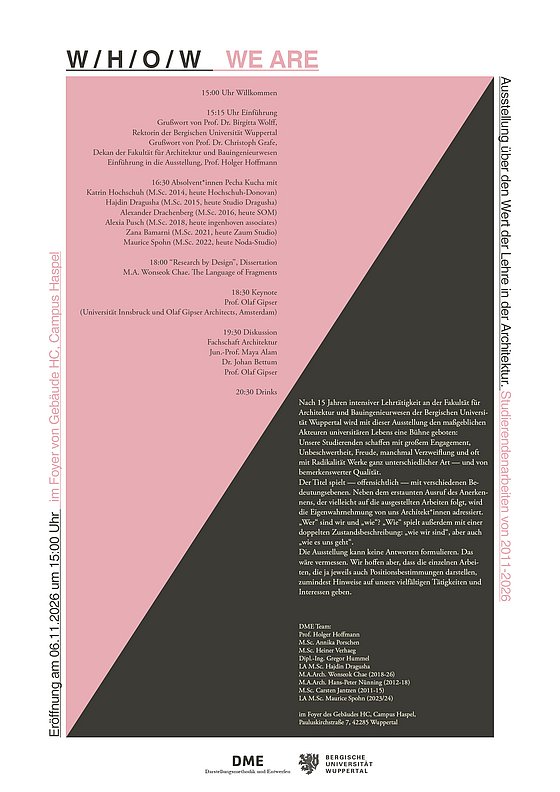
Poster 1 for the exhibition:
DME: Representation Methodology and Design
In architecture, so-called ‘Research by Design’ – that is, research through design – integrates teaching and research in a comparatively effective way. Could you explain that?
Holger Hoffmann: There are, of course, very different research cultures and the outputs that result from them. In architecture, a drawing, a model or even a building can be far more relevant to the further development of the discipline than, for example, written publications. Exploratory design – that is, the iterative development of an idea with the aid of references, drawings, (digital) models and virtual spaces – is actually not dissimilar to other research formats. Ideally, hypotheses are formulated, systematically examined for their potential and weaknesses, and synthesised into findings.
In our case, there is a deliberate integration of research interests and teaching within the Master’s programme. Particularly in the so-called ‘Experimental Design Studio’, we can initiate, test and develop design methods, and then reflect internally on the results – which are also significantly co-developed by our students – and further develop them, for example, through papers, conference presentations or dissertations. Digital design environments are ideal for this because, for example, we can take over and build upon our students’ digital 3D models. These are valuable resources for research within our department. I am therefore delighted that my colleague Wonseok Chae has just successfully completed his doctoral thesis on ‘The Language of Fragments’. This work was preceded by seven peer-reviewed papers in which he had explored the findings from our studio in greater depth.
You say that the value of teaching stems from the fact that students and lecturers act as multipliers, meaning that innovations often reach society more quickly than through other research projects. Could you give us some examples?
Holger Hoffmann: Our students start working in architectural practices at a fairly early stage; as working students locally and regionally, but also internationally through the compulsory work placement following their Bachelor’s degree. Here they acquire skills that a university simply cannot adequately teach. On the other hand, I repeatedly find that important topics which seem normal and commonplace to us in the academic world are not necessarily known or practised in the real world. For instance, the digitalisation of architectural practices has often been slow. We, however, can support or initiate relevant developments with greater freedom than architectural practices often can.
The distinctive profile of our architecture programme, with its focus on the responsible management of existing buildings and resources, has – as I hear from my colleagues at the local BDA (Association of German Architects, editor’s note) – been recognised in the market for decades. Our students bring the very latest issues and methods to the drawing board much more quickly and directly than an article – which may not even be known or read – could ever do. But contemporary design methods and, above all, a sound digital education also make our students and graduates attractive even to well-known international firms.
If firm owners are smart, they’ll make use of precisely this knowledge. I myself was fortunate enough to work in the Netherlands for six years. There, I was never criticised for not yet being able to carry out certain practical procedures; instead, the skills I’d acquired during my studies and honed in the office were put to use very precisely in the context of the projects.
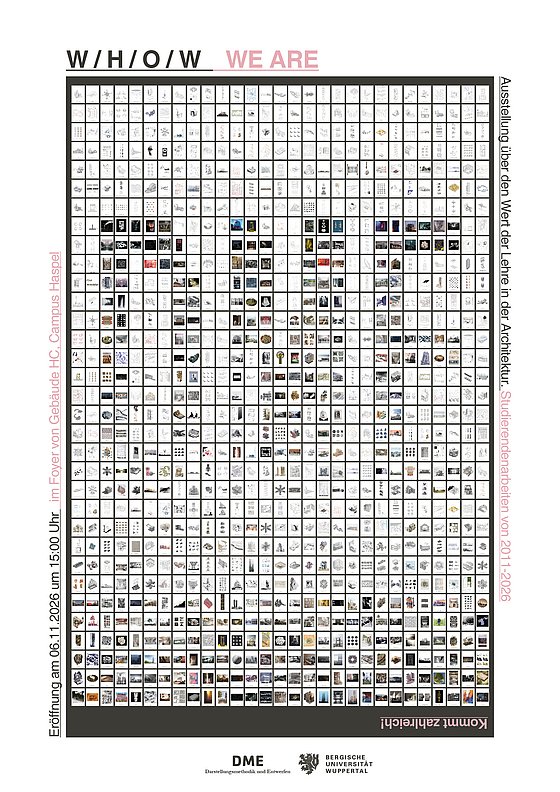
Poster 2 for the exhibition:
DME: Representation Methodology and Design
On 6 November, you will be presenting the exhibition ‘W/H/O/W we are’ at the Architecture Department, featuring around 970 pieces of student work from the last 15 years exploring the value of teaching. What does the title mean?
Holger Hoffmann: The title can be broken down into ‘who and how we are’ and – obviously – plays on different levels of meaning. As well as the exclamation of amazement and appreciation (wow) that will hopefully follow the viewing of the exhibited works, it addresses how we architects perceive ourselves. ‘Who’ are we and ‘how’? ‘How’ also plays on a dual description of our state: ‘how we are’, but also ‘how we are faring’.
Both the value of architecture itself and the way in which this discipline is practised and taught are repeatedly called into question. Because architecture is simultaneously a cultural and technical discipline, scientific inquiry and practical application, it is readily called into question by specialists in these fields. From a deliberately provocative standpoint, these criticisms may seem plausible: compared with the fine arts, architecture often appears opportunistic. A primarily technical focus, on the other hand, is precluded by its cultural relevance. To an increasingly commercialised academic landscape, the discipline does not appear academic enough, whilst practising colleagues lament the alleged detachment of the curricula from reality. Yet architecture’s great potential lies precisely in its positioning between these extremes. It is in the transitions – that is, where specialists fail in their struggle for canonical purity – that architects find innovation.
We therefore seem to be a rather elusive species. Nor can the exhibition provide any definitive answers. That would be presumptuous. We do, however, hope that the individual works – each of which also represents a statement of position – will at least offer some insight into our diverse activities and interests. As part of the exhibition, I have compiled all the assignment briefs I have reformulated each semester for five key seminars. This was quite revealing, and I hope they make a small contribution to our understanding of architecture and its protagonists.
You speak of a ‘reality of its own’ or a ‘proto-architecture’ in relation to the students’ work. What do you mean by that?
Holger Hoffmann: There are certainly different approaches to teaching architecture. Often, the focus is on simulating a supposed ‘practice’. That would amount to teaching as mere vocational training, which I do not consider sufficient, particularly at a university. After all, in teaching and research there is normally no ‘proof of concept’ in the form of a completed building. Nor is it possible to replicate the complexity of professional practice in an academic setting. Anyone who has ever planned a complex façade in collaboration with structural engineers, building physicists, fire safety engineers and contractors knows this.
Because they do not refer to projects yet to be built, student projects are always a reality in their own right. Every drawing, every visualisation and every model describes an architecture-in-the-making that enjoys far greater freedom than an architecture subject to the constraints and absurdities of local practice. Failure is far less costly, allowing us to explore methods that anticipate real-world practice. And this gives rise to architectures that do not merely reflect the status quo, but are speculations about possible future worlds.
Each selected graphic is stored as a ‘sedcard’ in a database. How do I, as a visitor, use this database?
Holger Hoffmann: I built the database with Claude Design in order to be able to manage the sheer volume of high-quality work at all. As things stand, I have processed around 1,000 graphics, which Claude has automatically ‘tagged’ and which I can now sort and analyse diagrammatically. We will be publishing some of these analyses as part of the exhibition:
One diagram, for example, describes thematic developments at DME: for around ten years now, we have been placing the handling of collections at the centre of our projects. Among other things, I’m interested in ‘adaptive typologies’ – that is, spatial arrangements that are integrated into existing spatial arrangements. Another diagram illustrates, based on the number of entries, the influence of students on our teaching area. It has become clear here that it is mostly groups of students (who, incidentally, almost always work in the faculty’s studios) who have driven our projects forward through the quality of their work.
We have converted the database into a website, which we intend to launch to coincide with the exhibition. Here, every visitor will be able to explore the work freely, or by selecting projects, cohorts, students, etc., and, if interested, compile a PDF containing selected entries. For graduates, this may be a nostalgic moment, allowing them to retrace the marks they have left with us. For students, this may be exciting as it provides inspiration and a concise overview of the standards achieved. And we hope that outsiders, too, will recognise the high standard of work that our architecture students in Wuppertal are capable of producing.
Furthermore, the exhibition also offers insights into the skills and potential of future generations. What future-oriented skills can I, as a visitor, discover there?
Holger Hoffmann: Architecture has long been characterised by plurality, and I’ve found that our students view the potential of diversity in a positive light. It would be wonderful if it became apparent that they are able to interpret complex contexts and translate them into their own designs. I also hope that the works in the exhibition highlight not only the artistic and digital-technical sophistication but also the spirit of experimentation among our students.
Many projects are developed in teams, and an awareness of multiple authorship is important in a profession that still celebrates the individual – think of the ‘star architect’. Architects also sometimes tend towards ideological dogmatism and moral self-aggrandisement. This makes our work unnecessarily arduous. Therefore, the cornucopia of work on display here is also intended to show that, for all its self-sacrifice, architecture is a joyful discipline.
We are highlighting excerpts from the best work of recent years. I have deliberately refrained from singling out a few individual projects, as I find the sheer volume and consistent quality far more telling. What they all have in common is design complexity and graphic quality. I find the intelligence and skills of so many of you truly inspiring. One highlight every year, however, is the work produced by our first cohort of Bachelor’s students. With ‘Digital Planning and Design (DPE)’, we offer a minor subject with a comparatively low number of credit points. Nevertheless, within a year, our students achieve a very impressive level of proficiency in digital three-dimensional modelling and drawing, which in turn forms the basis for all other activities in both practice and teaching. They are able to digitally reconstruct complex buildings, break them down into fragments and reassemble them into new compositions. This requires not only mastery of sophisticated software but also spatial understanding and a well-developed aesthetic sensibility.
Where and for how long will the exhibition be on display?
Holger Hoffmann: On 6 November 26, we will open the exhibition with a series of lectures, as well as a discussion entitled ‘On the Value of Teaching’. The exhibition will then remain in the foyer until 4 December 26.
Exhibition details:
W / H / O / W we are
Database and exhibition on the value of teaching in architecture over the last 15 years
Venue: Foyer, Building HC, Haspel Campus, University of Wuppertal, Pauluskirchstraße 7, 42285 Wuppertal
Dates: 6 November – 4 December 2026
Opening: 6 November 2026, 3 pm
Uwe Blass
Prof. Holger Hoffmann holds the Chair of Representation Methodology and Design at the University of Wuppertal and is the founder of the Düsseldorf-based architectural practice one fine day. After graduating from the Münster School of Architecture, he worked as an architect at Bolles+Wilson in Münster and, following his diploma at the Städelschule in Frankfurt, at the UNStudio practice in Amsterdam. Since then, his interests in practice, teaching and research have centred (among other things) on computer-aided design, visualisation and fabrication in architecture, with a particular focus on typological and tectonic issues.


