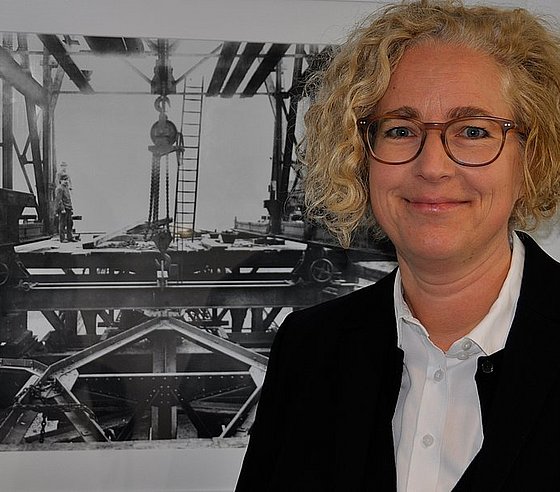
Marilyn Monroe - the mixture of glamour and fragility Prof'in Erica von Moeller (left) Mono Keßler (right) / Audiovisual Media Design Photo: UniService Third Mission

Marilyn Monroe - a mixture of glamour and fragility
Erica von Moeller, director and professor of audiovisual media design, and her student Mona Keßler on the 100th birthday of a Hollywood icon
Norma Jean Baker, better known as Marilyn Monroe, was born 100 years ago on 1 June 1926 and remains an eternal icon to this day. How is that?
Erica von Moeller/Mona Keßler: In the 1950s, Marilyn Monroe embodied the American dream: youth, glamour, sensuality. Scenes such as her appearance in "Gentlemen Prefer Blondes" or the song she performed, "Diamonds Are a Girl's Best Friend" - characterised an image that is still considered the epitome of classic Hollywood aesthetics today. This image was deliberately curated: blonde hair, red lipstick and sparkling costumes.
Her public image stood in stark contrast to her real life, which was characterised by an unstable childhood and psychological stress. She grew up in changing foster families and homes in an environment characterised by mental illness, neglect, abuse and constant relationship breakdowns. These early traumas formed the core of her later emotional vulnerability and lifelong mental health problems.
This mixture of glamour and fragility, fame and transience, etc. made her a figure with whom people could identify and who also functioned as a projection screen. From Madonna to Ikkimel, many artists still refer to Marilyn Monroe today - as an icon, as a myth, as a symbol of femininity, fame, vulnerability and media staging. In this sense, she is a cultural symbol that embodies glamour, tragedy and the power of the media. Her history, her images and her artistic treatment (particularly through Andy Warhol screen prints) have inscribed her in the collective consciousness. Her image functions in fashion, art, advertising, feminist debates and pop culture alike. Every generation rediscovers "their" Marilyn - sometimes as a sex symbol, sometimes as a victim, sometimes as a feminist figure, sometimes as a pop icon.
Even 64 years after her death, Monroe is still present in the media landscape. Where can we find her?
von Moeller/Keßler: That's right, Marilyn Monroe regularly appears in new documentaries, biographies or series about the 1950s and 1960s - often as a reference figure for fame, glamour and the mechanics of the media. The Netflix film Blonde (2022) shows how strongly Monroe functions as a projection screen. It is far more than a classic biopic and tells of violence and exploitation with a haunting visual design that revives real photos of Monroe with scenes from her life, emphasising the dark and voyeuristic.
Monroe is also regularly the subject of major exhibitions. Currently, the exhibition "Marilyn Monroe: Hollywood Icon" at the Academy Museum of Motion Pictures in Los Angeles (31 May 2026 - 28 February 2027) is particularly visible. Original costumes, photographs, letters and personal items are on display here, shedding light on Monroe as a strategic shaper of her own image. It becomes clear just how much she was able to utilise her public relations as a total work of art with fashion and performance with remarkable sophistication. Far from being merely a product of the studio system, the exhibition positions Monroe as a visionary co-creator of her own image.
There are various aspects of her life that are repeatedly taken up in the media at different times. The "blonde" effect or her fashion and style. Is that timeless, so to speak?
von Moeller/Keßler: Exactly, Marilyn Monroe is not just a historical figure, but a permanently reproduced cultural symbol that can be reproduced endlessly. Her face has been graphically simplified, emotionally charged and culturally coded, making it memorable as a brand. This makes her a motif that appears again and again in art, advertising and social media - much like Elvis, Che Guevara or Audrey Hepburn.
Marilyn Monroe has also managed to inspire many artists to reference her. Her style continues to inspire the fashion world. Monroe is regarded as a vintage and fashion icon whose outfits and silhouettes are repeatedly revisited in contemporary collections. She is therefore not a static monument, but a cultural chameleon that changes with the times without losing its recognisability.
Moreover, many of the films in which she has appeared and the images she has been portrayed in are often prime examples of the "male gaze". The term describes the predominant heterosexual, male narrative perspective in film, television, advertising and art, which relegates women to the role of passive objects and focuses more on the appearance and attractiveness of women rather than making them deeper, capable subjects.
In this sense, Marilyn Monroe functions as a mirror in which every era recognises its own themes. In the wake of the #MeToo movement, Monroe's story can also be seen as an example of the abuse of power and male domination in Hollywood. Along with this, she functions as an example of media criticism, precisely because she was exposed to a massive paparazzi culture. She was constantly followed by photographers - on film sets, in public, outside her home and even in vulnerable moments such as after hospital stays. This early form of modern celebrity stalking strongly characterised her public life.
A culture that has changed in the age of social media, as many celebrities and artists can now share insights into their lives themselves, taking the wind out of the paparazzi's sails to some extent. Overall, however, the problem remains of how to protect personal rights if images of celebrities continue to be produced and published using questionable means.

Marilyn Monroe photographed by David Conover in 1944
Photo: public domain
Many brands continue to capitalise on the Monroe-Core or their beauty trend. However, we often refer to this as rebranding nowadays, because their brand and image have changed. She is no longer just the blonde ditz and vulnerable victim; she is also a shrewd businesswoman with her own production company. That also enhances a brand’s value, doesn’t it?
von Moeller/Keßler: Exactly, the old Hollywood narrative – naïve, sexy, vulnerable – no longer resonates today. Brands that wish to continue using Monroe must retell her story: as a woman who consciously steered her own career. As one of the first actresses to rebel against studio contracts and even actively negotiate her roles and fees. This perspective then fits perfectly with modern brand values such as empowerment, self-determination and professionalism
In 1954, she founded her own film production company, ‘Marilyn Monroe Productions’, with the aim of freeing herself from the restrictive contracts of the major studios and gaining more influence over her artistic work and her roles. This is a step that more and more female filmmakers are taking today to change the male-dominated structures of the film industry and to be able to tell their own stories. Parallels to these developments can also be seen in the music world, where pop icons such as Taylor Swift are reclaiming the rights to their work.
However, some aspects of this should also be viewed critically. For instance, Monroe and her style are also very popular online amongst so-called ‘Tradwives’, who often draw heavily on 1950s fashion and are frequently associated with conservative to right-wing movements. In their worldview and the messages they convey to their audience, feminist positions usually have no place due to clear, ‘traditional’ gender roles and a binary gender system. They are a telling symptom of an era in which hard-won feminist perspectives and ways of life cannot be taken for granted, but are values that must be upheld and reinforced every day in the face of right-wing and misogynistic forces.
On social media, she is actively marketed by the Authentic Brands Group (ABG) as the official estate administrator. She has millions of followers on Instagram and TikTok. Sixty per cent of her target audience is in the 18 to 35 age group. So you can make a lot of money from dead people too, can’t you?
by Moeller/Keßler: A living celebrity can be embroiled in scandals, make unpopular decisions or fall out of fashion.
A dead icon, on the other hand, is stable, controllable and perfectly curatable. Following the death of Lee Strasberg, Marilyn Monroe’s principal heir, the rights passed to his wife, Anna Strasberg, and were later sold to the Authentic Brands Group. As a result, Monroe’s ‘estate’ is now in the hands of a corporate organisation with no personal connection to her. ABG runs official social media accounts that use Monroe’s image, voice and personality to promote products, brands and campaigns.
In doing so, ABG has turned her estate into a contemporary lifestyle brand that appeals to young target audiences just as much as it does to nostalgic fans. She is a cultural icon, an aesthetic brand, a digital influencer and, as such, an economic machine that carries no risks. This makes her extremely attractive to brands.
In 2024, an AI-generated, “hyper-real” version of Marilyn Monroe was unveiled, capable of chatting with fans in real time, smiling and responding in Monroe’s voice. Personalised AI films are on the way, but they’re every cinema-goer’s nightmare, aren’t they?
by Moeller/Keßler: Yes, the idea of an AI-generated, hyper-real Marilyn Monroe who smiles, speaks and chats is indeed a cultural shock and an ethical nightmare for many people. We’ve reached a point where we have to decide what constitutes cinematic art and who owns a face when the person behind it has long since passed away.
Because when deceased actors and actresses are brought back to life, it sets a dangerous precedent: who decides which roles they ‘play’? Who decides what they say? Who decides how they are portrayed? And who can exploit that person for their own purposes and messages? The deceased person behind the image can be given roles and have views put into their mouth that they themselves might never have held. This raises the question of which ethical boundaries are being crossed and to what extent a person can be posthumously stripped of their own views and body of work for economic gain. It is no longer the artist – it is a company.
Film is an art form that has always been closely intertwined with craftsmanship and the technical advances of its respective era. This is evident in editing, set design and, of course, cinematography – for example, when it became possible to shoot digitally rather than on film, and when practical effects were increasingly replaced by CGI (Computer-Generated Imagery). Each of these developments naturally brought with it its own debates and criticism; at the same time, as a creative filmmaker, one had – and still has – at best the choice to consciously opt for or against certain creative possibilities.
Given that AI in film is set to profoundly transform and influence so many different creative fields and professions, we may well be dealing here with a kind of novelty whose full consequences cannot yet be fully grasped, and which requires us to rethink the very concept of creative work. Here, too, it is important that there is no pressure to act, and the option to consciously decide against the use of these techniques must remain available. For example, this year’s Cannes Film Festival announced a ban on AI in films entered into the official competition. And, of course, there are also worrying cases of directors and actors whose copyright-protected works are being used by companies to train their AI models without their consent.
Marilyn Monroe remains a lucrative name for licensing today and regularly features in documentaries, films, biographies and art exhibitions. What significance does she hold in the world of filmmakers today?
von Moeller/Keßler: Marilyn Monroe is no longer an active star; she is a point of reference and a touchstone for how we talk about fame, femininity, performance and Hollywood itself. Her significance is not nostalgic, but structural. This makes Monroe a model case through which key mechanisms of the film industry can still be understood today: how studios create stars, how images are constructed and controlled, how sexualisation and marketing work, and how fame and psychological pressure are linked.
Uwe Blass
The director and writer Erica von Moeller studied both Fine Art in Mainz and Communication Studies in Frankfurt before graduating in film from the Academy of Media Arts in Cologne. She has been making films in various genres and formats since 2001. As a media artist, she develops exhibition projects at the intersection of moving image, space and sound. Following a variety of teaching posts in Cologne, Berlin and Trier, she has been teaching at the university of Wuppertal as a professor of audiovisual media design since 2011.
Mona Keßler is a research assistant on the Audiovisual Media Design degree programme.