Bergisch Innovation and Education Congress
How can AI become a competitive advantage for the region?
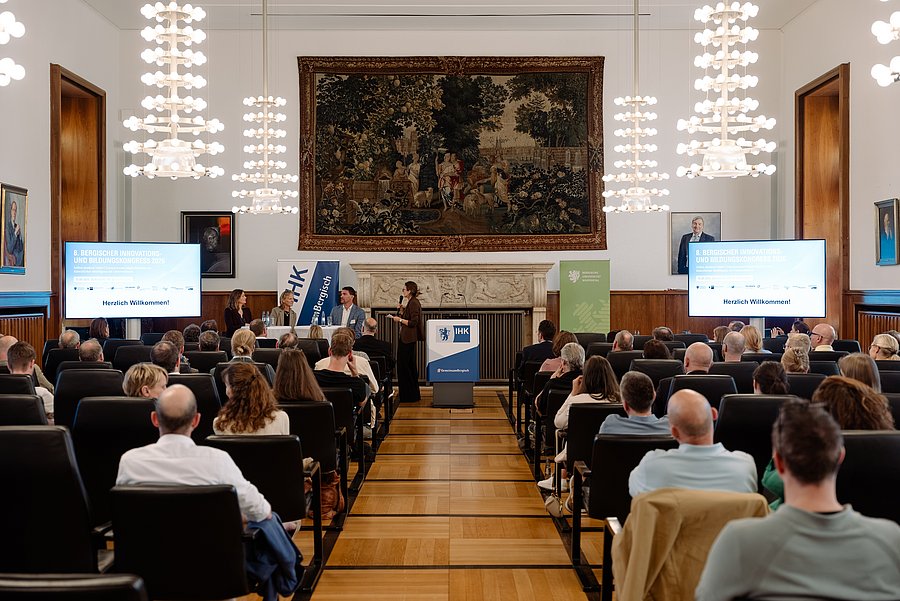
Opening address at the Bergisch Innovation and Education Congress in the plenary hall of the Bergisch Chamber of Industry and Commerce, featuring the Mayor of Wuppertal, Miriam Scherff (left), the rector of the university of Wuppertal, Prof. Dr Birgitta Wolff (centre), and Chamber of Industry and Commerce President Henner Pasch. // Photos: Gesa Niessen
How can artificial intelligence help to strengthen the competitiveness of businesses in the region? And what are the limitations? What impetus can the academic world provide for practical applications? And what skills will tomorrow’s workplace require? These questions were the focus of the 8th Bergisch Innovation and Education Congress held at the Bergisch Chamber of Industry and Commerce.
Under the theme ‘Think for yourself! Or not? The limits and possibilities of artificial intelligence in business’, Prof. Dr.-Ing. Peter Gust, vice-rector for Third Mission and International Affairs at the university of Wuppertal, welcomed the approximately 140 participants from business, academia and public administration who had accepted the invitation to discuss specific applications, experiences and prospects for AI.
Panel discussion: How AI can benefit the region
The exchange between politics, business and academia played a central role in the fully booked conference. Together, Wuppertal’s Mayor Miriam Scherff, Chamber of Commerce and Industry (IHK) President Henner Pasch and the rector of the university of Wuppertal, Prof. Dr Birgitta Wolff, discussed the opportunities offered by the technology and its significance for the region. Alongside the technology’s possibilities and potential, the question of how to use AI responsibly was a central part of the discussion. Wuppertal’s Mayor Miriam Scherff set out a clear principle: “AI should support, not decide.”
For the business community, the focus is also on how AI can be used effectively in practice. “When used sensibly, artificial intelligence becomes a competitive advantage for businesses,” summarised IHK President Henner Pasch.
The university contributes not only scientific expertise to this debate, but also further perspectives on practical changes. “Artificial intelligence is changing the way we conduct research, teach and work,” emphasised Rector Prof. Dr Birgitta Wolff. “We must work together to shape this transformation responsibly and successfully.”
Keynotes: Three perspectives on the working world of tomorrow
Three fascinating keynote speeches highlighted just how much AI is already transforming the world of work today, the opportunities this presents for businesses and employees, and the risks involved: Jörg von Plötz, Managing Director of Wuppertal-based Böhme & Weihs GmbH, Prof. Dr Stefan Diestel, an expert in occupational, organisational and business psychology, and Prof. Dr-Ing Fabian Hemmert, Professor of Interface and User Experience at the University of Wuppertal, examined the use of AI from different perspectives.
Workshops: AI Strategies and Future Skills
Participants were then able to explore in greater depth how these ideas could be put into practice in three workshops. The focus was on future skills for the world of work, prototyping with AI, and the development of an AI strategy.
The Bergisch Innovation Congress is organised on the initiative of the Bergische Transferrunde by the Wuppertal-Solingen-Remscheid Chamber of Commerce and Industry (IHK), the City of Remscheid, Solingen Business, Wuppertal Economic Development Agency, the Bergische Structural and Economic Development Agency, Circular Valley, Neue Effizienz and the Wuppertal Technology Centre (W-TEC), on whose behalf the Chamber of Industry and Commerce issued the invitation.