Between Faith and Personality
How Muslim women use colour to express their identity
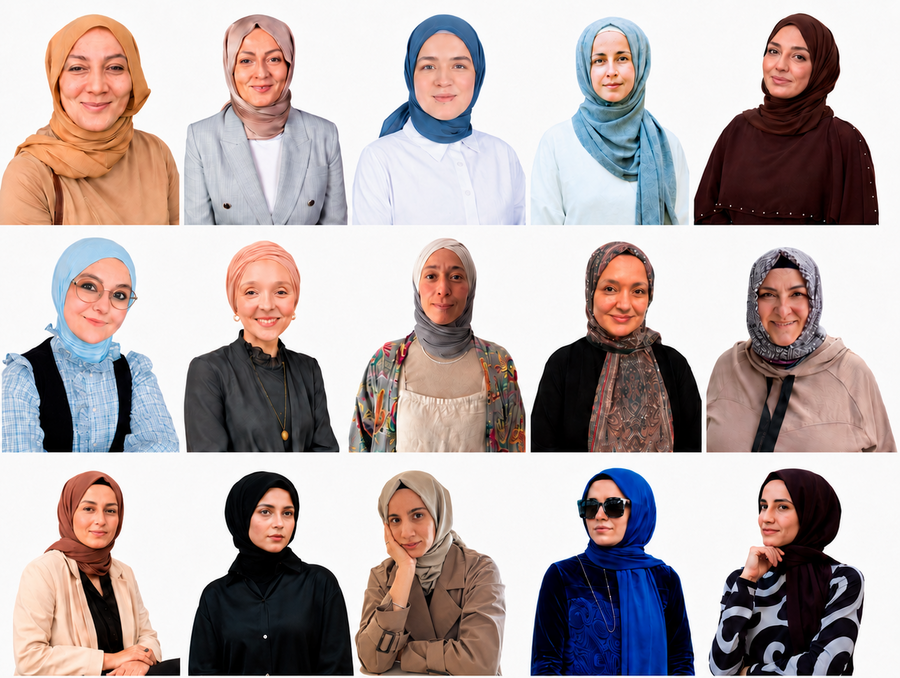
As part of the ‘Colours of Faith’ study, 593 Muslim women who wear headscarves from Germany and Turkey were interviewed. // Photomontage by Axel Buether and Tuba Işık
For Prof. Dr Tuba Işık, a religious education specialist and theologian at Humboldt University in Berlin, the study thus sends a clear message to the public: “Our data show unequivocally that Muslim women are diverse – one simply has to be willing to recognise this diversity. In light of these findings, generalisations that reduce the headscarf to a homogeneous, one-dimensional symbol are finally a thing of the past.”
As part of the ‘Colours of Faith’ study, 593 Muslim women who wear headscarves from Germany and Turkey were surveyed. For the first time, the researchers systematically documented correlations between personality traits, religiosity and the choice of headscarf colour.
Personal taste as the most important factor influencing colour choice
A key finding of the study is the high significance of personal preferences: 97 per cent of the women surveyed cited their personal taste alone as the most important factor influencing their choice of colour. Religious norms merely limit the scope for choice. Furthermore, family, religious authorities, social media and societal expectations all play a completely minor role in everyday life.
“We were able to show that personality remains visible even where religious expectations and social norms influence colour choice,” says colour psychologist Prof. Dr Axel Buether of the university of Wuppertal. “Colours are not merely a decorative detail. They are a means of visual self-expression.”
Colour preferences and forms of religious orientation are linked
The study also highlights links between certain colour preferences and forms of religious orientation. It is not white, but black, that shows the strongest link to a pronounced taqwa orientation. This central guiding concept of Islamic practice does not describe a rigid dogma, but rather a comprehensive attitude of inner mindfulness, moral integrity and ethical self-development in everyday life. Whilst white is often associated with purity and spirituality, in everyday practice black apparently stands more strongly for modesty, seriousness and a consciously reduced visibility.
Differences also became apparent when comparing Germany and Turkey. Whilst the women surveyed in Germany more frequently associated their choice of colour with individuality and openness, the participants from Turkey showed a stronger orientation towards traditional patterns of reserve and of not ‘standing out’ visually. The researchers attribute these differences to varying social contexts and everyday experiences.
“Faith is shaped aesthetically”
In practice, the headscarf proves to be a highly complex, multidimensional system of identity. “Faith is actively and aesthetically shaped by the women. The choice of colour is not an act of blind conformity, but an internally rooted, independently reflected practice through which women subtly harmonise their spiritual focus, their personal identity and the demands of everyday life,” Tuba Işık continued.
The study combines, for the first time, approaches from colour psychology, personality research and Islamic religious education. According to the researchers, this interdisciplinary approach opens up new perspectives for the study of visual self-expression in the interplay between personality, religiosity and social context.
Key findings at a glance
- Personality remains evident in colour choices even within the context of religious norms.
- Openness to new experiences is linked to a more varied use of colour.
- Women systematically adapt their colour choices to different social situations.
- Black – not white – is the colour most strongly associated with taqwa in the study, based on empirical evidence.
- 97 per cent cite their own taste as the most important factor influencing their choice of colour.
- Despite comparable levels of religiosity, Germany and Turkey differ significantly in their colour practices.
- The choice of colour can be understood as a form of visual self-expression.