
Working together on the ground
How a solar-powered container is set to open up new opportunities for farmers in Africa
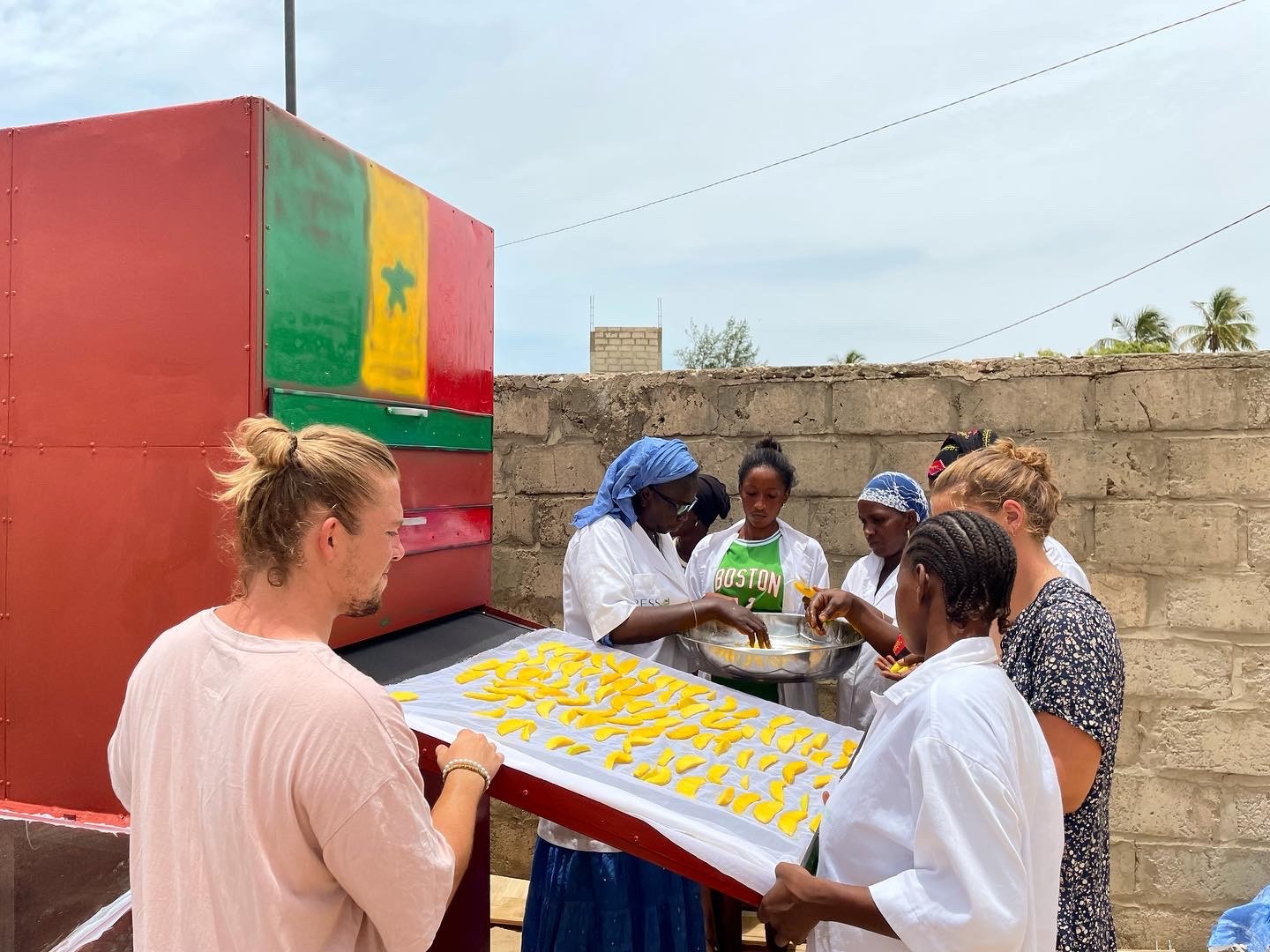
It all began with the ‘Solar Dryer’. The Save the Grain team is now working to realise a bigger vision. // Photo: Lenia Römer
“Innovation has a lasting impact when it reaches the places where it is needed. We want to work with local people and, together, create opportunities for fair value chains,” says Robin Schallenberg, explaining the vision behind the planned start-up.
After completing an apprenticeship as an industrial clerk, he studied business psychology in Cologne and is now working alongside mechanical engineer Marvin Maul at the University of Wuppertal on a solution that reduces food waste and supports the economic independence of farmers in sub-Saharan Africa.
Why are they doing this? “According to the APHLIS information system and the United Nations World Food Programme, up to 40 per cent of the harvest in sub-Saharan African agriculture is lost due to inadequate drying and storage,” explains Schallenberg. Furthermore, many farmers are heavily dependent on middlemen. “Without a direct link to local markets, they sell their harvest below its true value and often remain in such a precarious financial situation that they cannot, for example, afford the costs of sending their children to school,” he continues. For many, therefore, access to education is by no means a given. The two aspiring founders learnt this first-hand during a stay in Senegal.
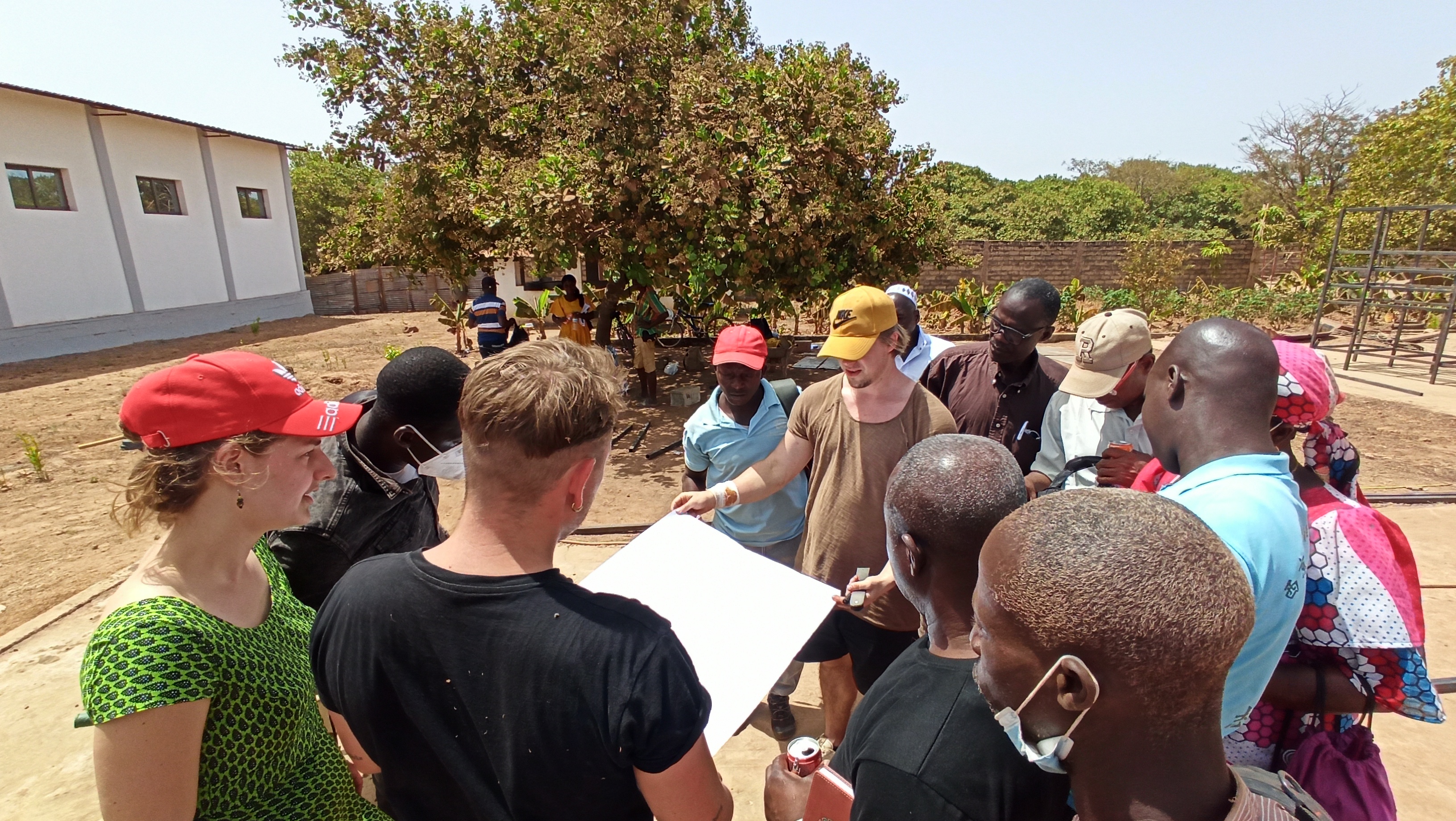
Robin Schallenberg (3rd from the left) and Marvin Maul (5th from the left) talking to representatives of the Ghanaian Ministry of Food and Agriculture. // Photo: Maximilian Krämer
Everything in one place
A lot has happened in the meantime: the idea of making a difference on the ground with local people has evolved into Save the Grain, a funded start-up and research project at the University of Wuppertal. The team’s portfolio already includes the ‘Solar Dryer’, a purely solar-powered drying system designed to reduce crop losses. “We want to take an even more holistic view of the value chain, which is how we came up with the idea for a production container that also operates without access to the mains electricity supply or petrol,” explains Marvin Maul.
Since then, Schallenberg and Maul have received support at the University of Wuppertal – from the Start-up Centre and the UNESCO Chair in Entrepreneurship and Intercultural Management, both headed by Prof. Dr Christine Volkmann, as well as the Chair in Electromobility and Energy Storage Systems, headed by Prof. Dr-Ing Benedikt Schmülling.
The Start-up Centre not only guides the team through the development of their start-up project, but also assists with applying for funding and setting up the start-up. A first milestone: together with the Start-up Centre, the Save the Grain team has secured funding under the Start-up Transfer.NRW programme.
The vision
The Solar Dryer dries the harvest; the dried produce is then processed and packaged directly in the production container. “Everything in one place, rather than selling the raw material unprocessed,” summarises Marvin Maul. The development of the individual modules is in full swing. On paper, the concept looks like this so far:
The container, which also operates without being connected to an external power supply, is equipped with stainless-steel work surfaces, systems for sorting and weighing the harvested produce, and a mill for powdered products. A hygiene chamber is being specifically installed to ensure hygienic production and thus lay the groundwork for future certification for export to Germany.
Packaging takes place directly on site using a vacuum sealer. All machines are powered either directly via the solar panel system or indirectly via a battery storage unit. “The key is to carefully balance how many machines are automated and how many are operated manually, so that we can produce as quickly as possible whilst consuming as little electricity as possible,” explains Marvin Maul.
For the farmers, this means they also take on the entire processing of their yield – sorting, grinding, packaging – and thus turn the dried harvest into finished, marketable products.
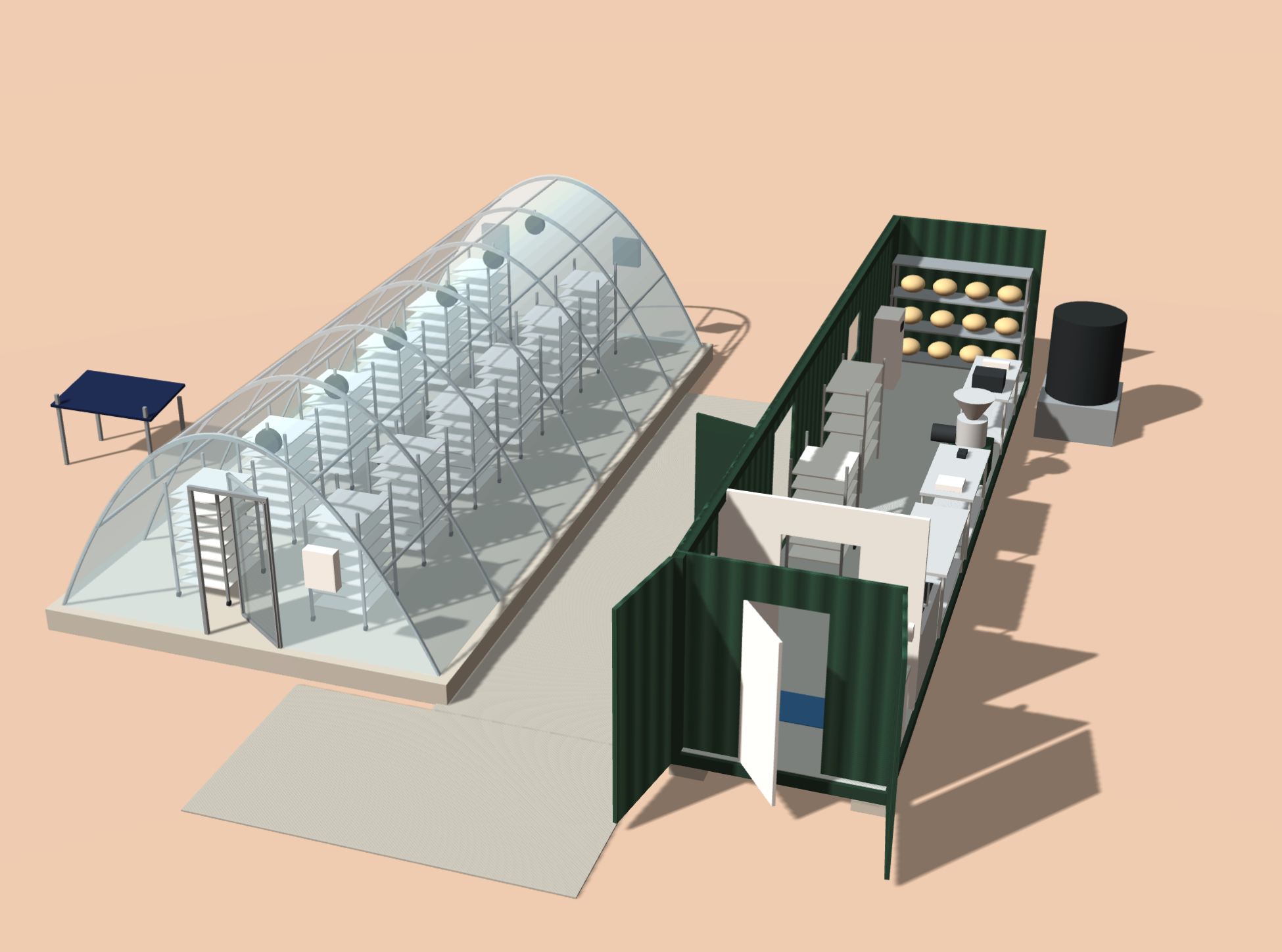
The concept behind the vision. The 3D model shows the components of the planned solar dryer and production container with hygiene airlock in Ghana. // Image: Save the Grain
Creating stability
According to Robin Schallenberg, this can lead to the creation of new, skilled jobs locally, offering new income opportunities. A higher proportion of the value added would remain with the farmers and in the region rather than with intermediaries. He emphasises: “With Save the Grain, we want to highlight ways forward and help ensure that local value creation in agriculture is a lasting success. Reducing harvest losses and enabling the processing of the yield are the first steps. Ideally, this will result in new brands and distribution structures, enabling farmers to supply European markets in future and thus secure their financial independence.”
Development of the container is due to be completed by spring 2027. The project team is currently seeking industrial partners to assist with the construction of the container, the establishment of a harvest distribution network to the retail sector, and the marketing and promotion of the products. It is also in contact with the Ghanaian Ministry of Agriculture to plan transport, set-up and deployment. “If everything goes to plan, we will set up the entire system on site in May 2027 and monitor its operation to learn more about its effectiveness. We are interested, for example, in how much crop losses are reduced, what the product quality is like, and what impact this has on the incomes of the participating farmers,” says Schallenberg, looking ahead. He and his project partner also intend to work closely with Ghanaian universities.
Looking ahead
The first container is the pilot project. If the results prove successful, the plan is to extend the model to West African countries. According to Schallenberg and Maul, countries in Asia or South America could also be of interest – always closely tailored to local needs and partner structures. “The idea is not a container network operated centrally by us, but a concept – thanks to the construction plans, training and operational model – that can be replicated and implemented by local partner organisations or cooperatives with our support,” summarise the two visionaries.
Save the Grain is funded as part of the ERDF / JTF programme in North Rhine-Westphalia via the Start-up Transfer.NRW programme.
Further information: www.savethegrain.de/



