EU funding worth millions
Much more than just decoration: the TROWI research project explores the almost forgotten history of houseplants

Junior lecturer Anne Sophie Overkamp, who has received an EU grant, will be researching the history of houseplants. // Photo: Friederike von Heyden
In her project TROWI – The TROpics on the WIndowsill, Anne Sophie Overkamp aims not only to trace the journey of subtropical and tropical plant species to Europe and to investigate their domestication and commercialisation, but also to gather new insights into the relationship between us humans and nature.
The assistant professor of the History of Science and Technology Research also impressed at EU level with her project and its significance: The European Research Council (ERC) has selected the researcher from the university of Wuppertal for one of its prestigious ERC Starting Grants in the latest funding round (see also info box). She is thus the first person in the School of Humanities to receive an ERC grant.
Highlighting connections
But why houseplants in particular? According to the researcher, they reveal just how closely everyday life and world history are intertwined. The spread of houseplant cultivation is directly linked to industrialisation and urbanisation on the one hand, and to imperialism and colonialism on the other. In TROWI, she is therefore taking a closer look at the period from the mid-19th century up to the Great Depression of 1929.
“For many people, having green plants in the home was a way of coming to terms with changing living conditions in the city and of countering the perceived alienation from nature,” reports Anne Sophie Overkamp.
Furthermore, many of these plants were only available because European powers were expanding their spheres of influence and appropriating resources from other regions. “The tropical and subtropical origins of many houseplants that we now take for granted have almost been forgotten,” Overkamp continues.
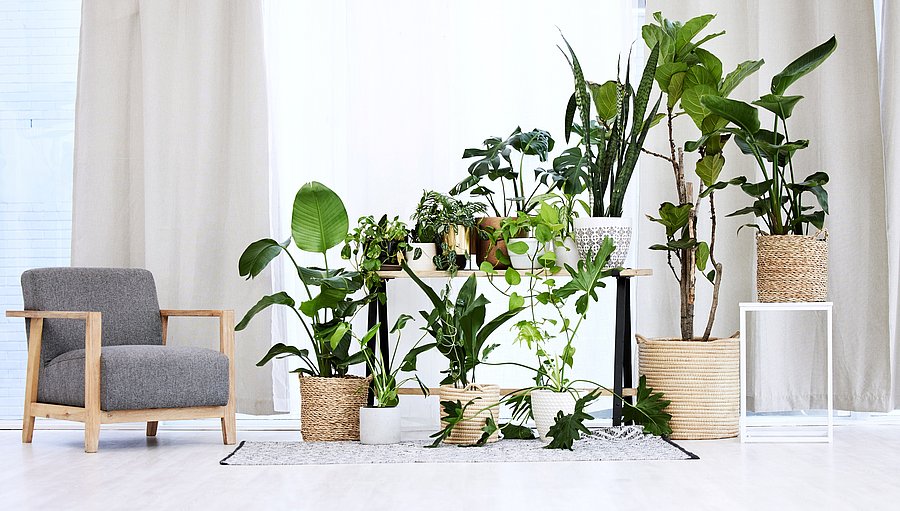
Houseplants brighten up our homes and make us feel at ease. Many people today are no longer even aware of where they come from. // Photo: Colourbox.de*
No trivial matter
She wants to change that, partly to use knowledge of the past to open up new perspectives on the present and the future. “TROWI is the first large-scale research project dedicated to houseplants. These are often seen as a minor issue. But they offer an original way of linking research questions that have, until now, mostly been considered in isolation. This is because the plants embody both global transfer processes and local practices of appropriation,” explains Anne Sophie Overkamp.
Overkamp makes it clear that her research can provide a new and comprehensive picture of how people shape the plant world – and, just as importantly, are shaped by it. The project is thus also intended to help us better understand what nature means in a globalised world and how nature reacts to human intervention.
To foster fresh ways of thinking, the research team deliberately places plants at the centre of their analysis. “From this perspective, in which plants are no longer seen merely as passive resources but as independent actors in history, we shed new light on familiar themes such as scientific progress, imperialism and gender roles.”
There are also plans for BUGA 2031
At TROWI, the five-member team combines approaches from the natural sciences and the humanities – ranging from botany through the history of science, technology and art to global history. Their research draws on contemporary seed and plant catalogues from major nurseries, historical horticultural journals such as Möller’s Deutsche Gärtner-Zeitung, the Belgian Journal d’Horticulture Pratique and the Botanical Magazine, as well as photographs, prints and advertising graphics.
“We examine these materials and, in doing so, can trace, for example, how plants originating from distant lands found their way into everyday European life, how they were bred and modified, and how their presence became visible there: When did they first appear in catalogues, how were they advertised in magazines, and what image, if any, was conveyed?”, the researcher summarises.
The findings are expected to include three academic books and several journal articles. In addition, the team is planning a publicly accessible website showcasing major commercial nurseries and plant cultivation in the 19th century.
Podcast interviews and an interactive exhibition – ideally as part of the 2031 Federal Horticultural Show in Wuppertal – are also planned to bring the research and its findings to a wider public.
Rector Prof Dr Birgitta Wolff, on behalf of the University management, warmly congratulates Anne Sophie Overkamp on this outstanding achievement: “Anne Sophie Overkamp’s ERC-funded project demonstrates how a novel research approach can shed new light on seemingly mundane aspects of everyday life, whilst addressing important questions about our relationship with nature, globalisation and social change.”
Further background: ERC Starting Grant
In the current funding round, 4,807 project proposals were submitted, of which only just over 8.8 per cent (421) will receive funding. Researchers will initially each receive a grant of 1.5 million euros for their Starting Grants. The funding will be made available over a period of five years.
ERC Starting Grants are aimed at outstanding early-career researchers at the start of an independent career: researchers of all nationalities with between two and seven years’ professional experience since completing their PhD, a promising academic career and an outstanding research project are eligible to apply. ERC Starting Grant calls for proposals are open to all topics and disciplines. Applications are assessed solely on the basis of scientific excellence.
Further facts, figures and background information: https://erc.europa.eu/news-events/news/erc-2026-starting-grants-results (ERC press release dated 3 September 2026)
* The rights to use the Colourbox image are held by the university of Wuppertal. It is not licensed for publication by third parties.