Practical and customised
Support for a successful start to your studies
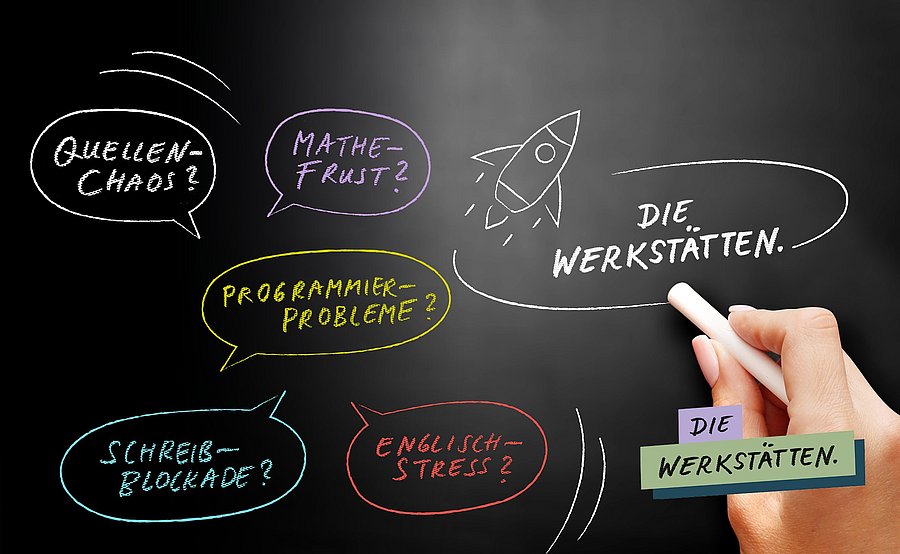
Photo dizain - stock.adobe.com
The focus is on the idea of facilitating the transition from school to university and at the same time creating a sustainable basis for the further course of study. The workshops offer numerous formats for this: from personal counselling and learning opportunities in small groups to digital tools and self-learning formats.
The five workshops cover key areas of expertise:
- The writing workshop wort.ort supports academic work from the ground up - from the first text to fine-tuning the style.
- The English Workshop strengthens confidence in dealing with English-language study content and academic communication.
- The "SourceLab" teaches research skills and promotes a critical approach to sources in times of information diversity.
- The maths learning centre MatZe! helps to build up mathematical foundations and develop independent solution strategies.
- In the Code_Bar programming workshop, the first steps in programming and small projects are taught in a practical way.
"The workshops are a central building block for a supportive, modern study environment. The offer is aimed at students from all disciplines and is deliberately introduced early on in the course of studies," explains Professor Susanne Buch, Vice-Rector for Studies and Teaching. At the same time, lecturers also benefit: "The workshops help students to refresh and expand their basic academic skills, which are necessary for a successful degree programme," says Buch.
In organisational terms, the workshops are part of the quality measures in the introductory phase of studies (QSP). This network builds on many years of experience from previous support programmes and is continuously being developed further. The aim is to sustainably ensure the ability to study and to promote academic success in the long term.
Studying at the BUW
Prospective students can choose from a diverse range of over 100 degree programmes at the University of Wuppertal. In addition to traditional subjects and disciplines such as architecture, design and art, computer science, mechanical engineering, music, psychology, sport and economics, there are also dual study programmes, interdisciplinary courses and special study programmes such as food chemistry, safety engineering and industrial design.
Applications for degree programmes with restricted admission are possible from mid-May (until 15 July). Prospective students can also enrol for open-admission degree programmes from mid-May (until 15 October).