
Staff news
New professor is researching how language shapes our view of the world
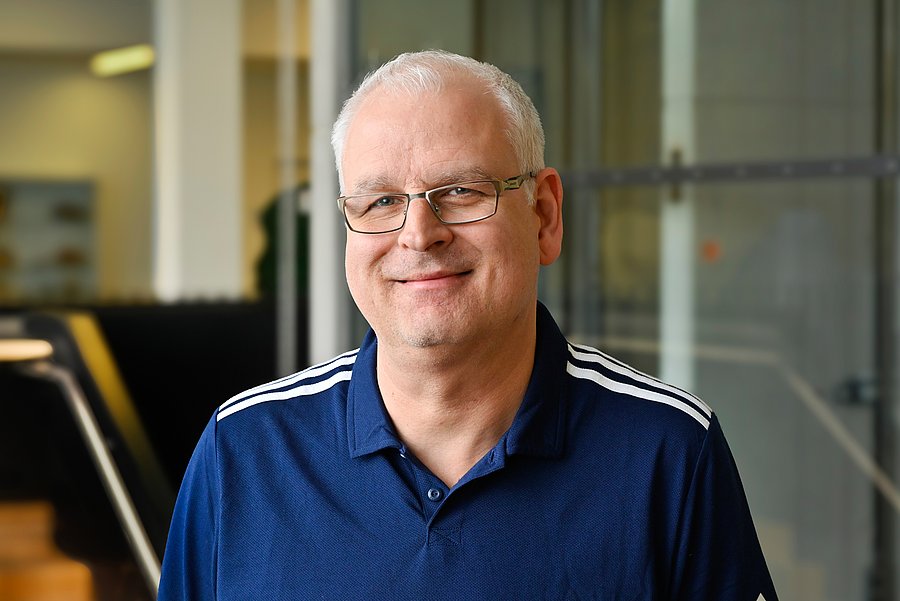
Prof. Dr Stefan Hinterwimmer // Photo: Michael Mutzberg
What does a sentence really mean? Whether a statement is meant ironically or what a pronoun refers to often depends on who is speaking, the context in which the statement is made, and what the people involved already know. Prof. Dr Stefan Hinterwimmer, the new Professor of German Linguistics at the University of Wuppertal, is researching how these factors interact.
“Language is more than just a collection of words and grammatical rules. It is only through the interplay with context and the speaker’s intentions that the meaning we ascribe to an utterance emerges,” says Hinterwimmer. His research combines semantics, which deals with linguistic meaning, with pragmatics, which examines how we understand utterances in their respective contexts.
When images and text interact
A key focus of his research is the question of how language conveys different perspectives. In this context, Hinterwimmer also examines the interplay between different forms of expression: How do spoken language and gestures complement one another? What message emerges when images and text work together – for example, in internet memes?
Together with Prof. Dr Cornelia Ebert from Goethe University Frankfurt, he is leading a research project on the construction of perspective in visual communication. It forms part of the ‘Visual Communication’ priority programme of the German Research Foundation (DFG).
How words shape social perceptions
Political debates also offer important points of reference for linguistic research. Why are terms such as ‘democracy’, ‘liberalism’ or ‘the people’ understood in different ways and contested politically? And how do linguistic formulations contribute to the establishment of enemy stereotypes? Hinterwimmer intends to focus more closely on these questions in future.
“Anyone who wants to understand how social conflicts are played out through language must look closely: which words are used, which groups are described and how – and what ideas are associated with them?” says Hinterwimmer.
He is also investigating how grammatical gender relates to social and biological gender. Another research project focuses on pronouns such as ‘das’, which refer to previous statements. Particularly in negative sentences, it can remain unclear to which part of the statement the pronoun refers. The projects form part of the Cologne Collaborative Research Centre ‘Prominence in Language’.
About the person
Prof. Dr Stefan Hinterwimmer previously served as an Academic Councillor in the Department of German Studies at the University of Wuppertal from 2019 to 2024. He subsequently took up a professorship in German Linguistics at the University of Hamburg, which he held until September 2026. He studied linguistics, philosophy and sociology at the University of Regensburg, obtained his PhD in linguistics from Humboldt University of Berlin in 2006, and completed his habilitation at the University of Cologne in 2015.


