Interview
Sustainability and diversity as a strategic task for the future
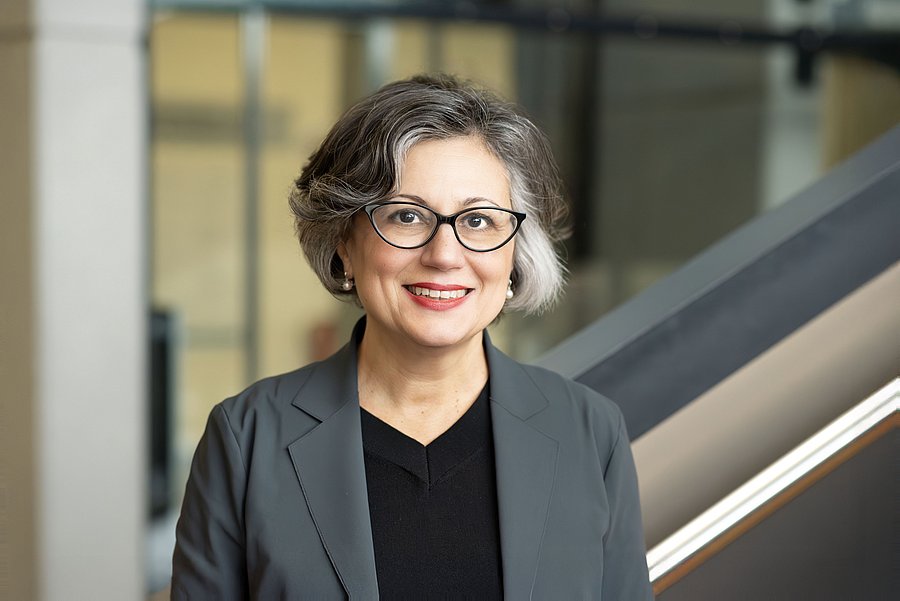
Professor Dr Rita Casale // Photo Friederike von Heyden
Professor Casale, you have been Vice-Rector for Sustainable Organisational Development and Diversity since the beginning of the year. How have you experienced your first few months in this role?
It has been a very intensive time, more intensive than I had imagined. The tasks that need to be mastered are different from those associated with a professorship. They require a different form of collegial cooperation and a kind of scientific translation. In addition, the area I am responsible for - sustainable organisational development and diversity - is not only diverse, but the associated topics are cross-cutting tasks that require a high degree of communication and coordination.
What motivated you personally to take on this task?
I am not only a philosopher and historian of education, but also a university researcher. The university as a public place of education plays a decisive role in my academic biography. In my role as a professor, I have tried to convey the significance of the university in terms of educational theory and educational history to several generations of students and doctoral candidates. Today, we are living in a historical phase in which it has become particularly important to remember this significance and to defend the university as an institution of public life. This conviction has prompted me to take on this task.
You have had many discussions within the university over the past few months. What impressions have you gained from them?
Yes, I have indeed had many conversations - and they have surprised and enriched me in many ways. I was particularly impressed by the clear willingness of department heads, heads of staff units and central institutions, as well as of officers, to consistently develop the university from a sustainable, inclusive and anti-discriminatory perspective.
Books have always been the most important source of knowledge in my life. They will remain so. However, in the numerous conversations I have had over the past few months, in the various meetings I have been allowed and required to attend, I have learnt a lot in other ways. This form of knowledge circulation - in exchange, in structured discussions and within an institutionalised framework - fascinates and enriches me greatly. I would like to keep an open mind for this.
Your department combines sustainable organisational development with diversity. What does that mean in concrete terms for a university?
I see a close connection between sustainability and diversity, both in systematic, theoretical and institutional and cultural terms. A great classic of economic and social transformation, Karl Marx, who was not a feminist or sustainability thinker, claimed in one of his early writings that the degree of civilisation of a society can be measured by the relationship that its members have to the opposite sex and to nature. I am still convinced of this today. Today, in relation to diversity, the relationship to what is considered foreign should be added. In cultural terms, this implies on the one hand a commitment to the tradition of the European Enlightenment, and on the other hand the need to clarify this tradition itself, more precisely with regard to its relationship to nature and diversity.
Establishing sustainability and diversity as cross-sectional tasks at the university means anchoring them in research, teaching and transfer beyond cultural fashions and political trends and establishing them institutionally with new formats and procedures in the long term.
In taking up this position, you are succeeding the "BUW pioneer" Professor Gertrud Oelerich. Which impulses are you picking up on, and which do you currently see as the particular focus of your work?
Starting from a sustainability perspective, I have a temporal, even historical understanding of knowledge acquisition as well as organisational and institutional development. I see my work as Vice-Rector for Sustainable Organisational Development as being in continuity with the work that my colleague Gertrud Oelerich did in the run-up to structuring and developing the area. I am deliberately drawing on this work because I am convinced that establishing new fields requires time and a certain continuity that must be thought of beyond the individuals who bear responsibility for a particular term of office. My predecessor was able to draw on years of established equal opportunities work and succeeded firstly in expanding this area with a focus on anti-discrimination and secondly in outlining the topic of sustainability as a central element of organisational development.
What will you be focussing on?
My current focus is on the heuristic structuring of the field of sustainability in teaching, research and transfer. Together with the sustainability officer at BUW, Julia Schumacher, we are developing a heuristic that will give visibility to the numerous activities on the topic of sustainability in these areas both within the university and publicly. On the one hand, it is intended to promote closer cooperation between teaching staff and researchers and, on the other, to provide civil society and other academic institutions with structured access to the various initiatives in this area.
In the field of diversity, I would like to anchor the topic of equality and diversity, which is excellently established at an institutional level, more firmly in research with the support of the Equal Opportunities and Diversity Unit headed by Sophie Charlott Ebert and in connection with the successful participation in the Women Professors Programme III and in cooperation with the Equal Opportunities Officer Prof. Dr Brigitte Halbfas.
Conversely, the topic of inclusion, which is already prominently represented in research, should also receive more attention at operational and institutional level in future.
If you look a few years ahead: How would you like to recognise for yourself that your efforts as vice-rector have been successful?
I would be satisfied if we succeed in anchoring sustainability as a cross-cutting issue and at the same time as a driver of ecological, social and economic transformation in the BUW's profile in the long term - despite the different political cycles. It is equally important to me to develop structures, teaching formats, research contexts and cooperation between the university and civil society during my term of office that will last beyond this period and can continue to develop.
I would be very pleased if I could also succeed in organising discussions between the university and the city in such a way that they make an intellectual contribution to public democratic life.