
Start-up
Overcoming crises together: the University of Wuppertal brings together expertise in the field of civil security research
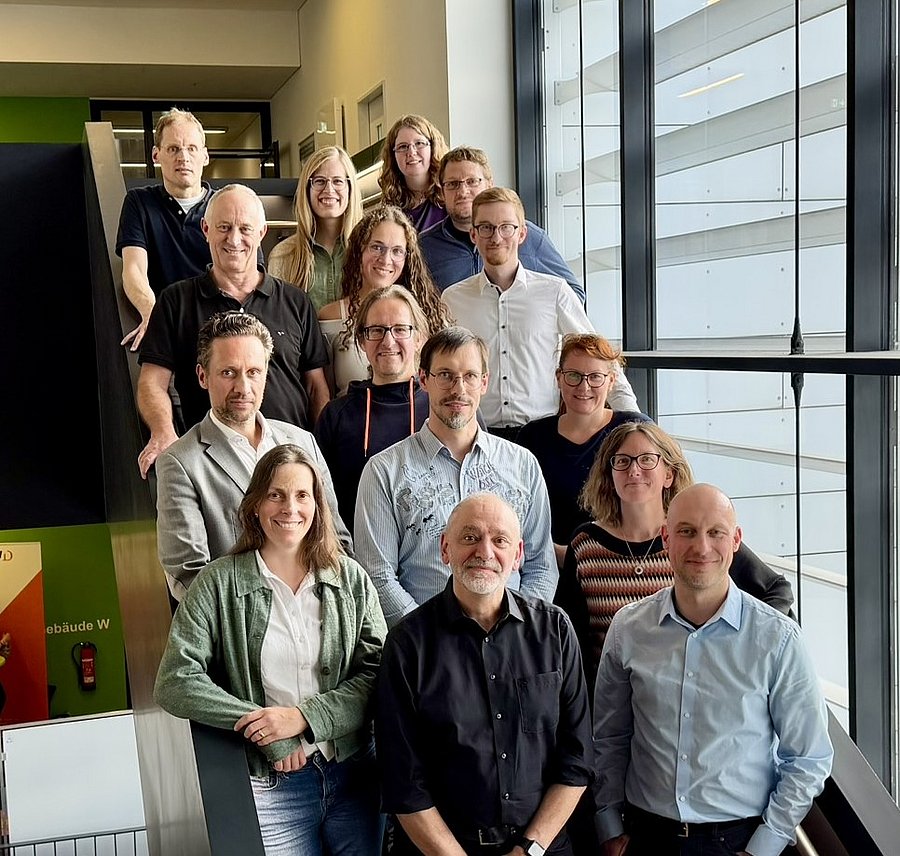
Fifteen professors and their teams will conduct joint research in the future at the newly established Interdisciplinary Center for Civil Security Research: (left, from top to bottom) Prof. Fabian Brännström, Prof. Armin Seyfried, Prof. Stefan Diestel, Prof. Anna Sieben, (center, from top to bottom) Dr. Mira von der Linde, Dr. Francesca Müller, Prof. Lukas Arnold, Dipl.-Ing. Benjamin Dymel, Prof. Frank Fiedrich, (right, from top to bottom) Dr. Marloes Venema, Prof. Tibor Jager, M. Sc. Jakob Wieland, Prof. Nicola Fricke, Dr. Sylvia Bach, and Prof. Meinald Thielsch. The photo was taken at the last working meeting. Not pictured: Prof. Anna Baumert, Prof. Maria Behrens, Prof. Roland Goertz, Prof. Peter Imbusch, Prof. Anke Kahl, and Prof. Markus Zdrallek. // Photo Muhammed Enes Bodur
Recent years have made it clear that modern societies are exposed to a growing number of crises, risks and threats, the dynamics, complexity and interdependence of which are intensifying. Global developments such as geopolitical tensions, the consequences of climate change, pandemics, technological dependencies and digital vulnerabilities have a direct impact on the state, the economy and society, and can disrupt fundamental aspects of daily life.
“Against this backdrop, the ability to identify risks at an early stage, take preventive action, remain capable of responding and strengthen societal resilience is of paramount importance,” emphasises Prof. Dr Frank Fiedrich. At the University of Wuppertal (BUW), he heads the Department of Civil Protection, Disaster Relief and Facility Security and co-chairs the newly established centre alongside his colleagues Prof. Dr Anna Sieben and Prof. Dr Meinald Thielsch.
A long tradition
The field of (civil) security has been an important area of research at the University of Wuppertal for many years. With its Department of Security Engineering, which celebrated its 50th anniversary last year, the University of Wuppertal possesses a key unique selling point within the academic landscape. In addition, other researchers address topics relating to civil security and crisis and disaster research from the perspective of their respective disciplines. This includes, amongst other things, research into natural, fire and cyber hazards, conflict research, the behaviour of people and organisations in critical situations, and societal violence – including its threat to democracy.
“This is where we are starting with the establishment of the Interdisciplinary Centre for Civil Security Research. Together, we want to further harness the potential of our existing expertise by intensifying current activities and developing new research collaborations – including beyond the university,” explains Prof. Anna Sieben.
The psychologist, who, alongside her professorship at the University of Wuppertal, heads the ‘Social Psychology in Pedestrian Dynamics’ department at the Jülich Research Centre, is currently conducting research – for example, with her BUW colleague Prof. Dr Anna Baumert – into the factors that influence whether people prepare for crises, whilst also examining existing civil protection concepts.
Understanding interrelationships
A holistic approach to the subject matter is important to the members. Occupational and environmental psychologist Prof. Meinald Thielsch explains it as follows: “When it comes to hazard prevention and system security, we aim to take all conceivable threats into account comprehensively – regardless of whether they are of natural, technical or human origin. We examine hazards within their contexts, thereby aiming to gain new insights and make contributions that, for example, help prepare the public and local authorities or benefit the work of crisis management teams and emergency services.” In the case of wildfires, for example, this could mean using computer simulations to gain a deeper understanding of how they spread, whilst also investigating their impact on critical infrastructure and society.
Focusing on the next generation
Furthermore, the centre’s members focus on supporting the next generation of researchers. In the long term, this includes the training of PhD students and postdocs, as well as the early involvement of junior professors, alongside the organisation of academic events such as lecture series, conferences or summer schools.
“Through the Interdisciplinary Centres, the University of Wuppertal is creating spaces where researchers can collaborate to shape innovative research addressing societal challenges. With the new Interdisciplinary Centre for Civil Security Research, we are sharpening our research profile in this unique field, which is so important for shaping our future and, surprisingly, is all too often neglected at other research institutions in the state,” sums up Prof. Dr Stefan Kirsch, Vice-Rector for Research and Digital Affairs at the University of Wuppertal.


