Added value for society
Invisible success with a major impact

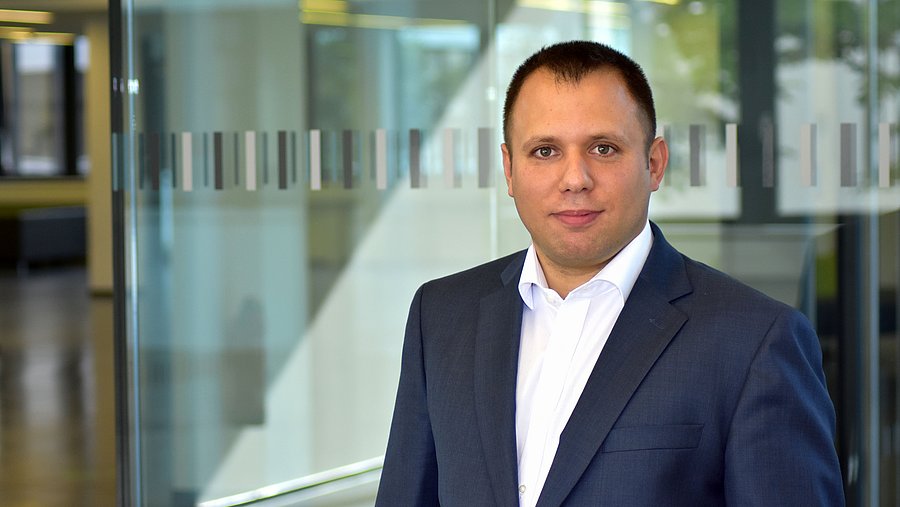
The Chair of Finance and Corporate Governance at the University of Wuppertal actually focuses on sector analyses of private-sector companies. The ‘Economic Barometer’ project, carried out in collaboration with the Bergisch municipal savings banks, is a well-known example of this. “We examine the structures and developments within these sectors nationwide, but also with a particular focus on the Bergisch city triangle,” explains Markus Doumet, senior academic officer at the Chair. Consequently, the enquiry from the Association of Independent Welfare Organisations presented a particular challenge, which subsequently led to a new project.
“When we, as an institute, set about examining what the independent welfare organisations actually do, we quickly realised that the methods we normally use here would not work in that context,” says the economist. “After all, these are not traditional, privately organised companies that operate primarily with the aim of making a profit. That’s why we needed a different analytical approach here.”
Together with six leading umbrella organisations of the independent welfare sector in the Bergisch city triangle – AWO, Caritas, Der Paritätische, the German Red Cross, Diakonie and the Welfare Association of the Jewish Community – the project ‘The economic significance of the independent welfare sector in the Bergisch city triangle’ was finally launched.
Non-profit organisations provide added value to society
All the organisations and providers examined as part of the project are non-profit and committed to the common good. “They do not make a profit, but rather provide added value for society. They meet social needs in the welfare sector,” explains Doumet. Consequently, the success of independent welfare organisations cannot be measured by business metrics, as the services provided and their effects are not visible within the organisation itself, but are evident in society.
The special status of independent welfare organisations under the principle of subsidiarity
The principle of subsidiarity – which states that a higher-level entity should only intervene if a lower-level entity cannot fulfil a task independently – grants independent welfare organisations a special status in the fulfilment of welfare state tasks. Doumet comments: “The principle of subsidiarity in itself is a fundamental principle that we have in a federal state.” He adds that this makes particular sense. The aim is to find a local solution to a local need or problem. “And that is beneficial, first and foremost, because it promotes personal responsibility amongst citizens. It leads to a tailored solution being found for the specific local problem, in line with actual needs,” says Doumet.
Independent welfare organisations also take precedence when it comes to the provision of services, another aspect of the principle of subsidiarity. When it comes to whether a local authority commissions a service from a private-sector provider or from independent welfare organisations, it has historically been the case – and is also a political choice – that the state gives priority to non-profit organisations. “However, this does not mean that independent welfare organisations can do as they please; rather, there is a legal framework within which they operate. Furthermore, not all costs are always covered,” explains the researcher.
Doumet illustrates this using the example of a nursery. “In the case of a nursery, this is based on the number of children, their ages and the level of care provided. And the local and regional funding allocated to this is very clearly limited. Independent welfare organisations have no choice but to operate according to economic principles, because otherwise they would be unable to cover their costs.” Furthermore, over the last ten years – spurred on by changes in legislation – there have been efforts to encourage competition between independent providers themselves, as well as with private-sector providers, wherever possible.
Volunteering is on the wane
Two key tasks of the independent welfare sector involve representing the interests of socially disadvantaged groups and mobilising voluntary engagement. Whilst the first group is growing, engagement within the second group is declining, particularly in traditional clubs. “It is fundamentally true that voluntary engagement at club level is on the decline,” confirms the researcher, adding: “The nature of voluntary engagement has changed. There is less long-term commitment in clubs; young people, in particular, tend to get involved on a short-term, project-based basis.” This, in turn, poses a challenge for independent welfare organisations, as they have traditionally relied on long-term voluntary work. “So they need to reinvent themselves to some extent, adapt to this new form of engagement and try to develop different, new initiatives, particularly for young people.”
The economic significance of independent welfare organisations
The voluntary welfare sector is one of the largest employers and thus a key factor in the region’s economic development, yet it receives little attention in public debate. “When the project began, we had no idea of the scale involved,” notes Doumet, “but if you look at employment relationships subject to social security contributions, ten per cent of these are in the social services sector. A large proportion of this is also attributable to the independent welfare sector. If this key sector were to disappear, one in ten people in employment would be out of work.”
Every euro invested in the work of independent welfare organisations yields a manifold return through direct and indirect social effects. This measurement of social impact can be illustrated using the example of childcare centres. “If you take a childcare centre, it’s relatively easy to calculate the costs,” says Doumet. This is because a nursery must operate according to business principles, and its funding can also be mapped out relatively easily, as it consists mainly of state and local authority funds. “Own funds are added to this, but even that can all be calculated,” says Doumet.
The financial cycle
To assess the benefits, the project team conducted interviews with nursery staff, the nursery management, the children’s parents and other family members to understand what it means for each individual when a child has a place at a nursery. The result is a financial cycle:
There are three key effects.
Firstly, the employment of nursery staff. These are jobs subject to social security contributions. The money that flows into the nursery and is paid out to staff in the form of wages and salaries thus returns to the economic cycle and, in part, back into the public budget. As the majority of staff also live in the Bergisch City Triangle and the neighbouring municipalities, the money stays in the local area.
Then there are the parents. The moment a child starts attending a nursery, parents have more time and can take up employment or work longer hours. The researchers have also examined the consequences that would arise if a child were unable to attend a nursery. Doumet: “For two-parent households, this would mean that the person with the lower-paid job would have to cut back on it even further or even give it up altogether.” That income would be lost – not just immediately, but perhaps in the long term as well. The situation is even worse for single parents, who may not even have grandparents nearby; they would then suddenly be reliant on social security systems, placing an additional strain on the public purse.
Finally, the researchers highlight a crucial effect on the children themselves: “In the Bergisch city triangle, we have a very high proportion of children for whom German is not their mother tongue at home. This means that, for these children in particular, engaging with the German language by speaking with their peers is absolutely vital, and it helps them later on in a school context – entirely independently of the ‘Kitakonzept’ educational approach,” summarises Doumet. If one considers the impact of this effect alone on educational opportunities at primary school age and subsequently in secondary school, it is immense. “These are early childhood educational effects; they do not have an immediate impact, but they are long-lasting and very powerful, and this naturally also has consequences for entry into working life and overall future earnings.”
All this is difficult to quantify, yet the researchers have attempted to work with a model that at least gives an indication of the cost-benefit effect. “This brings us back to the field we work on at the department, namely finance. A euro generated in twenty years’ time has a different value to a euro that has immediate value,” Doumet sums up. And if you look at that and compare it with the immediate costs, you arrive at a benefit of between 4.60 and 6.60 euros for every euro invested in childcare centres.
The social significance of independent welfare services
The project translates the social impact of social work into comprehensible key figures, going beyond traditional, often purely cost-based assessments. Independent welfare organisations thus form an indispensable part of the social infrastructure in the Bergisch city triangle. Doumet emphasises that the significance of the social and economic commitment of independent welfare organisations lies in their role as employers and commissioning bodies. “They are also a major economic player. Time and again, particularly when it comes to the funding of independent welfare organisations, the issue of costs arises. The public budget only ever looks at the costs. What we have tried to do is establish a method that can demonstrate what the societal costs are – as well as the costs to the public budget – should a measure be implemented or not.”
To avoid long-term societal costs, Doumet stresses that public debate must always ask whether short-term savings in the public budget might not lead to significantly higher societal costs in the future; this, he emphasises, is the advantage of this project, as it takes a long-term view of the issue.
* The rights to use the Colourbox image are held by the University of Wuppertal. It is not licensed for publication by third parties.
Transfer stories
This article is also published by the University Communications department at the University of Wuppertal. The ‘Bergische Transfer Stories’ use numerous examples to illustrate how researchers actively shape society, the economy, the region and everyday life through their findings.
You can find the full article on the UniService Third Mission website.