Best Start-up
Expertise for the Energy Transition: Wuppertal Business Award Honors University Spin-Off
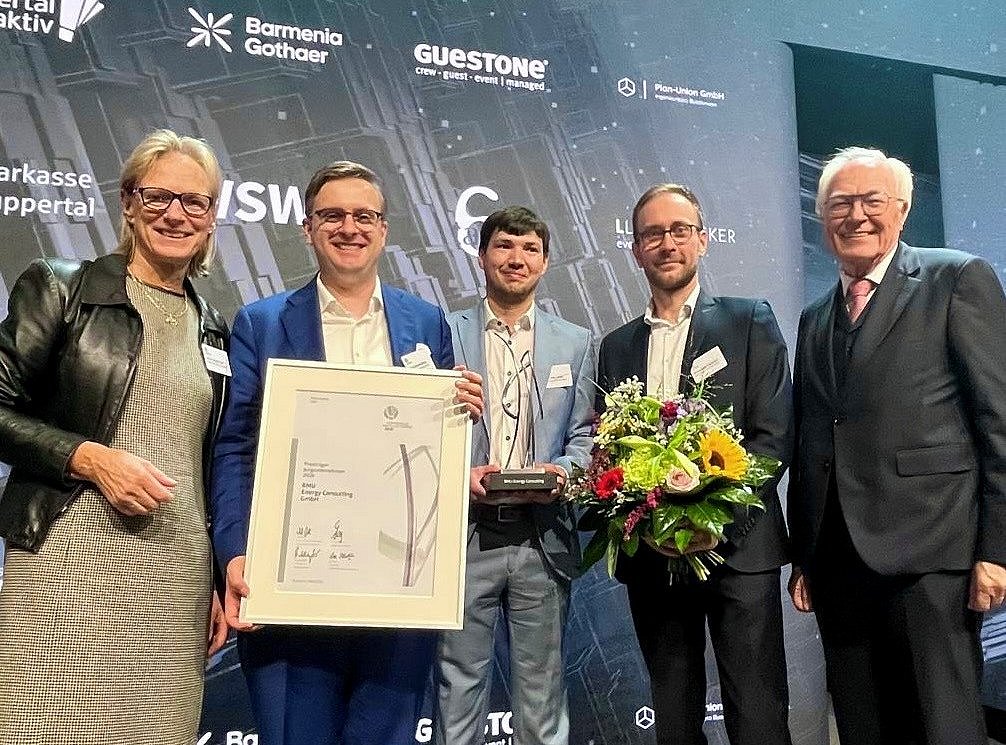
Among the first to offer congratulations were University Rector Prof Dr Birgitta Wolff (left) and University Council Chair Dr. Josef Beutelmann (right), along with the trio of managing directors of the university spin-off: Michael Becker, Tobias Müller, and Björn Uhlemeyer. // Photo by Christina Semke
“The award for our BUW alumni beautifully highlights the practical impact of university knowledge. Spin-offs, such as BMU Energy Consulting, contribute to our mission of making innovative knowledge accessible to society and thereby helping to solve pressing challenges,” summed up University Rector Prof Dr Birgitta Wolff at the award ceremony, which took place under the patronage of Wuppertal’s Mayor Miriam Scherff in the Glass Hall of the Stadtsparkasse Wuppertal.
Markus Hilkenbach, Chairman of the Board of WSW Wuppertaler Stadtwerke, emphasised in his laudatory speech: “BMU Energy Consulting GmbH combines scientific excellence with practical applicability, thereby providing guidance to local authorities, energy suppliers and network operators at a time when such guidance has become invaluable. We here in Wuppertal can be proud of that.”
A service for everyone
The founders, Michael Becker, Björn Uhlemeyer and Tobias Müller, have a background in university research. BMU Energy Consulting was established in 2023 as an offshoot of the Chair of Electrical Power Supply Engineering at the University of Wuppertal, which focuses on research into the energy transition. “The idea to set up the company arose when we realised that the topics we had been researching three or four years ago were now becoming relevant in practice,” reports Michael Becker. He cites municipal heating planning as an example: in recent years, this has evolved from a research topic into a concrete task for towns and local authorities, and is now a key component of strategic planning for future heating supply.
Michael Becker: “We find it immensely appealing to now offer our knowledge and experience from the many research projects we have already carried out as a service from which everyone who lives and works in a city can benefit.”
The link with the university is invaluable and therefore remains firmly embedded within the company: for the founding trio, regular dialogue with their academic mentor and chair holder, Prof. Dr Markus Zdrallek, is a key part of their work. “By keeping our finger on the pulse of scientific research and regularly discussing current developments in the energy sector with Prof. Zdrallek and his team, we are able to advise local authorities, municipal utilities and network operators on their path to climate neutrality with a forward-looking perspective and based on the latest scientific methods,” says Björn Uhlemeyer.
Various building blocks are brought together
The young entrepreneurs’ services are not limited to the field of heat supply alone, but also take its wider implications into account. For example, the operation of heat pumps places a massive additional strain on the electricity grid. “During our time at university, we took a holistic view of the energy infrastructure and led various projects that support the reliable expansion of renewable energies and climate-neutral technologies across all areas of energy demand,” explains Tobias Müller. The three managing directors are now pooling these areas of expertise, together with their staff, to support various stakeholders in the energy sector in tackling the upcoming challenges of the energy, mobility and heating transitions. The scope of work now ranges from district heating network planning, through gas network strategies and holistic neighbourhood planning and energy master planning, to the analysis of the resilience of energy networks.
“For me, BMU Energy Consulting GmbH is a prime example of successful knowledge transfer: this is how scientific findings create tangible benefits in real life – in this case, for heat supply in our towns and local communities,” says Prof. Zdrallek.
The Wuppertal Business Award is one of the city of Wuppertal’s most prestigious honours, presented annually to recognise outstanding companies and entrepreneurs. It highlights exceptional achievements in the areas of sustainability, growth and innovation that contribute to sustainable development and quality of life in Wuppertal. The prize is jointly awarded by Stadtsparkasse Wuppertal, the Economic Development Agency, wuppertalaktiv and Wuppertal Marketing GmbH.
Three questions for BMU Energy Consulting
What exactly does ‘municipal heat planning’ mean?
Tobias Müller: The overarching goal is for Germany to be climate-neutral by 2045 – in other words, to no longer emit climate-damaging greenhouse gases such as CO₂. To achieve this, our heat supply must also gradually move away from fossil fuels such as natural gas and crude oil and rely more heavily on renewable energies and other climate-neutral heat sources. Municipalities must therefore submit a heat plan by 2026 or 2028, depending on their size. It is important to note that municipal heating plans do not constitute a blanket ban on heating systems, nor do they impose an automatic obligation to replace existing heating systems. Rather, it is a roadmap that identifies local potential and gives the local authority an overview of where, for example, district heating networks might be appropriate – perhaps because many buildings are close together and a suitable heat source is available. The use of waste heat from industry or data centres can also play a role here.
And that’s where you come in?
Björn Uhlemeyer: Exactly. We sit down with the city administration, the municipal utilities and other relevant stakeholders. Based on the data provided to us by the cities, we examine the local conditions: What is the population density in the individual districts? How much industry is there locally? How high is energy consumption? And what heat sources are available? On this basis, we draw up the heating plan and can, for example, highlight in which areas a district heating network might be practical and cost-effective.
We also organise information events for residents. After all, raising awareness and gaining the support of the local people – for whom the planning is ultimately being carried out – are key components of such a project. It is interesting to see how attitudes have evolved at these events: when we started, there was significantly more resistance. Many people were worried that they would be forced into something. Now, however, we’re finding that interest is much more often the driving factor. Many realise that changes are needed in energy supply and are increasingly coming to understand the opportunities that heating planning opens up for their local community – and therefore for them personally.
So what happens next?
Michael Becker: Our findings include specific measures that we recommend, which the towns and energy suppliers or network operators can then prioritise and implement. Because we take into account cost-effectiveness, practicality and local circumstances, the local authority ultimately ends up with a plan that it can use to take concrete further action.
If, for example, we identify potential for a heating network in an area, the local authority can then examine that area in more detail. This raises specific questions: Who will build and operate the heating network? Where will the heat come from? How should the network be dimensioned and planned? And how will the heat travel from the source through the distribution pipes to the property connection? We can also support local authorities with this further planning.
Heat planning must be regularly updated. This makes sense because new developments and potential may arise in a few years’ time, whilst at the same time the prioritised projects from the previous planning phase will have been further developed or implemented. In this way, the local authority moves step by step towards the goal of a climate-neutral and, as far as possible, cost-effective heat supply.
For us, however, it doesn’t stop there. We also support towns, energy suppliers and network operators with the subsequent issues arising from municipal heating planning. For example, with specific heating network planning or in addressing the question of how they should proceed with the gas network. We have also been working for some time on integrating municipal heating planning into an energy master plan, as well as on comprehensive analyses and concepts for entire neighbourhoods.