
More than just football
The University of Wuppertal awards Manuel Neukirchner an honorary doctorate

At the gala event, Manuel Neukirchner gave a talk entitled ‘Like the sulking Achilles’ – phenomenological reflections on the
culture of football. // Photos: Friederike von Heyden
Football as a mirror of society, as an object of cultural memory and as a subject for literature and art: the Faculty of Humanities and Cultural Studies at the University of Wuppertal has awarded Manuel Neukirchner an honorary doctorate in recognition of his outstanding achievements in this field.
“His work has raised Germany’s cultural self-portrayal as a footballing nation to a new level and has provided a fresh interpretation of the popular phenomenon of football through the lens of the humanities and cultural studies,” said Germanist Prof. Dr Matías Martínez, who had proposed Neukirchner for the honour.
“Examining football from a humanities and cultural studies perspective is a rather unusual approach, which Manuel Neukirchner embodies very convincingly. Deriving insights from this that also shed light on commonalities within society is a matter of great importance to us all,” emphasised Vice-Chancellor Prof. Dr Birgitta Wolff in her welcome address. “I would like to thank the Faculty of Humanities and Cultural Studies for this original initiative.”

University Vice-Chancellor Prof. Dr Birgitta Wolff (left) and Dean Prof. Dr Ursula Kocher (second from the right) presented Manuel Neukirchner (second from the left) with his doctoral certificate. The laudatory address was delivered by Germanist Prof. Dr Matías Martínez.
From a student in Wuppertal to Director of the German Football Museum
Manuel Neukirchner, born in 1967, studied General Literary Studies, Modern German Literary History and History at the University of Wuppertal. After completing his Master’s degree, he initially worked as a print and radio journalist. From 2009 to 2015, as its founding director, he was responsible for the architectural, scenographic and content-related realisation of the German Football Museum in Dortmund. He has been in charge of the museum since its opening in 2015.
Under Neukirchner’s leadership, a museum has been created that is unique in the world. “It does not reduce football to sporting successes, legendary matches and great personalities. Rather, the exhibitions also shed light on the social, political and aesthetic dimensions of the sport. Topics such as migration, national identity, the culture of remembrance, diversity and dealing with anti-Semitism find their place there just as much as the history of German football,” explains Prof. Martínez.
With its distinctive exhibition design, the museum combines historical documents and artefacts with multimedia and immersive forms of presentation. It thus sees itself not only as a place of remembrance, but also as a space for social debate.
Football between literature, art and history
Neukirchner’s work extends far beyond the conception and management of the museum. As an author and editor, he has produced numerous publications on the cultural history of football. Neukirchner has also broken new ground as a playwright. His play*Die Nacht von Sevilla* (2022) reconstructs the dramatic 1982 World Cup semi-final between Germany and France using documentary sources and a variety of voices. Facts from sporting history, emotions and the memory of a match of extraordinary drama are woven together in this play. At the ceremony held at the University of Wuppertal, this work was given a special presence through a staged reading by actor Peter Lohmeyer.
A bridge between academia and the public
In its justification for the honour, the faculty particularly highlights Neukirchner’s contribution to communicating insights from the humanities and cultural studies to a wide audience. Through the German Football Museum, he has shaped an institution that links sporting history with literary, artistic, media and social history, whilst addressing socially relevant issues.
Prof. Martínez on the significance of Neukirchner’s work and the faculty’s decision: “Manuel Neukirchner has pioneered a field that is steadily gaining relevance in cultural studies research whilst also reaching a wide audience. He is a bridge-builder between academic research and the wider public. His work sheds light on the historical, cultural and political dimensions of football, thereby contributing to cultural education and critical reflection within our society.”
For Neukirchner himself, the honour also has a personal dimension: he has ties to the University of Wuppertal through his own studies. In an interview, he spoke to us about his memories of studying in Wuppertal, what the honorary doctorate means to him personally, and his work on the subject of football.
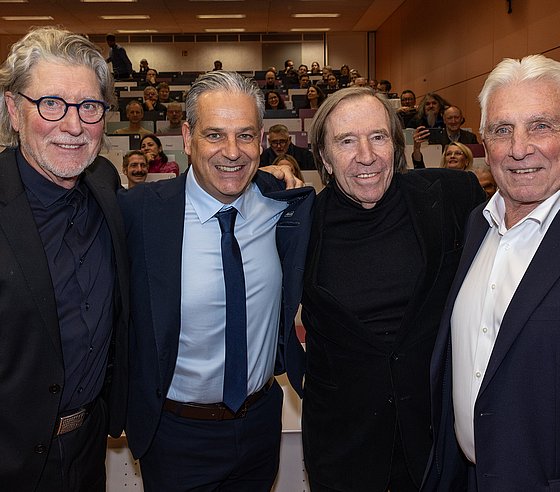
Here to congratulate Manuel Neukirchner (2nd from left): Toni Schumacher (left), Günter Netzer (3rd from left) and Klaus Fischer (right). // Photo: Carsten Kobow

Vice-Chancellor Birgitta Wolff presented the new honorary doctorate recipient with the Bergische University ‘jersey’.

Ceremony in Lecture Theatre 32 on the Grifflenberg Campus (from left to right): Prof. Dr Matías Martínez, Günter Netzer, Prof. Dr Ursula Kocher, Dr Hagen W. Lippe-Weißenfeld, Head of the Cultural Affairs Department for the City of Wuppertal, Vice-Chancellor Prof. Dr Birgitta Wolff, Toni Schumacher, Dr h. c. Manuel Neukirchner, Erwin and Helmut Kremers, Klaus Fischer and Peter Lohmeyer.

Günter Netzer congratulated Manuel Neukirchner on this special honour.

FABU board member Andreas Mucke (right) presented Manuel Neukirchner with honorary membership of the university’s alumni association, together with Christina Semke, Head of UniService Third Mission.

Prof. Dr Matías Martínez delivered the laudatory address.

Actor Peter Lohmeyer brought the evening to a fitting close with a staged reading from Manuel Neukirchner’s documentary-style football drama *Die Nacht von Sevilla*.


