“effort+flow”
A moment of realisation with a fun twist: the best time in sheep herding goes to BUW student Till Lehnen
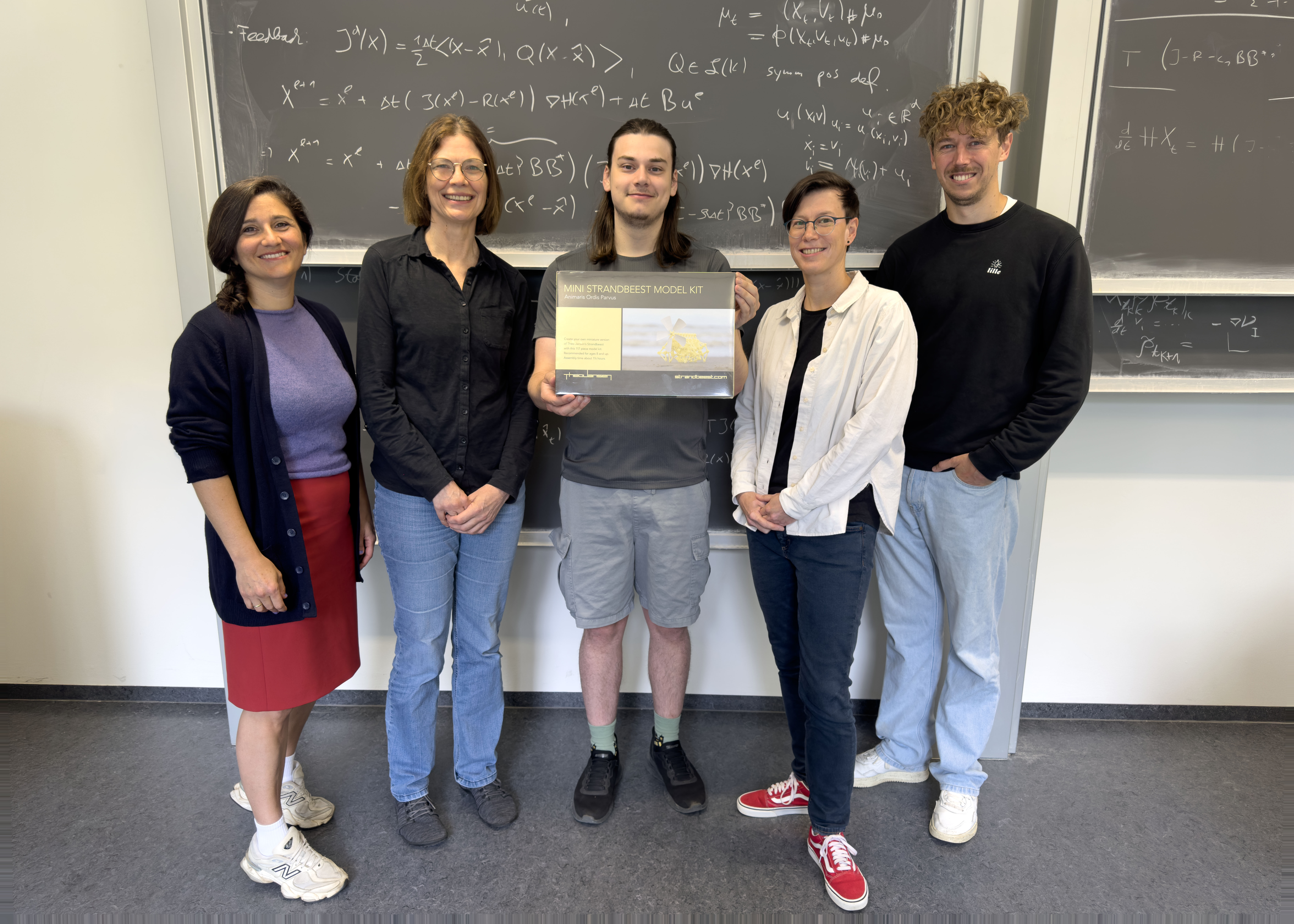
At the awards ceremony, the organising team behind the ‘effort+flow’ exhibition gathered once again to congratulate BUW student Till Lehnen (centre): (from left) Ariane Dehghan (Kunsthalle Barmen), Professor Birgit Jacob, Professor Claudia Totzeck and Merlin Schmitz (members of the Collaborative Research Centre). // Photo: Marylen Reschop
It took Till Lehnen 32.3 seconds to use a controller to guide the sheepdog on the screen through a flock of sheep in such a way that, in the end, all the sheep found their way to the correct pen. “After playing a few times, you eventually work out how the sheep react to the dog’s path and can optimise your control,” explains the architecture student.
This is precisely the aim that Professor Dr Claudia Totzeck and her research group are pursuing with the game. “We’re conducting research into what are known as interacting particle systems – in other words, mathematical models that describe the collective behaviour of many individual components. For the exhibition, we asked ourselves how we could make this visible,” explains the mathematician.
They found the solution in an ‘aha’ moment that’s both fun and addictive. The game, programmed by computer science student Justin Dawa, is based on the algorithms that Totzeck and her team work with on a daily basis. “When the dog runs, it drives the sheep apart in a certain way. You learn to understand and utilise this force whilst playing,” says Totzeck. The game is set to be used in future as well, helping many more people to grasp the concept.
Till Lehnen’s hard-fought best time earned him not only the highest praise from the exhibition organisers, but also a special prize: a DIY model of the ‘Ordis’ beach beast by artist Theo Jansen. “The original was also part of the exhibition: a large structure made up of many individual parts that moves – powered solely by wind,” explains Prof. Dr Birgit Jacob, spokesperson for the Collaborative Research Centre.
Normally, the beach beasts can be seen on Dutch beaches. One of them, in miniature form, will now remain in Wuppertal, at Till Lehnen’s home. Assembling the 117 individual parts is likely to take longer than 32.3 seconds, however.
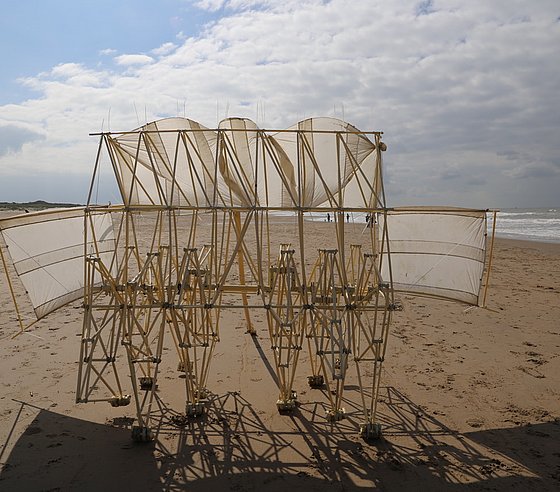
Celebrities on a Dutch beach: the ‘Beach Beasts’, here ‘Ordis’, by artist Theo Jansen. // Photo: Theo Jansen
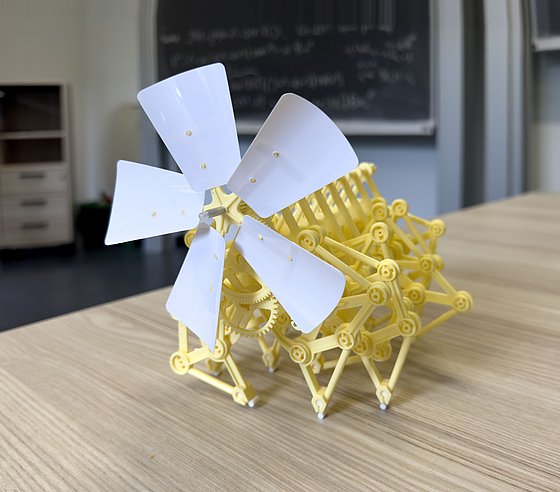
A mini beach beast to assemble: this is what BUW student Till Lehnen’s entry is meant to look like when finished. // Photo: Marylen Reschop