Travel report: Berlin Part 2
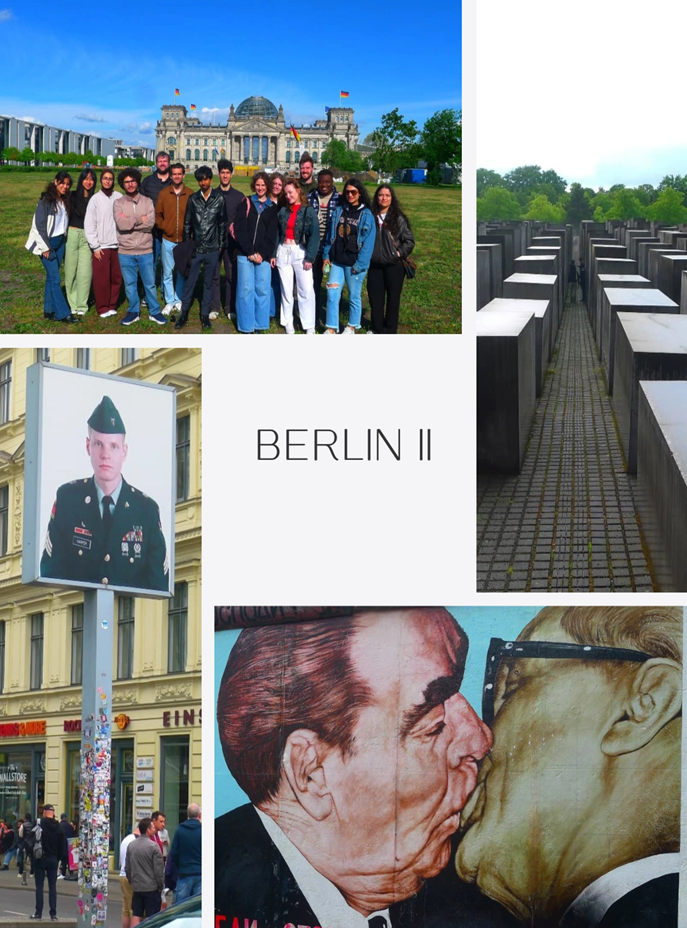
In May 2025, the International Students Team (IST) at the University of Wuppertal went back to the German capital for a second time. Under the title "Berlin - City of Remembrance", this trip was all about political education and exploring Germany's history in the 20th century.
Politics and German history
One of the first highlights was a visit to the German Cathedral on Gendarmenmarkt. During a guided tour, we were given an overview of the development of German democracy and the eventful history of the political system. The exhibition linked historical events with current issues relating to the state, society, and responsibility-an exciting start that stimulated discussion within the group.
Places of remembrance
We then delved deeper into the history of National Socialism and the Cold War. The guided tour of the Berlin Wall Memorial on Bernauer Strasse was particularly impressive. Here, the division of Berlin is visible in all its drama - from escape attempts and the fates of individual families to the political tensions between East and West.
The East Side Gallery, the longest remaining section of the Berlin Wall, was also on our itinerary again. This time, however, the focus was less on the colourful artwork and more on the stories about the Wall as a symbol of separation and, at the same time, as a place of creative processing.
Another important chapter in our exploration was a visit to the Topography of Terror, located on the site of the former SS and Gestapo headquarters. The exhibition illustrated how persecution, terror, and violence were systematically organised under National Socialism.
Berlin Story Bunker and Checkpoint Charlie
At the Berlin Story Bunker, we experienced an intense exhibition that depicts the rise and crimes of National Socialism in detail. In the unusual atmosphere of the bunker, history became particularly tangible and oppressive at the same time.
The subsequent visit to Checkpoint Charlie, once one of the most famous border crossings between East and West Berlin, took us back to the Cold War era. Here, it became clear how much Berlin was a focal point of global political conflicts for decades.
Conclusion
The second part of our stay in Berlin impressively demonstrated why Berlin is still considered the "city of remembrance" today. Through guided tours, exhibitions, and historical sites, we dealt intensively with the darkest chapters of German history and the consequences of division.
For many international and German students, the trip was not only a historical learning experience, but also an impetus to reflect on democracy, freedom, and responsibility in the present.