10 years of Literary Encounters - Les Rencontres Littéraires
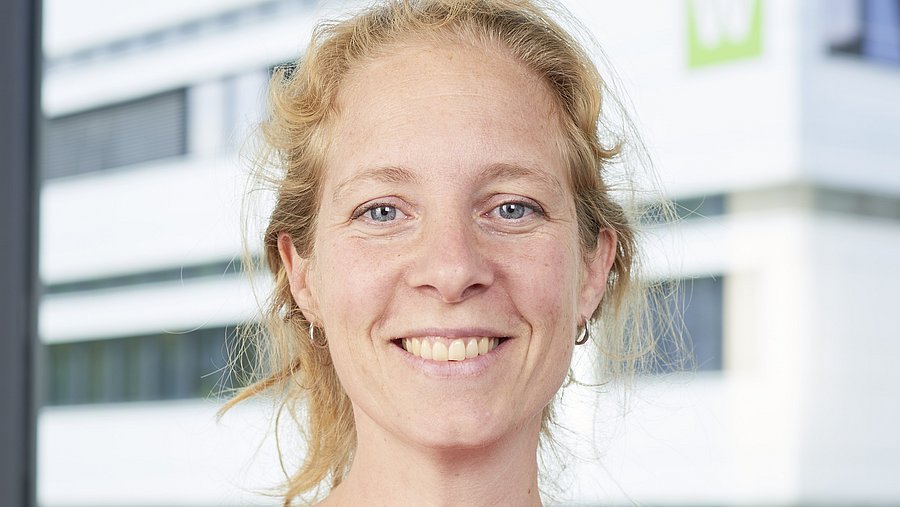
Marie Cravageot / Romance Studies
Photo: Jan Wengenroth
10 years of ‘Les Rencontres Littéraires’
Marie Cravageot on the anniversary of a successful series of events on contemporary French literature
The “Rencontres Littéraires” series has been running at the University of Wuppertal for 10 years now. How did it all start back then?
Marie Cravageot: The project began with an invitation of the writer Jean-Philippe Toussaint by Stephan Nowotnick. He met the students of the Department of Romance Studies. The meeting quickly led to further invitations in the following semesters, making this event open to the public and attracting more and more participants not only from the university, but also from the city of Wuppertal and the surrounding area. From the very beginning, the aim was to offer the opportunity to exchange ideas with renowned writers of contemporary French literature. The common thread of this event was to look at the guests’ entire oeuvre and not just a single book in order to recognise some of the central features of their writing. And this wish still exists today! This is the unanimous feedback from our guests, who are pleased that our project has a different format to the events they attend in bookshops to mark the publication of a book. The discussion we hold about several books to explore a ’author’s writing desk is indeed a unique concept!
The remarkable thing about this series is that the students also come into personal contact with well-known writers of contemporary literature. What criteria do you use to select the guests?
Marie Cravageot: Several criteria play a role in the selection of guests. The first concerns the attractiveness for students of Romance studies. As each literary meeting is integrated into a seminar and the students prepare presentations for this occasion, it is important that the texts of these authors are accessible and also thematically interesting. The second criterion concerns the diversity of the guests. Contemporary French literature is rich in so many different talents with very different backgrounds, especially when you think of the Francophone region spread over five continents, that it seems important to us to reflect this diversity in our encounters. It is also important that our guests are also of interest to a broad audience outside the university. For this reason, we invite authors who have been honoured with major literary prizes and thus offer the opportunity to meet authors who are already very present in the press and who are already known by many Francophones and Francophiles from Wuppertal and the surrounding area.
I have to admit that I have only very rarely received rejections to my invitations in recent years, and each time it was mainly for organisational reasons with a scheduling problem. It is always a great pleasure for me to come into contact with so many talented authors.
This rendezvous with contemporary authors now also attracts interested citizens from the valley. Where do the meetings take place?
Marie Cravageot: The Rencontres littéraires still take place at the university, on the Grifflenberg campus, in the church at the university (Gaußstr. 4). It is a very beautiful hall that is ideally suited for this exchange. We welcome our students and colleagues from the university there, of course, but also numerous participants of different ages and backgrounds who come from Wuppertal, but also from the surrounding area, sometimes even from more distant cities in North Rhine-Westphalia. The unique opportunity to meet these famous authors in person is a must for many, especially because this event is held in French. In fact, there are sometimes other readings and talks with French authors in the region, in bookshops or in French institutes. These always take place with the publications of German translations. This idea is also very good, but in this sense our concept is unique because of the language. Many people are happy to be able to deepen the discussions without translation. However, these literary encounters are by no means academic, even if they take place at the university. The aim is to offer a convivial moment of exchange about contemporary French literature. There is always a very pleasant atmosphere. Participants have the opportunity to buy books (in French) by the author and have them signed. And of course, the event ends with our traditional aperitif, which is always very popular with the participants!
It is important to add that each Rencontre is broadcast live online via Zoom. Over the years, we have gained many loyal participants who follow our events from other cities in Germany, but also from faraway countries such as Canada, the Ivory Coast, etc. We now have registrations from 15 different countries and every time all eyes are on Wuppertal! It’s interesting to see that this project brings people from all over the world together. And I’m very happy about that!
A colleague of yours told me years ago that the status of a writer is different in France than in Germany. What is the reason for this?
Marie Cravageot: Yes, I would say that beyond the status of writers, the status of literature in general is also different. Without going into historical details, it is indeed interesting to emphasise the visibility of authors in France in society in general. Take, for example, the literary television programme La grande librairie (The Big Bookshop), which has been broadcast every Wednesday in prime time for over twenty years. It is not only very successful, but also a reference for anyone interested in literature - both the general public and critics and professionals in the field. It is true that many writers are guests in all areas of the press and their voices are sometimes heard beyond the literary field. Think of the Nobel Prize winner Annie Ernaux, who regularly publishes columns in the press and shows her political and social commitment as well as Nicolas Mathieu, who has many followers on his Instagram account and publishes numerous thoughts on current topics. This is indeed reminiscent of writers such as Victor Hugo and Émile Zola, who were also strongly committed to political and social causes in their time, but nowadays of course with their own characteristics and using modern means. But yes, contrary to popular belief, the French read a lot of literature, are very interested in their authors, and love to exchange ideas with them when they have the opportunity. And that’s exactly what we notice during our literary encounters!
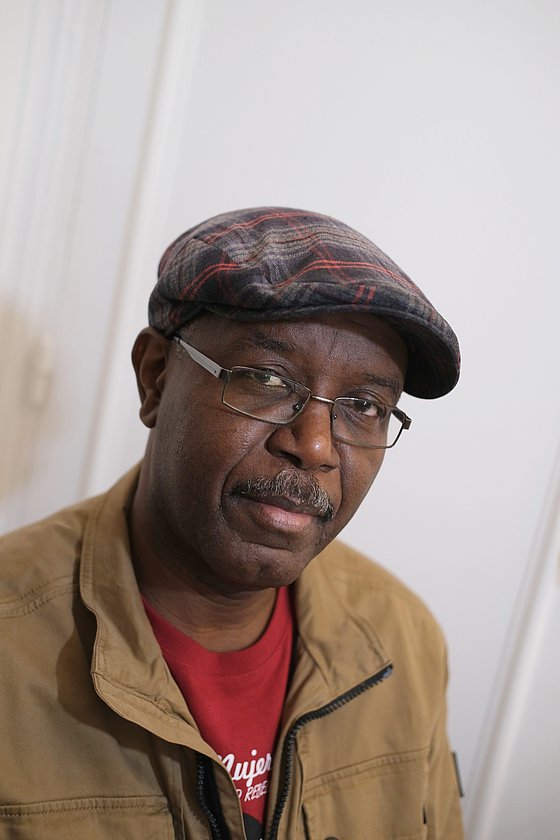
Louis-Philippe Dalembert
Photo: S. Bassouls
This year, a great author of contemporary French literature is coming to University of Wuppertal for the event. Why don’t you introduce the man?
Marie Cravageot: The desire to reflect the diversity and richness of contemporary literature in French in our project has led us to explore very different literary fields, whether with authors whose work is more than 30 years old or with young authors who are already very present on the literary scene. For some, their involvement in literary collectives such as the “Collectif Inculte” was very interesting, I’m thinking of Jérôme Ferrari, Maylis de Kerangal, Hélène Gaudy or Oliver Rohe. For others, the themes of their works or certain characteristics of their writing style were able to build bridges between our guests themselves, I’m thinking of Nicolas Mathieu and Marie-Hélène Lafon, who are directly linked to Annie Ernaux’s work because of the social discourse in their works. Others are simply great masters of literature, such as Laurent Gaudé, Sylvain Prudhomme, Tanguy Viel or Jean-Philippe Toussaint.
And then, in the context of our French literature and culture courses in Romance Studies, we have endeavoured to give a voice to writers from French-speaking countries, with writers from Morocco, Mauritius, etc. - but also writers with a migrant background such as Laura Alcoba or Maryam Madjidi, for whom French is both a language of exile and their written language.
In this spirit, the Haitian writer Louis-Philippe Dalembert will be the next guest of the Rencontres littéraires. Louis-Philippe Dalembert is not only a writer, but also a novelist, poet and essayist. He was born in Port-au-Prince in 1962 and grew up there. Since his childhood, he has been surrounded by literature, Haitian poetry, and cinema. Having lived through the dictatorship, he believed in committed literature from a young age and published his first work at the age of 19. After studying literature and journalism, he left Haiti in 1986 and moved to France.
His often bilingual works (French and Haitian Creole) deal with universal themes that are influenced by his travels and his connection to different cultures. He was awarded the Prix Goncourt de la poésie in 2024 for his complete works. He has received numerous French and international literary awards. Among others, he received the Prix Goncourt de la poésie (prestigious literary prize in France) for his complete works in 2024 and the Literary prize of the Fondation Prince Pierre de Monaco in 2025. These prizes make him a writer of international renown!
What will be your central theme this year? When does this Rencontre littéraire begin, and where can people find out more?
Marie Cravageot: Childhood occupies a central place in Louis-Philippe Dalembert’s work. In Le crayon du bon Dieu n’a pas de gomme (The pencil of God has no eraser), for example, where he talks about his childhood in the Caribbean, it serves as an introduction to his literary work. Therefore, his texts, just like his childhood, are characterised by the strong presence of women, religion, but also by the absence of a father.
His work and his life are also characterised by wandering. Louis-Philippe Dalembert, who has lived in Haiti, France, Italy, Jerusalem and Berlin, has characters who dream of other places, such as in Mur Méditerranée ( The Blue Wall, Nagel & Kimche, 2021), where he portrays three women from different social and religious backgrounds who are linked by their experience of exile.
And it is precisely this central theme that will be discussed at our meeting on the basis of several texts by Dalembert: the foreign and the rejection of confinement. On the occasion of his visit to Wuppertal, the author writes: ”Today, the question ‘‘Where are you speaking from‘‘ takes the form - and above all the tone - of an invitation to remain silent in the face of any human experience other than one’s own. It is as if we are moving from a physical wall between countries to ever more impermeable barriers between people; from the withdrawal of nation states into themselves to a diversity of humanities that goes beyond anything that already separated identities. While it is certainly appropriate to understand these phenomena and question their origins, it seems to me that it is our task as writers to ask ourselves how we should respond, if not from a political point of view - in the broadest sense of the word - then at least from an aesthetic point of view. How can we continue to speak about the world and humanity with empathy and in complete freedom? How can we express our own sensibility in harmony with that of others in order to describe our common humanity? I made this decision when I first published about thirty years ago. It was this refusal to assign an identity, and therefore to compartmentalise, that led me to write novels such as Mur Méditerranée, Ballade d’un amour inachevé or Une histoire romain; or a collection of poems such as, for example, En marche sur la terre. I have always believed in it and continue to believe in it, even if it means going against the strong headwinds of fashion and convention. Otherwise, art and literature would be pointless in my eyes.” This will be the central theme of the discussion, supplemented by text passages read aloud by the author himself.
The project has now been running for ten years. How do you look back on this project as a whole? And how will it continue?
Marie Cravageot: Over the years, the aim has always been to improve the project, and it has indeed developed very positively. I will give some examples of significant changes below. Firstly, however, I would like to point out something that has never changed and that is the very warm and friendly atmosphere at every Rencontre. Even if we sometimes choose complex and topical issues or the authors talk at length about their work, each event remains first and foremost a moment in which everyone can have their say and the exchange is very pleasant.
The most remarkable dimension that has developed over time is undoubtedly the international orientation of the project. This applies not only to the profile of the guests, who come from France and many other French-speaking countries, but also to the participants who take part in our events, which sometimes take place thousands of kilometres away from Wuppertal.
Another important aspect is the number of collaborations that have developed over time. At each meeting, we can count on the financial support of numerous partners. This project has created an incredible network and it is a real pleasure to work closely with all these people.
I would also like to emphasise that twenty-two authors have already been guests in Wuppertal over the last ten years, as a Rencontre takes place on average once a semester. Each event was recorded and carefully transcribed. The result of this work will be published in the form of a book in a few weeks’ time. I am very pleased that the publication, entitled Écritures françaises d’aujourd’hui. Les rencontres de Wuppertal , published by the French publisher Presses Universitaires de Rennes, is a wonderful gift to mark this anniversary. The book is a collection of lectures the authors gave on their literary work, exchanges with the public and a detailed introduction that provides an overview of contemporary French literature. It is a book that should be of interest to a wide audience, both literary enthusiasts and professionals.
We have not yet come to an end, the project continues! We are ready for the next ten years. I would like to thank Stephan Nowotnick for bringing this wonderful project to life and I am sure that it has many more successful years ahead of it.
Uwe Blass
Marie Cravageot teaches French literature at the School of Humanities and Cultural Studies. She is an expert on contemporary French literature.