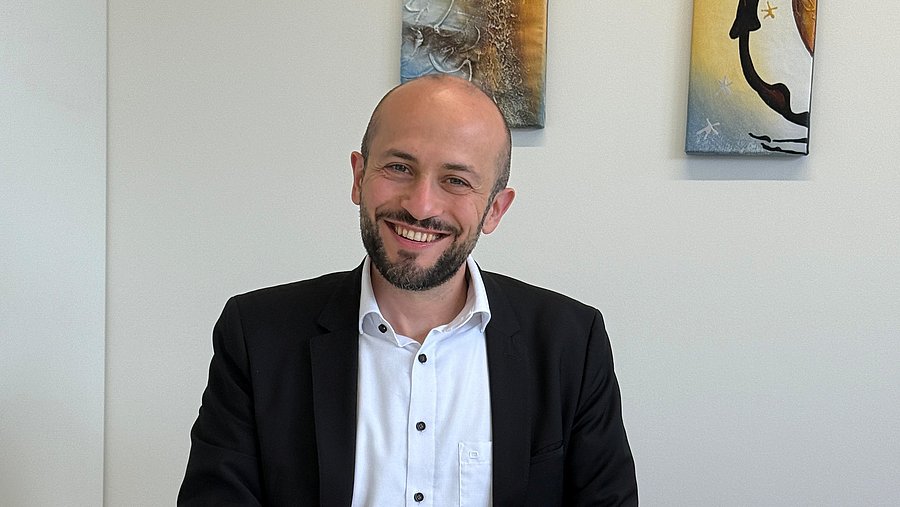
Success knows no origin
Prof Dr Bilal Gökce / Mechanical Engineering
Photo: Gökce
Setbacks are learning experiences
Professor Bilal Gökce from the University of Wuppertal on his motivational book “Erfolg kennt keine Herkunft” (”Success knows no origin”)
“At Wuppertal schools, we have a migration rate of almost 65%. Demographics show that we will continue to have more and more pupils from educationally disadvantaged households in the future,” Professor Bilal Gökce from the University of Wuppertal says. Although the current figures for 2025 are not yet available, the trend points to a further increase in the proportion of pupils with a migrant background throughout North Rhine-Westphalia. Gökce knows the worries and hardships of children from educationally disadvantaged households and has now written the book ’Erfolg kennt keine Herkunft’ (Success knows no origin), which is intended to motivate pupils on their way to a successful future.
Chair of Materials Science and Additive Manufacturing
Bilal Gökce’s Chair of Materials Science and Additive Manufacturing is actually concerned with the development and research of new materials for 3D printing, which primarily involves technological applications of metallic materials and plastics. “This goes as far as nuclear fusion. We are researching materials for nuclear fusion, materials for electromobility or implants, where the aim is to increase biocompatibility, among other things. We then develop materials that can also be absorbed by the body, i.e., biomedical materials.”
It all started with TikTok and Instagram
The 41-year-old scientist is also active on social media, where he gives talks and shares his experiences with users. “I am known as @profinsight (Profinsight is the social media presence of Prof Dr Bilal Gökce. He uses it to share his experiences and inspire young people, editor's note) on TikTok and Instagram,” he explains. “After my live broadcasts, which are about studying, educational advancement, and motivation, I often received questions about how you can go your own way despite hurdles and the request to write it all down.” This request was the initial spark for writing the book. “The title 'Success knows no origin' means that everyone has the chance to make it. Of course, there are barriers, which I also address, but the book is a motivational book,” he explains. It is intended to motivate people without academic background and migrants, children and adults, to go far. “The book is structured in such a way that I guide people and back it up with anecdotes from my own life. This way the whole thing more authentic. I have travelled this path myself and know the problems. I know what is particularly important for this target group, and that’s what I write about in this book.”
From working-class child to university professor
Gökce knows what he is talking about. He is happy to cite examples from his past that show the self-doubt and difficulties he himself had to deal with. “For me, it was a balancing act between financial problems, self-doubt, and the constant feeling of not belonging.” In addition, of course, there is always everyday racism in many places and you have to realise one thing: “For a child from a non-academic household or for an immigrant child, going to university is a step into a completely new world. Attending the opening week was the first time I had ever been to a university. In other words, I had no previous experience and I didn’t know the academic system at all because I had no academic role models. I was the first person in my family to finish university. I had to find my way around on my own and that was a big act. University is self-study, there is no longer any guidance like you know it from school. Today I also see it from the professor’s side. And if you don’t have any role models or mentors, it’s very difficult.” However, the natural scientist persevered, also with the support of his family. ”I really believed that success, and the associated social advancement, would bring me closer to my goals, because I’m a very determined person. The other point is very clear, I had friends, mentors, and my family who supported me.” Above all, the words of his father, a first-generation migrant worker in the 1960s, have always motivated him. ”’Bilal, make something of yourself so you don’t have to do the backbreaking work that I do,’ he said. He was always proud of me and fully supported my career.”
Self-doubt, even though migrant children are German
Migrant children often have self-doubt and there are two reasons for this, Gökce says. “On the one hand, as migrant children, we feel the social pressure, especially now in the current social climate. Well, I'm German, many of these children with a migrant background are German, their families are often second and third generation settlers in Germany. And yet you are told: ’You are welcome if you work, if you achieve something’. However, this shouldn’t be a condition if we are German. You don’t say that to Germans without a migration background either. Then you get that feeling of not belonging again. And I often address this in my book and in my lectures.” Gökce has even noticed this social pressure within his family with his underage son, which leads to self-doubt. In addition, the children of migrant workers naturally want to show their parents that it was worth coming here so that they are proud of their offspring. “But that also builds up enormous pressure and that can be unhealthy in the long run,” Gökce says, “I also realise this in my conversations with young people. And when someone goes to university and gets their first bad grades, this feeling of not belonging immediately pops up again and they think: ‘Maybe this isn’t my path after all, maybe I don’t belong here’. Doubts are understandable, but you have to learn to deal with them and use them as strength to continue on your path.”
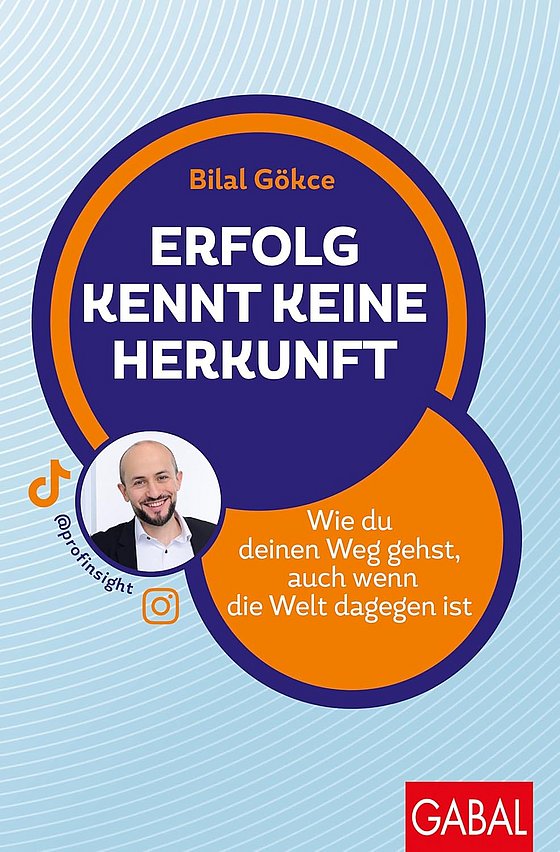
Book cover 'Success knows no origin' by Bilal Gökce
Small steps to self-confidence
Gökce’s book offers help and exercises that can be used to overcome obstacles because, as he has learnt, “you often see certain psychological effects that are more pronounced in migrant children and children from non-academic households. They are shyer and insecure and are reluctant to leave their comfort zone. I dedicated a whole chapter to this topic in my book. In psychology, there is exposure therapy (exposure therapy, also known as confrontation therapy, is a method of behavioural therapy in which patients are specifically exposed to fear-inducing stimuli in order to reduce anxiety, editor’s note), which is about taking small steps to get out of your comfort zone.” This could be, for example, approaching a stranger, which can be a obstacle for an introvert, or having a cup of coffee in a different pub. “You first have to realise that it’s not that difficult, then you slowly overcome your fear. I’m always talking about myself, because I’m also a rather introverted person. When I spoke live on TikTok for the first time a year ago, it took me an enormous amount of effort. However, you have a lot of people listening to you, and that’s always a responsibility. Then I realised that I enjoy it. That’s why you have to try things out."
Have goals
Discipline and perseverance have to be built up slowly. This is why goal-oriented work is very important. “You have to have goals in mind,” the scientist says, but many young people don't have any goals yet. “I see this phenomenon in many people who graduate from high school but don’t know what they would like to work or study. They don’t have a plan, and that’s not nice.” Although plans don't have to be set in stone, having plans is motivating and leads to discipline. “If you want to achieve something, you think twice or three times about not working that day after all or studying for the exam, because you know that this learning, what I'm currently doing, will lead to me successfully completing this semester, successfully completing my studies and then getting my dream job and maybe even finding fulfilment in it.” Furthermore, you also have to take setbacks into account. “I myself failed eight out of ten exams in the first two semesters. I could have given up, but I stayed on the ball, went my own way and even graduated within the standard period of study. Setbacks are learning experiences.”
Finding talent
Gökce says: “Especially in times of skills shortages, the country needs young talent." And he is certain that these talents are available, they just need to be discovered. "There are statistics that show that there are many gifted and talented people in every population. And then you ask yourself: ‘Where are all these people who might even have the potential of Albert Einstein or Marie Curie?’ They simply haven’t been discovered. And that’s the task for me and for all teachers.” The talents themselves could also help themselves by trying things out, really doing internships, going abroad as students or doing voluntary work. "I can’t know if I would have been a great hockey player if I had never played hockey. Some things you can’t experience without trying them out.” And some talents are not so easy to find in our social climate. He gives an example: “When I have job advertisements at the university for PhD students or postdocs, I have potential applicants, i.e., highly qualified people, who write to me and ask: Is Germany a safe country for us? I could never have imagined hearing something like that before and that Germany has such an image abroad in some regions. However, the political situation is getting around abroad.”
Motivational talks also possible at schools
Gökce regularly gives a lecture entitled ’Without role models to the top - how non-academic children realise their dreams’. This is particularly aimed at pupils and students who find themselves in similar life situations and is intended to encourage them to believe in themselves and resolutely follow their own path. He has already reached more than 1,300 listeners at around 15 universities. ”The response has been very positive and I also do it for my own benefit, because I love motivating people because it motivates me, too. People often respond by saying that they felt seen, and they often write to me afterwards. They then say things like: ‘Thanks to your lecture, I passed the exam’, or ‘I was about to drop out of university, but thanks to you, I carried on and realised that I could do it after all’. And this is very fulfilling. I see motivating people as my job. If time allows, I also like to give my talks at schools.”
Book tip (in German available only):
Bilal Gökce
Erfolg kennt keine Herkunft
Wie du deinen Weg gehst, auch wenn die Welt dagegen ist
GABAL-Verlag 2025
Also available as an e-book
Uwe Blass
Bilal Gökce is professor of materials and additive manufacturing at the School of Mechanical Engineering and Safety Engineering at the University of Wuppertal.