
First serial liquorice production in Germany
Prof Dr Julia Bornhorst / Food Chemistry
Photo: Sebastian Jarych
1925 - First serial liquorice production in Germany
Food chemist Julia Bornhorst on the use of liquorice root
What is liquorice actually made of?
Julia Bornhorst: Liquorice is obtained as an extract from the root of the liquorice plant. It is harvested, grated, extracted and then further processed as a raw liquorice mass, depending on the desired product. The thickened root extract is often mixed with sugar, glucose syrup, flour and potato starch. The flavour of liquorice ranges from extremely sweet to intensely salty. And flavourings such as aniseed oil, fennel or menthol are often added to cater for different tastes. For the very salty flavours, ammonia (ammonium chloride) is sometimes added. The black colour that liquorice sweets usually have is sometimes artificially enhanced with the colouring agent E 153, i.e. activated charcoal. Liquorice is an extremely versatile sweet, as it can be processed into sweets, sticks, syrup or powder.
In our part of the world, the expression "to grate liquorice" has been coined. What do you mean by that?
Julia Bornhorst: People like to use this saying to flatter someone. And this saying really comes from liquorice, because the liquorice root is grated and used to be used as a sweetener, due to the sweetener glycyrrhizin. Because liquorice tastes sweet, this was symbolically transferred to 'sweet words' . The flattering metaphor of liquorice was already known to people in the 17th/18th century.
Alexander the Great gave his troops liquorice to make them less thirsty. What does liquorice do when you chew it?
Julia Bornhorst: Liquorice actually has several functions when chewed. Firstly, it stimulates the flow of saliva, can have a cleansing effect on the teeth and can even contribute to remineralisation, which is beneficial for dental health. The flow of saliva is also perceived as helpful in cases of dry mouth, as it keeps the oral mucosa moisturised and gives us the feeling that we need to drink less, although the water balance is not actually replenished. Alexander the Great gave it to his troops not only to quench their thirst, but also to combat hunger. There are studies and expert opinions that suggest that liquorice can even curb the appetite, as it improves blood circulation and thus stimulates the metabolism. This makes you feel full more quickly. However, studies on this are still in their infancy and more is needed to better understand all of this. Another effect of chewing liquorice is that it has an anti-inflammatory effect and can therefore relieve irritation in the throat and inflammation of the stomach lining.
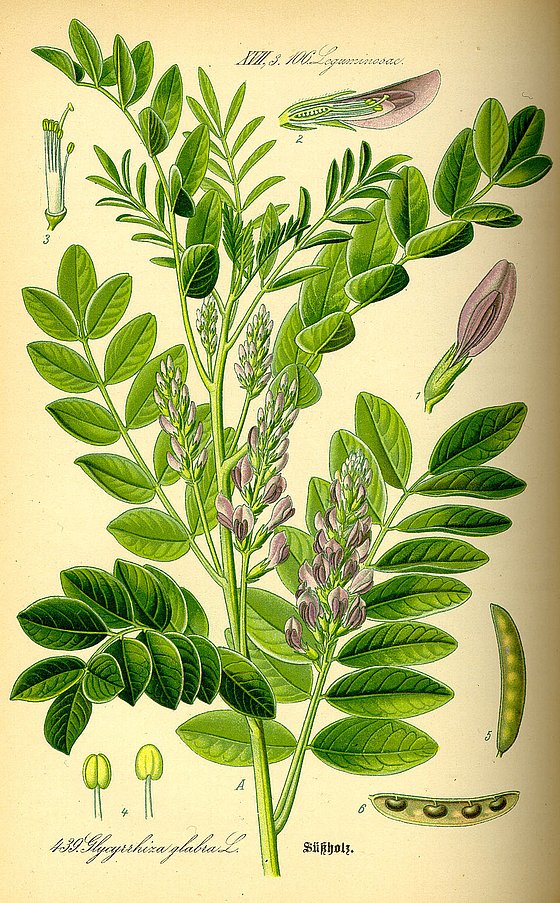
Liquorice, illustration from: Professor Dr Otto Wilhelm Thomé, *Flora of Germany, Austria and Switzerland*, 1885, Gera
Right up until the 1970s, you could still buy liquorice as a medicine in pharmacies in Sweden. What sort of ailments was it used to treat?
Julia Bornhorst: It was quite multifaceted, because the health benefits attributed to liquorice include aiding digestion and its antioxidant properties. It relieves stomach complaints, has anti-inflammatory and antibacterial properties, acts as an expectorant, is used to lower liver enzyme levels and strengthens the immune system. That is why it used to be prescribed for a wide variety of conditions. The key active ingredient here is glycyrrhizin. Nowadays, liquorice is hardly used medicinally at all due to its potential side effects; for example, prolonged use or even an overdose can lead to nausea and vomiting, high blood pressure, low potassium levels and cardiac arrhythmia.
HARIBO began manufacturing liquorice products 100 years ago. Since then, liquorice has been known to us primarily as a sweet. How much sugar does it actually contain?
Julia Bornhorst: In addition to the sugar often found in liquorice, liquorice extract (glycyrrhizin) is also used to enhance the sweetness. It’s worth noting that glycyrrhizin is 50 times sweeter than sugar. So, in a way, the sugar further enhances the sweetness of the liquorice extract. Many of our liquorice products contain around 40 to 50 grams of sugar per 100 grams of product, which means there’s just as much sugar in liquorice as in other fruit jellies, and sometimes even more than in cola. Given the high sugar content in liquorice, it really should only be eaten in moderation.
Liquorice varieties from the Netherlands are among the best, whilst Calabria is home to the finest growing regions. It is also popular as both an alcoholic and non-alcoholic drink. However, too much of it is not good either. What effect does it have on the body?
Julia Bornhorst: The key substance is glycyrrhizin. It affects hormone balance, as well as mineral and water balance. So if we eat excessive amounts of liquorice, this can lead to a build-up of sodium and water, whilst at the same time causing a loss of potassium. The consequences include muscle weakness, high blood pressure and water retention. Interactions with certain medicines, such as digoxin, diuretics and blood pressure-lowering medicines (antihypertensives), are also possible. The European Food Safety Authority (EFSA) therefore recommends a maximum daily intake of 100 mg of glycyrrhizin, which corresponds to approximately 50–70 grams of standard liquorice. People who are particularly sensitive – for example, those with high blood pressure, cardiovascular disease or diabetes – should generally avoid liquorice.

Liquorice Variations
Photo: UniService Third Mission
Some products also contain salmiak. But that’s not suitable for children, is it?
Julia Bornhorst: Quite right, salmiak liquorice is definitely not suitable for children, and for good reason. Salmiak – or, to be more precise, ammonium chloride – is not simply a harmless additive, but a chemically active substance that can have physically noticeable effects. It is a white salt with a salty, pungent taste, which is used in the food industry under the additive code E510, particularly in very salty liquorice. In higher doses, ammonium chloride leads to acidosis and disrupts the normal ion balance, which can then cause nausea, vomiting and neurological disorders.
This is why there is also a labelling requirement in Germany. Where the salmiak (ammonium chloride) content exceeds 20 grams per kilogram, the labelling ‘Adult liquorice – not suitable for children’ is mandatory. There are three types of liquorice: children’s liquorice, adult liquorice and strong liquorice. These warnings are necessary because, according to the Federal Institute for Risk Assessment (BfR), ammonium chloride is harmful in higher doses.
In the classic film *The Gold Rush*, the actor Charles Chaplin was able to eat his shoes and laces because these props were made of liquorice. Which type of liquorice do you like best?
Julia Bornhorst: I must admit that I don’t really like eating liquorice. I find it too harsh and too bitter. I might have a salted liquorice herring now and then, but that’s about it. I like it really sweet.
Uwe Blass
Julia Bornhorst studied and completed her PhD at the Westphalian Wilhelms University of Münster. She worked for five years at the Institute of Nutritional Science at the University of Potsdam. Since January 2019, she has been a professor of food chemistry at the University of Wuppertal.