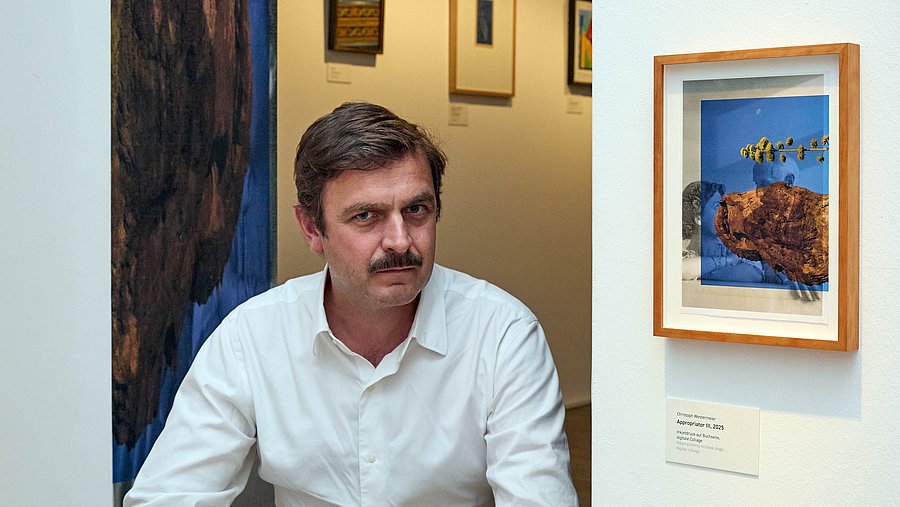
Revolution in photography - the first 35mm camera
Christoph Westermeier / Art
Photo: Westermeier
Revolution in photography
The photographer and lecturer in art, Christoph Westermeier, on the serial production of the first Leica camera
Oskar Barnack, an employee of the Ernst Leitz company, invented the so-called "Ur-Leica" in Wetzlar in 1913. That was for health reasons, so to speak, wasn't it?
Christoph Westermeier: Oskar Barnack is one of those ingenious inventors of the 19th century whose invention had a decisive influence on the photographic image in the 20th century and whose significance extends to the present day. He was born in Brandenburg in 1879, went on an apprenticeship towards the end of the century and was employed as a master mechanic by the company now known as Leica Camera AG in 1911, back in the days of the German Empire.
In his spare time, Barnack was an enthusiastic amateur photographer - and when we talk about photography at the beginning of the 20th century, we are talking about plate cameras, heavy equipment and complicated technical processes.
However, Oskar Barnack had severe asthma and suffered from lung and bronchial problems. This restricted him in his favourite hobby, photography. However, as he did not want to give up photography, he looked for a way to take photographs without great physical exertion and became the inventor of the "Ur-Leica".
Where does the name Leica come from?
Christoph Westermeier: The name has nothing to do with the world's favourite dog, Laika, but is a very mundane combination of the words "Lei" - from Leitz (the surname of company founder Ernst Leitz) and "ca" - from camera.
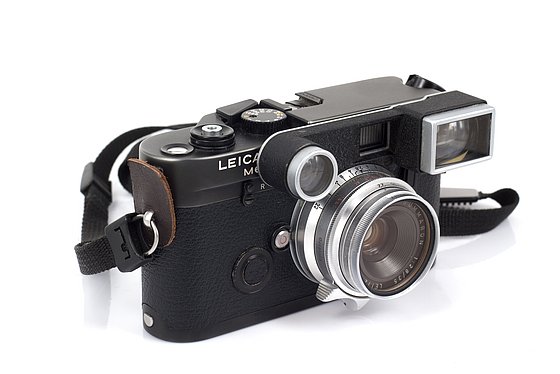
Leica Retro Camera
Photo: Colourbox
Following lengthy discussions, the Leica I went into production in 1925. This 35mm camera sparked a revolution in photography. Why?
Christoph Westermeier: Until the invention of the Leica,photography was a static process. A large camera was set up, the exposure time was long, and the process was technically complicated.
Early photographs were therefore taken from a frontal perspective; they are static and unmoving. With the invention of the Leica, photography became more physical, the lines of sight changed, and the gaze turned upwards, downwards and to the side. With the spread of the Leica 100 years ago, a new chapter began and photography changed fundamentally.
Barnack turned the cinema image into a photographic image. What does that mean?
Christoph Westermeier: When Barnack started working at Ernst Leitz, film was mainly used in the cinema – that is, as 35 mm-wide cinema film, which ran horizontally through the projector and on which each frame measured approximately 18 × 24 mm. However, Barnack loaded this film sideways into his camera and enlarged the image format to 24 by 36 millimetres. This enabled him to use the same film, which was otherwise intended for cinema, for still photographs. In this way, Barnack turned the ‘cinema image’ into a ‘photographic image’.
As well as the technical ingenuity, the body of the camera – which was developed to enable this new invention to be used in everyday life – is also of interest.
He had the body cast from aluminium. The camera actually fitted into a jacket pocket. But the patent application was rejected at the time. Why?
Christoph Westermeier: Oskar Barnack was not the only inventor working on a new type of camera. The Imperial Patent Office, where the original Leica was to be registered, noted that it infringed a patent held by Carl Zeiss/Jena and a French patent. Consequently, only the ‘little brother’ of the patent – utility model protection – was initially granted.
Interestingly, before taking up his post in Wetzlar, Barnack had been employed as a precision engineer and fitter at Carl Zeiss.
The Leica I was presented at the Leipzig Spring Fair in 1925 and impressed with its compactness, easy handling and image quality. It made completely new types of photography possible for photojournalists and amateur photographers. What became possible?
Christoph Westermeier: The photographic image as we know it today was only made possible by Barnack's invention. Photojournalism that can act quickly and actively on location didn't exist before. Hobby photography was also an elitist pursuit until then and was more comparable to watercolour painting. This changed 100 years ago: photography reinvented itself. The democratisation of the image, easy access and the inclusive approach of photography are the consequences of Barnack's pioneering invention.
His invention defined the photographic image until the introduction of the digital camera. However, digital photography works very differently: instead of capturing a moment for eternity on a negative, a file is created that can be easily edited and results in AI-generated images.
The Leica was a financial success. But Barnack also developed this camera further, didn't he?
Christoph Westermeier: Of course. The model that was presented 100 years ago was already different from the original Leica, and it goes without saying that the Leica was adjusted and optimised from model to model, even after Barnack's death. Technical change did not stop at the company and the camera and continues to the present day.
The Leica inventor died in 1936. But his camera is a recipe for success and is still in production today. Do you also work with a Leica?
Christoph Westermeier: I work with many different cameras - and one of them is a Leica. The famous lettering still characterises the photography scene today and a living legend like my colleague Katharina Sieverding would be unthinkable without Leica.
Uwe Blass
Christoph Westermeier studied at the Kunstakademie Düsseldorf. He is a lecturer in photography in the school of art and design at the University of Wuppertal.