Ernesto Cardenal - the great poet of Latin America
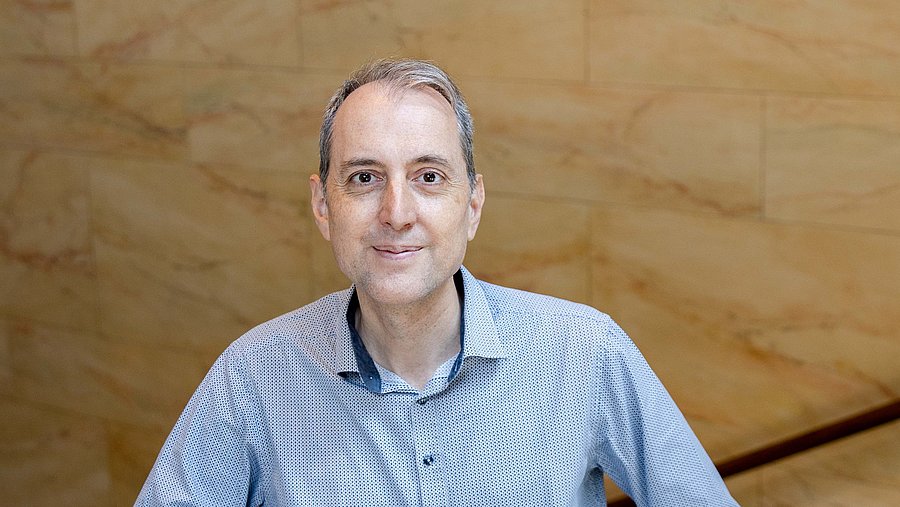
Prof Dr Matei Chihaia / Romance Studies
Photo: Sebastian Jarych
Democracy cannot be taken for granted
Matei Chihaia on the 100th birthday of the great Latin American poet and Wuppertal honorary doctor Ernesto Cardenal
Ernesto Cardenal was a Catholic priest, socialist politician and poet. In what context did you first become aware of him?
Chihaia: After my habilitation, I had started a major research project on the poetry of ruins, which then increasingly centred on the idea of "zero hour" and "zero point" - these terms are no longer very familiar today, but they played an important role in my parents' generation: it was about the historical turning point that the end of the Second World War meant and the question of how literature and culture could deal with the literal and symbolic ruins left behind by the Nazi era. This model for thinking history can be applied to many situations, including current ones. In any case, this research was initially centred entirely on Europe until I met a Peruvian author at a conference, Félix Terrones, who now teaches at the University of Bern, and who told me that the concept is also very central to Latin American poetry. And she owes this to a long poem by Cardenal entitled "Hora cero", or "zero hour". It begins like this: "Tropical Central American nights, with lagoons and volcanoes under the moon and the lights of presidential palaces, barracks and sad curfews." This powerful image has become almost iconic for the problems of Central American countries, and it speaks about them from both a distance and a distance, as is typical of Cardenal.
He joined the opposition youth movement UNAP at a young age and fought - also in literature - against the dictatorial President Anastasio Somoza García. He almost paid for this with his life. What happened?
Chihaia: The poem is a small epic in which the origins and background of the Somoza dictatorship are described. Because the Somoza who ruled Nicaragua in Cardenal's time was the son of the first Somoza, who established the family rule over the country in the 1930s, Anastasio, whom we can call Anastasio the First. He was followed by his son Luis as president, and after his death, Anastasio, Anastasio the Second, took over the seat in the palace. It is a story that has happened in a similar way in many countries in Latin America and the world - just think of North Korea! - and should serve as a reminder that democracy cannot be taken for granted. Cardenal, who had studied literature and theology in Mexico City, New York and Colombia, returned to Managua in the early 1950s - a young man from the upper classes, educated at the best universities and, at the age of 29, already an intellectual who wanted to change the world, starting with his own country. So he joined an opposition movement and sympathised with an attempted coup in 1954, which was launched by some officers of the National Guard and failed miserably. Cardenal somehow escaped the bloody retribution of the regime, but had to go into exile: he became a novice in a Trappist monastery in Kentucky, where he continued his spiritual and poetic training. "Hora cero", a relatively early work, looks back at the failure and relates it to the historical struggle of Augusto César Sandino against the first Anastasio Somoza, and to the role of the United Fruit Company and other foreign companies in Nicaraguan politics. Overall, the poem offers a poetic overview of the country's history. In a way, it is an attempt to use poetry to remind us that it exists.

Cardenal at a reading in March 2010 at the Kreuzkirche in Munich
Photo: Herbert Erwin, public domain
In his mid-30s, he began studying theology and was ordained as a priest in Managua in 1965. Literarily, it was during this period that he wrote the Psalms (Salmos, 1969), which are regarded as an expression of liberation theology. He was always involved in political issues throughout his life, wasn’t he?
Chihaia: I think Cardinal’s Psalms are one of the truly great works of Latin American poetry. They spring from his own experience of exile, which he historically projects back into the past – this time not to the 1930s, as in *Hora cero*, but straight back to the time of the people of Israel. On the one hand, his decision to be ordained as a priest was the culmination of his own ‘novel of education’ – that is, an educational ideal he had devised himself, in which dialogue with people, with nature and with God was to be possible. On the other hand, during the Cold War, it was also a way of protecting himself from persecution. There were relevant organisations for international solidarity, such as Ostpriesterhilfe and Aid to the Church in Need, with which I myself was involved as a young man; and from the 1960s onwards, there was a growing awareness that clergy in Latin America who were fighting for social justice were also being oppressed and threatened.
He wrote his best-known book in Germany, *The Gospel of the Farmers of Solentiname*, in the commune of the same name. How did that come about?
Chihaia: Solentiname is the name of an archipelago in the vast Lake Nicaragua. After his ordination, Cardenal and a group of friends moved there to realise, together with the local fishermen, the ideal of an early Christian community. Nicaragua is, after all, a country of great contrasts: on the one hand, the cities on the Pacific coast with their educated upper classes; on the other, the rural areas and the Caribbean coast, which have traditionally been neglected by the state and where people live in very poor conditions. Yet it is precisely this way of life that offers points of connection with the Gospel, which also speaks of a simple life: Peter is a fisherman, just like the inhabitants of the Solentiname archipelago. *The Gospel of the Farmers of Solentiname* records the discussions taking place within this community about various passages from the Gospels, in which these people relate Christ’s message to their own lives. Cardenal also encourages the parishioners to link the Gospels figuratively to their own world, and this gives rise to these enchanting, naïve paintings, in which the history of salvation is transposed from the desert of Palestine to a colourful tropical setting.
This commune came to a dramatic end in 1977. Why?
Chihaia: Cardenal had visited Cuba in the 1970s, where a group of scattered guerrillas led by Fidel Castro had, from a rural area – the Sierra Maestra – sparked a broad popular uprising ‘from below’ and ultimately brought about the overthrow of the local dictator. This myth of the Sierra Maestra, which Che Guevara, amongst others, had helped to shape, also inspired their neighbours in Central America. Could the Solentiname Archipelago become the starting point for a Nicaraguan revolution modelled on the Cuban example? Cardenal was close to Nicaragua’s Sandinista National Liberation Front; he championed the idea of a Christian revolution, and within his community there were many who sought to bring about the overthrow of the regime by force of arms. When they occupied a National Guard barracks, the regime’s tolerance came to an end: the facilities at Solentiname were destroyed, and Cardenal was forced into exile once more.
The Nicaraguan Revolution took place in 1978–79; Cardenal returned to Nicaragua and served as Minister of Culture for just under eight years. What did he achieve during this time?
Chihaia: I find it difficult to answer this question, because I know a number of people who worked closely with him and could provide much better insight: first and foremost Lutz Kliche, who had translated his poems and went with him to Nicaragua to assist him at the ministry. This cultural work attracted international attention: publishing houses and libraries were established, and there were festivals and exhibitions. It went hand in hand with a literacy campaign, which received an award from UNESCO and through which some 400,000 Nicaraguans learnt to read and write. Unfortunately, the situation has since deteriorated again, as the then Minister of Education, Carlos Tünnermann, laments: in 1980, 13 per cent of people over the age of 15 were unable to read and write; by 2008, this figure had risen to over a quarter of this age group. Incidentally, his commitment to culture during his time as minister is evident even in the postage stamps: In 1983, a beautiful series featuring Latin American poets was issued, including Pablo Neruda – whom Cardenal admired – as well as many Nicaraguans such as the great Rubén Darío, whose portraits appear alongside their handwritten texts. A dual tribute to the culture of the written word, then. The state prize, renamed the ‘Orden de la independencia cultural Rubén Darío’, was awarded that same year to Julio Cortázar, the Argentine novelist who had visited Cardenal in Solentiname and subsequently written a highly acclaimed novel about the destruction of the island community in 1977, ‘Apocalipsis de Solentiname’. These authors, at any rate, believed that culture can have the final say.
The Catholic Church did not at all approve of Cardenal’s political activism or his proximity to the Liberation Church, and Pope John Paul II even suspended him from the priesthood. Yet Cardenal did not abandon his stance, did he?
Chihaia: Yes, John Paul II and Cardenal had a great deal in common: both were poets and priests at the same time; both believed in the possibility of combining mystical religiosity with political commitment; both came from small states whose sovereignty was constantly under threat; and both possessed enormous charisma. Tragically, they belonged to opposing sides in the Cold War. There were formal reasons for the suspension – a priest could not simultaneously be a minister – but underlying this was the fact that the Catholic Church was anything but neutral. And John Paul II was closely linked to the political opposition in Poland, where clergy were being persecuted and murdered; the very idea that the Church was involved in the government of a socialist state must have been unbearable to him. In the Latin American context, however, Cardenal was celebrated for his commitment, precisely in contrast to the problematic role that much of the Catholic Church had played in the South American dictatorships and continued to play in the 1980s. Support for his stance also came from Germany: when the poet-priest was awarded the Peace Prize of the German Book Trade in 1980, the eminent theologian Johann Baptist Metz delivered the laudatory address.
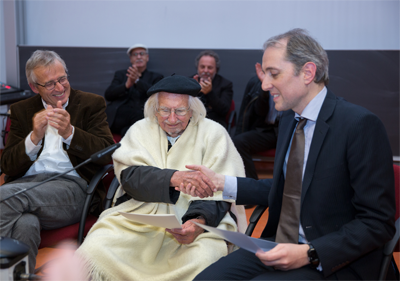
Ernesto Cardenal and Matei Chihaia (right) during the honorary doctorate ceremony at the University of Wuppertal in 2017
Photo: Sebastian Jarych
In 2017, the University of Wuppertal awarded him an honorary doctorate. You yourself were present at the event. How did you experience Ernesto Cardenal?
Chihaia: I only spoke to him a little because I was focused on organising the event - I was mainly concerned with details such as the weakening batteries in the wireless microphone, the telephone announcement to dpa that he had actually received the honorary doctorate and arranging interviews with the poet. But it was touching to see how many people came who had known him all their lives and how much friendship and respect he exuded for everyone. It was also noticeable how he felt at home in Wuppertal, he had his favourite places and habits here. The award from the school of humanities and cultural studies came at a difficult moment in his life, when he had openly spoken out against the dictatorship of former liberator Daniel Ortega in Nicaragua and was subjected to all kinds of reprisals. At the time of his honorary doctorate, it seemed as if he would have to go into exile one more time, which gave the event a special significance.
His works in Germany were mainly published by Peter Hammer Verlag in Wuppertal. How did the contact come about?
Chihaia: That should really be explained by Hermann Schulz, the former publishing director who met Cardenal in Latin America when he was not yet so well known and ultimately made Wuppertal the centre of the European solidarity movement with Nicaragua. Peter Hammer Verlag played an important role in the worldwide boom of Latin American literature in the 1970s, together with Suhrkamp in Frankfurt, Seix Barral in Barcelona and Gallimard and Seuil in Paris.
He is considered one of Nicaragua's most important poets. What do literature lovers appreciate about his work?
Chihaia: I think lyrical poems can create relationships and connections, and in this way create meaning. They can be reassuring or unexpected, often opening up new perspectives on the familiar. This is the case, for example, with Cardenal's travel impressions from Germany, which can be found in "Heimweh nach dem Paradies", the volume published by Peter Hammer Verlag, which Lutz Kliche and Hermann Schulz have now edited: "In the house of a Westphalian farmer / fine curtains in front of the windows, / pictures, flower vases, modern lamps / "Why are the farmers in Nicaragua so poor?" / he asks me." Together with Karla Domínguez and Enrique Delgadillo, two young cultural workers born in Nicaragua and living in Germany, we are planning a week of activities in November 2025 that will make the survival of Cardenal's work visible. Domínguez, who is a musician, has set his poems to music for a concert in the Immanuel Church, and Delgadillo, himself an author and publisher, will offer a workshop on creative writing, following on from a series of seminars for master's students at the University of Wuppertal that has already begun.
Uwe Blass
Prof Dr Matei Chihaia studied Comparative Literature, Romance Studies and Philosophy at the Ludwig-Maximilians-Universität in Munich and at the University of Oxford. He has been teaching French and Spanish literature at the University of Wuppertal since 2010.