
The wow signal
Professor Dr Karl-Heinz Kampert / Astrophysics
Photo: Michael Mutzberg
The wow signal
Astrophysicist Karl-Heinz Kampert on the search for extraterrestrial life using radio telescopes
The search for extraterrestrial life using radio telescopes has a long history. How long have people been conducting on this search?
Karl-Heinz Kampert: Important discoveries are based on human curiosity. In science, they are often the result of a coincidental observation, and this is also the case with radio astronomy itself. In 1930, the physicist and engineer Karl Jansky wanted to get to the bottom of the cause of a fault in the newly opened transatlantic radio link. With the help of a simple construction, he realised that the fault did not follow a 24-hour rhythm, but instead repeated itself approximately every 23 hours and 56 minutes. It therefore followed a “star day”. He concluded that the source of the disturbance could not be of earthly origin, but must lie outside the solar system. Thus, radio astronomy was born. In honour of Jansky, the strength of radio signals is measured in units called “Jansky”.
Radio signals propagate almost unhindered through the universe and are not absorbed by the Earth’s atmosphere. Even the smallest signals can be detected very well with large telescopes, e.g., the Effelsberg radio telescope in the Eifel region. So, if we on Earth use radio signals for communication, it stands to reason that extraterrestrial civilisations will do the same, because the laws of nature apply everywhere. There is indeed nothing more obvious than to search extraterrestrial radio signals for intelligent high-frequency patterns, i.e., to use them to search for extraterrestrial intelligence (SETI).
The search for E.T. began in April 1960 with radio astronomer Frank Drake, who pointed a 26-metre antenna from the US National Radio Astronomy Observatory at two nearby stars. After a short time, he found suspicious signals, which unfortunately turned out to be radio signals from an aeroplane. As of 1972, radio astronomers “listened” to 650 stars with an even larger telescope. SETI research was thus established as a serious scientific discipline and existing telescopes were increasingly used for this purpose. The instruments used included the 103 x 33 square metre so-called “Big Ear” antenna of Ohio State University, which was put into operation in 1963 and with which a large astronomical sky survey was completed in 1971. Between 1973 and1995, the telescope was available for SETI research. This is the longest measurement period to date, which is even recorded in the Guinness Book of World Records.
In this context, researchers often speak of the “great silence”. However, sciences don’t actually believe that we are alone, do they?
Karl-Heinz Kampert: The search for extraterrestrial life has been a waiting game for six decades now. It has been coordinated since 1984 by an independent non-profit organisation headed by Frank Drake. However, apart from signals from other spy jets, no evidence of a message from extraterrestrial intelligence has yet been fished out of the flood of data. In the universe, there is a “great silence” instead. As early as 1950, physicist Enrico Fermi asked the pertinent question: “Where is everyone?” Given the sheer endless number of stars and planets in our universe, there must be millions of intelligent civilisations. So why have we not yet found clear proof of their existence? This is known as the Fermi paradox.
The aforementioned Frank Drake, the pioneer of SETI research, may have found an answer to this big question - in the form of an equation named after him. This equation combines various probabilities relevant to the occurrence of intelligent life and takes into account various factors: the proportion of stars with a planetary system, the average number of planets per star, the proportion of planets with life, the proportion with intelligent life, the proportion with an interest in communication, and – most importantly – the lifespan of a technical civilisation in years. It is this last point that at least prevents the practical possibility of establishing contact with civilisations outside our home galaxy, the Milky Way, due to the immense vastness of the universe. According to conservative estimates one civilisation may live in our Milky Way and according to optimistic estimates about 100 civilisations may exist. The latter corresponds to an average distance between two civilisations of 5000 light years. The distance to the nearest Andromeda galaxy is already over 2 million light years. We must not forget in this discussion that we have only been able to receive radio signals for about 90 years (see above).
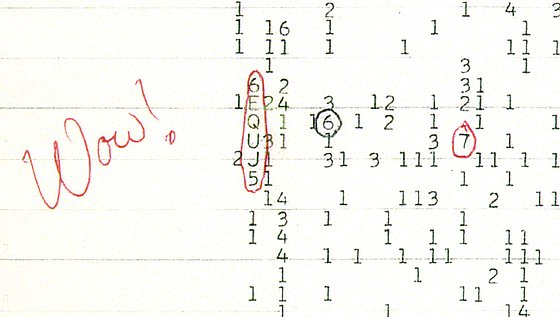
The wow signal
Scan of the eponymous document by Jerry R. Ehman, public domain
On 15 August 1977, astrophysicist Jerry R. Ehman recorded a signal that is considered the most promising candidate for an extraterrestrial message, the so-called wow signal. What is it all about?
Karl-Heinz Kampert: In August 1977, astronomer J. R. Ehman analysed the signals recorded by the “Big Ear” antenna in the preceding days. At that time, this analysis was still done by reading the computer printouts on continuous paper. The time sequence of the signal strengths was coded in the form of consecutive digits, where 0, 1, 2, ... 9, A, B, ... X, Y and Z stood for increasing signal strengths during a time window of ten seconds. In the printouts, which seem confusing today, Ehman found a sequence of the form “6EQUJ5” beginning at 23:16 local time on 15 August, i.e., an immensely strong, long-lasting signal from a direction not far from the galactic centre. He marked this signal on the printout with the note “Wow!”. It was to go down in the history of SETI research and radio astronomy as the “Wow!” signal.
A repetition of the signal, which had a bandwidth of less than 10 kHz at a frequency of 1420 MHz (a hyperfine structure transition in the neutral hydrogen atom), could not be observed to this day, even with more sensitive radio antennas. There is still speculation about the cause. . A reanalysis of the original data using modern methods, which was completed a few months ago, was also unable to solve the puzzle, but could confirm an astrophysical origin.
A lot of money is being invested in the exploration of signals. A few years ago, a Russian billionaire even invested 100 million dollars in the “Breakthrough Listen” project, which was supported by renowned astronomers such as the then star physicist Stephen Hawkings, in order to find intelligent life beyond Earth. The aim of the project is to scan a million star systems close to the Earth, the hundred nearest galaxies, and the galactic centre for signs of extraterrestrial intelligence. Is this just pure science fiction for rich bigwigs?
Karl-Heinz Kampert: SETI research undoubtedly touches an inner nerve in humanity: are we alone in the universe? The idea of inhabited other worlds has existed since ancient times and is often found in philosophical works and myths. It is therefore hardly surprising that people from different financial backgrounds are happy to support such projects. Steven Spielberg, the star director, for example, supported a SETI research project after his success with ”E.T.”. Scientists and amateurs worked on a voluntary basis to analyse the Big Ear data, which took place over many years. Many may also remember the SETI@home project, which was launched by the University of California in Berkeley in 1999. Until 2020, the project utilised the resources of unused home computers by means of a special screensaver to search for signals in the available radio data. Many people took part in the initiative because they were intrigued by the question itself and they might have been able to detect a signal on their own PC.
However, according to the most recent status (Sept. 2025), only 4.5% of the sum mentioned has been invested in the “Breakthrough Listen” project so far. The data obtained and the software used are available to everyone. Let’s take another very recent example: a group of private individuals and foundations recently pledged €860 million to CERN for the construction of the Future Circular Collider as a follow-up project to the LHC. This is around 5% of the sum required.
There can certainly be different opinions about the usefulness of such donations. The donor is, of course, depriving the public sector of tax revenue in this way. Otherwise, politicians would decide of its use. In Wuppertal as well, many social, cultural and other projects, along with a few endowed professorships, are supported by private donations. Many of us also like to donate to causes that are close to our hearts. Ultimately, this should be criticised in the same way, because the process is the same. Conversely, the ”rich bigwigs”, to stick with the term and the cliché, could also have their next yacht built. Would that be better for the general public? In order to be tax-effective, donations are usually made via foundations (as is the case at CERN), i.e., via a legal structure with a mostly charitable purpose.

FAST, before the installation of the instrument platform, CC BY 3.0
The largest radio telescope on Earth, the Five-hundred-metre Aperture Spherical Telescope (Fast), a 500-metre-diameter “giant dish” in the remote Dawodang Depression of Guizhou Province in southern China, has been searching for signals from extraterrestrial civilisations since 2019. Has anyone or anything ever come forward?
Karl-Heinz Kampert: This is indeed an impressive, stationary telescope that is primarily used for astronomical research, for example to study pulsars (rapidly rotating neutron stars), detect interstellar molecules, create high-resolution images from the vicinity of black holes or search for gravitational waves. The detection of foreign communication signals is also possible. A possible signal was reported in June 2022, but was identified as a detector artefact just four days later. However, the search continues.
At present, the so-called TRAPPIST-1 planets are among the most interesting stars when it comes to the search for extraterrestrial life. How did you come to this conclusion?
Karl-Heinz Kampert: The search for so-called exoplanets, i.e., planetary systems outside our solar system, is a highly topical and intensively pursued field of research. In 2019, the scientists who discovered the first planets around a sun-like star were honoured with a Nobel Prize. Since then, there have been thousands of other discoveries that have expanded our understanding of the universe. The aim of this search is therefore not to detect signals from extraterrestrial civilisations, but to find out how often and possibly where habitable planets can be found in the universe.
Trappist-1 is a planetary system about 40 light years away from Earth. For your better orientation: the closest star to the sun, Proxima Centauri, is 4.24 light years away from the Earth. The discovery was made in 2016 using the so-called transit method which utilises the fact that the planets slightly block the light of their sun during their orbit. The star then appears alternately dimmer and brighter to the observer in the equatorial plane.
The star Trappist-1 has only about one twelfth of the mass and half the surface temperature of the sun. The orbital periods of the planets are between 1.5 and 20 days. Densities similar to those of the Earth were found for the medium-sized planets. One planet is even thought to have an iron core similar to the one of the Earth. A hydrogen-based atmosphere has also been detected. Due to the temperatures prevailing there, NASA assumes that there could be liquid water on several of the planets. The age of the system is estimated at 7.2 billion years. The age of the solar system, by contrast, is 4.5 billion years, so there was enough time for life forms to form on the planets. All these observations make Trappist-1 a promising star system with potentially habitable planets and possibly life.
Scientists are not just looking for aliens with these mega telescopes. What other findings does such research bring?
Karl-Heinz Kampert: As I already mentioned, all modern telescopes are used for astronomical research. There are still many unsolved questions of great astrophysical importance. With the help of telescopes, we can take a much closer look at the universe and thus also explore the history of its origins.
With the commissioning of new instruments, which are more sensitive than anything ever seen before, surprises are almost guaranteed. Observations are made that were literally not on the screen, and these are always particularly exciting as they lead to an expansion of knowledge. However, there is always a danger here: when new, unknown signals are observed, it must first be ensured that it is not an error in the apparatus or analysis. Unfortunately, there have been many examples in the history of science where researcher jumped to conclusions that later had to be revised.
You yourself were the spokesperson for the research collaboration at the Pierre Auger Observatory in Argentina from 2010 to 2017. Cosmic radiation is analysed there using detectors. Can scientists draw conclusions about possible extraterrestrial life from the results researched there ?
Karl-Heinz Kampert: The primary aim of our research is to identify the sources of the highest-energy particles in the universe. We observe particles whose energy is 100 million times greater than the energy that can be generated in the world’s largest accelerator, the LHC at CERN. However, we have no idea of how nature achieves this. We were able to prove that these particles do not originate from the Milky Way itself, but from neighbouring galaxies. In this respect, these particles are the only form of matter that reaches us from other galaxies and that we can detect here on Earth: Messengers from other worlds. Such high energies can only be achieved under extreme conditions, e.g., in the immediate vicinity of massive black holes or in regions where a large number of stars explode into supernovae in a short space of time and subsequently form many new stars at the same time. However, this is exactly the opposite of what we understand by a habitable zone.
Interestingly, however, it has already been suggested that neutrinos are more suitable than light or radio signals for sending or receiving signals to foreign civilisations. The reason is that neutrinos – unlike electromagnetic radiation – can penetrate matter almost unhindered and are not subject to any other interfering influences. However, this advantage of neutrinos, that they pass through the universe without interference or absorption, is unfortunately also their disadvantage. Detecting neutrinos requires very large detectors such as the IceCube Neutrino Observatoryat the South Pole, a project, in which the University of Wuppertal is also involved. In view of its practicality, however, I would personally categorise the idea of using neutrinos for SETI research as ”science fiction” at the moment.
Uwe Blass
Professor Dr Karl-Heinz Kampert studied physics at the University of Münster between 1977 and 1983. From 1983 until 1986, Kampert was a research assistant at the University of Münster and obtained his doctorate in 1986. He then worked as a postdoctoral research fellow at the large-scale research centre CERN in Switzerland for three years. From 1989 until 1995, he was an assistant professor of physics at the University of Münster, and habilitated in 1993. He then hold a professorship of physics at the University of Karlsruhe and the Karlsruhe Research Centre, which both merged to the Karlsruhe Institute of Technology in 2009. Finally, he has been teaching experimental physics at the University of Wuppertal since 2003.