Primary school of the future
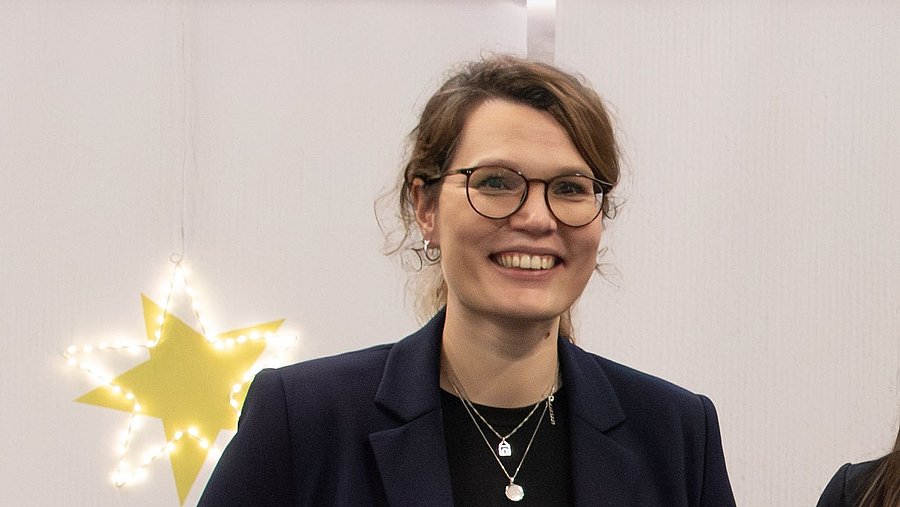
Professor Dr Juliane Schlesier / Primary School Pedagogical Research
Photo: Friederike von Heyden
A cooperative relationship characterised by trust and appreciation
Professor Dr Juliane Schlesier on the 'Primary School of the Future' teaching and learning project
First place in the University of Wuppertal's Third Mission Honour Award was not the first award that Juliane Schlesier received for her teaching-learning project 'Primary School of the Future' last year. "It's a project that started on a very small scale," says the professor, "and this success clearly shows us that there is potential for transfer."
Schools receive support with school development
Schools receive support from the university for school development. The question of why schools cannot manage this on their own does not arise for the academic. "Schools do a lot and do it very well. At the same time, however, the requirements are also growing beyond pure teaching," she explains. "School development, sustainable design and the promotion of social participation are all complex, long-term processes that naturally have to be jointly organised in some way and, above all, further developed on an empirical basis." Schools are already working at full capacity on a day-to-day basis, so external support can also provide relief and additional perspectives as well as systematically and effectively support development processes.
Reflecting on authentic practical experience with the knowledge of today
Today, teacher training often lacks authentic practical experience and lively cooperation with society, even though it has all been there before. "In principle, this is old hat," says the researcher, "because authentic practical experience and social cooperation were already a central element in teacher training in the past, especially in training at teacher training colleges for primary school teachers. Especially in the period before the 1970s, before the reforms, the PHs were primarily training centres for primary school teachers and there was a very close practical focus." With the reforms of the 1970s, the primary school teaching profession was also more firmly anchored at universities. As a result, the scientific and empirical foundation of pedagogical concepts became more important and training became more formalised and scientifically oriented overall. "Today, there is a return to what existed in the past, I can already see that, but with the knowledge of what we have learned from the strong academisation of teacher training in recent decades. So we are not just taking steps backwards, but are reintroducing new or further developed practical concepts into the predominantly theory-based teacher training programme."
'Primary school of the future' project
In a teaching-learning project entitled 'Primary School of the Future', funded by the Barthel/EWE Foundation, which is based on the democracy-building teaching-learning method of learning through engagement, Schlesier brought together around 150 student teachers and around 400 primary school children in Lower Saxony in small, inclusive so-called 'heroine teams' to develop and implement charitable and sustainable projects for schools. The prerequisite was individual support for each school. "In the project, the real needs of the schools were determined in advance and the projects were also embedded in the curriculum, i.e. in subjects such as science, German, art and maths lessons," says Schlesier, explaining the approach. "The children were actively involved in the planning and implementation so that these projects could not be planned in advance. The schools individually investigated what was needed so that lessons could take place properly, so that the children could perhaps have a nicer playground where they could relax and play after lessons." The measures ranged from the simple refurbishment of old benches to the planting of snack bars and raised beds, the cleaning of ponds and the construction of insect hotels. "Sensory trails have been created and construction trailers have been purchased and converted so that toys can be stored in them. We now have around 70 projects that have been created and are totally diverse."
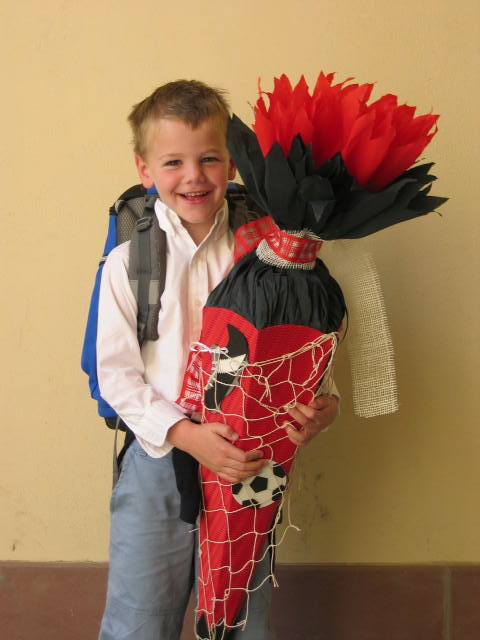
Primary school of the future also benefits him / First graders with school cone
Photo: CC BY-SA 3.0
Coexistence without social media
A key aspect of the project, which ran from 2023 to 2025, was to bring people back into contact and interact with each other without digital media. Schlesier explains: "In fact, a key aim of the method is to organise learning as collaborative, real action and to consciously bring people into direct, personal contact. In times of corona, there was a strong emphasis on everyone cooking their own soup. This was a development that took place during the corona phase in a very formative phase of children's lives. But now, in these sub-projects of 'Primary School of the Future', the children, students, teachers and parents are working together without digital media, coordinating, making decisions, solving problems and simply doing things together." And this joint interaction was experienced as very valuable after just three to five days of project work on site. "There was such close contact that the children hardly wanted to let go of the students afterwards. Relationships were built, so the success of the project is not only measurable in numbers, but also in the spirit that was created." The project did not manage entirely without digital media, as one group at each school was also responsible for the documentation, which was then carried out using digital media. "However, this was also done jointly," emphasises the project manager and continues, "interviews were then conducted with the other participants, so that it was not about passively consuming digital media, but about actively working with digital media."
Culture of mutual support
The 'Primary School of the Future' project promotes a culture of mutual support, which was evident on several levels. "Within the 'heroine teams', the children and students took responsibility for each other. They supported each other in planning, implementation and problem-solving and contributed different strengths. Help was not seen as an effort, but as a natural part of the joint work. The older children also helped the younger children as a matter of course. Those who didn't have as much strength to saw or dig were given immediate support." Further support also developed between the groups of participants. As the teachers opened up their school to this new project experience, the university was suddenly actively involved in the project and helped to shape it. "It was a school project during lesson times. The teachers were there as advisors, but stayed in the background and only mediated between students and pupils when problems arose. That worked really well. It was a cooperative relationship characterised by trust and appreciation."
A project with transfer potential
"I had the project carried out at primary schools," says Schlesier, "but of course it can also be transferred to other types of school. The project is based on the learning method 'learning through engagement', which is already used primarily in secondary schools, but in a slightly different way than I do, because it has not been linked to teacher training so far. It is therefore something special that I am taking the project to primary schools and linking primary schools with teacher training. It shows that it is already possible with the very youngest pupils. That's where the transfer potential lies. The universities and schools can move a little closer together and establish reliable cooperation so that theory can also diffuse into practice and, conversely, the practical ideas and experience can also reach the student teachers." Schlesier has received great support from the university and will now also start the project in Wuppertal schools.
Interested schools can obtain further information on the project at: schlesier[at]uni-wuppertal.de
Uwe Blass
Professor Dr Juliane Schlesier is head of the Department of Primary School Education Research at the Institute for Educational Research at the University of Wuppertal. She conducts research into socio-emotional school experiences at primary level, in particular relationships, emotions, well-being and stress, as well as teacher training and school development. Her projects include profiles of relationship experiences, intervention approaches such as "learning through engagement" and school transitions.