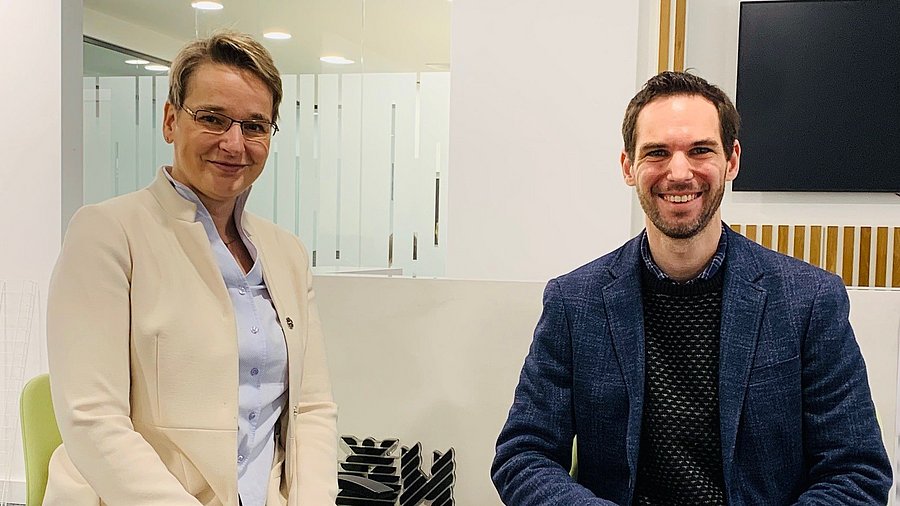
Documentation on the construction of the New Bergisch Synagogue
Prof. Dr. Juliana Brauen, Sebastian Braun / History
Photo: UniService Third Mission
Documentation on the construction of the new Bergische Synagoge (1996–2002)
Historians Juliane Brauer and Sebastian Braun from the University of Wuppertal on a narrative against forgetting
During Reichspogromnacht (“November Pogroms”) in 1938, both synagogues of the Jewish community in Elberfeld and Barmen in Wuppertal were destroyed. It would take 64 years for a new synagogue to be built in Barmen. In 2023, Leonid Goldberg, chairman of the Jewish community in Wuppertal, approached the University of Wuppertal with a request to document the construction of the new synagogue, which was inaugurated in 2002. A group of 10 students led by historian Prof Dr Juliane Brauer and her doctoral student Sebastian Braun (Department of History and its Didactics) took on the task and developed a narrative against forgetting. It promises much more than the mere documentation of the history of a house of prayer.
The Jewish community in Wuppertal asks the University of Wuppertal for help
“At first, I was a little sceptical,” historian Juliane Brauer admits, “because contemporary history can sometimes be a little difficult, as we are still too close to it.” However, after the first meeting, Leonid Goldberg, chairman of the Jewish Community, had convinced her. “Since I have a doctoral student, Sebastian Braun, who knows a lot about Jewish communities after 1945, I immediately thought of a joint student research project that could also lead to final theses.” The scholar was also interested in the ‘highly exciting project’ because of the historical and social significance of building a new synagogue for the city of Wuppertal.
In 1945, the Jewish community in Wuppertal no longer existed
On 8 December 2002, 64 years after the destruction of the former Synagogue in Barmen, the new Bergische Synagoge was inaugurated at Gemarker Straße. ‘In 1945, the Jewish community here had virtually ceased to exist,’ Sebastian Braun explains, describing the new beginning of Jewish community life. “Survivors returned to the city from the concentration camps, having survived by going into hiding, and some of them were so-called Jewish ‘displaced persons’. They formed a small community of about 145 people and first sought a new place where they could pray.” Since the entire infrastructure of Jewish life had been destroyed, the only place where the first services could be held was in the former Jewish retirement home at Friedrich-Ebert-Straße 73. Originally thought as a temporary solution, the Jewish community stayed there for a long time until the Bergische Synagoge was inaugurated. “It was important to the community back then as well as it is today, to say that even if it is only a small prayer room, it is our synagogue, because as soon as there is a Torah in a room, that room is considered a synagogue” Braun comments.
Ageing community experiences influx of new members in the 1990s
At the end of the 1980s, the community’s survival was seriously threatened due to ageing. The small religious community had only about 100 members left, reported Leonid Goldberg. However, political events then brought about a decisive change, with the community growing to over 2,000 members in a very short time. What had happened? ‘In 1991, a law was passed, the ‘Flüchtlingskontingenzgesetz’ (‘Quota Refugee Law’),” Braun reports. “As a result, people of the Jewish faith were able to come to Germany and join communities here.’ The reports of the interviewees, whom the students questioned about the construction of the new synagogue, made clear that the enormous influx also changed the urban society. ‘The majority of people came from the countries of the former Soviet Union. Suddenly, people saw prospects in the West. Many were completely unfamiliar with Judaism because they had been unable to practise it in the Soviet Union. The prospect of being able to learn about the faith in the first place motivated many people to come to Germany. Added to this, of course, was the desire for a future for their own children.” Brauer adds: “The Jewish community was then faced with a major challenge. It didn’t know where to put the new community members. The prayer room was no longer big enough, and suddenly there was an opportunity to completely rethink and reorganise Jewish life. In addition to documenting the actual construction process, this was also very interesting for us from a historical perspective.’
Prospective historians are briefed
In the first part of the project seminar in spring 2025, students were given a comprehensive introduction to the topic. “I focused primarily on the historical context so that the students would have the necessary background knowledge,” Braun says. “The students first had to learn about the post-war history of Jewish communities in Germany. They were not aware that there was also a Jewish community in Wuppertal.” The history of immigration and the challenges faced by the Jewish community, such as the integration of new community members and assistance with administrative procedures, also had to be understood in order to gain an overall picture. “Then we had to evaluate the sources, because we need them as historians,” she adds. “What do we know so far about the process that began in 1996, when the decision to build the new synagogue was made, and what information are we missing?” To this end, the team reviewed various minutes of the presbytery of the Protestant congregation on whose property the new synagogue was built. ‘Then there was the second part of the project seminar, in which the students were introduced to the method of “oral history,” history gathered through oral interviews,’ Brauer says. “What does it mean when we, as historians, interview contemporary witnesses and thus produce our own sources? What needs to be taken into account? We obtained biographical contextual information on the six interviewees from a questionnaire; everything else had to be done by the students.” Methodologically, the whole process was carried out very carefully, because you can’t just send young people with a camera to older contemporary witnesses and start questioning them, the researcher explains. “This is a situation that neither the students nor the older interviewees are used to. That’s why we did ‘role-playing’ exercises beforehand and rehearsed how to conduct an interview without interfering too much and still obtaining all the relevant information.” The interesting thing about this approach is above all the fact that you produce your own sources, which can also be used in the future. In the interviews, the students not only learned about the background to the construction process, they also asked questions about interreligious exchange and post-Soviet immigration, thus broadening the range of topics covered in the documentary.
The Theological Declaration of Barmen of 1934
In this context, the Theological Declaration of Barmen (Barmer Theologische Erklärung, BTE) of 1934 played a very important role for the interviewees from the Protestant community. First of all, the BTE was adopted at the site where the Bergische Synagogue stands today. “The BTE is particularly important for the Christian Protestant side, because it was, so to speak, the founding of the ‘Confessing Church’,” Braun says. “Representatives of the Lutheran and Reformed churches spoke out against National Socialist ideology. At the same time, however, this declaration is missing a very important part, because the exclusion and persecution of Jewish people is not mentioned at all in the declaration. People knew about it and did not take a clear position.” This haunted the Protestant Christian church for a long time. Although there were internal debates, the real process of coming to terms with the past did not begin until the 1980s. “Today,” he adds, “the Christian Protestant interviewees understand the construction of this synagogue on a former property of the Protestant regional church as an unwritten materialised thesis, so to speak.” Brauer explains that the construction of a new synagogue on what was originally Protestant community land is unique in Germany, and therefore the history of the decision-making and construction process is a special one for Wuppertal. “In 1996, the situation was already dramatic,” she says. “There were so many new Jewish citizens, and Leonid Goldberg pointed out in various committees that the community urgently needed a larger place to stay. However, there was simply no vacant land available for consideration. The site of the old synagogue is a memorial, a place of encounter. And then, from many different quarters, the idea arose to give the growing Jewish community the vacant plot of land directly adjacent to the Gemarker Church, free of charge.” Contemporary witnesses involved in the process repeatedly referred to it as a “miracle”. Representatives of the Jewish community met with representatives of the Protestant community incognito, so to speak, in the dark one evening in February 1996 and walked around the building site because they did not want the information to become public too early. “Then everything happened very quickly,” Brauer continues. “The big announcement came in September 1996, when the first press conference on the project took place. The construction process does not seem to have been particularly bureaucratic, as we know from Leonid Goldberg that he often had to make quick decisions regarding tiles, wallpaper or seating in response to enquiries from the municipal building authority. The ground-breaking ceremony took place on the historic date of 9 November 1998, and the synagogue was inaugurated in 2002.”
Contemporary witnesses replace missing written documents
With the support of the Jewish community and the local council, Wuppertal students met with contemporary witnesses. These included community representatives involved in the decision-making process for the construction of the new synagogue and members of the Jewish community. “Mr Goldberg felt a strong need to document the process. He was also concerned that the contemporary witnesses might not be around forever. And indeed, one interviewee passed away shortly after our conversation. When you listen to the recordings again, Mr Goldberg’s concern seems very real, because we interviewed people who are suddenly no longer with us, and we are glad that we had the chance to have this conversation,“ Brauer comments.
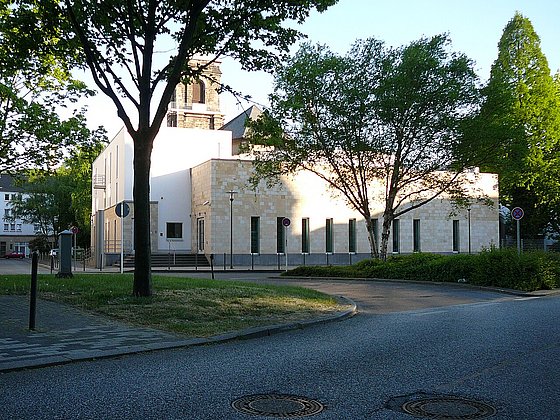
Bergische Synagoge
Foto: CC BY-S 3.0
Israeli President attends inauguration
The importance of the inauguration of the new Bergisch Synagogue in Wuppertal in 2002 was also underlined by the visit of the then Israeli President Moshe Katzav, whose attendance was made possible with the help of the then German President Johannes Rau. “There was a high security presence, which was not very well received by the population,” Braun reports, “as contemporary witnesses have also reported. However, it is still unique today that an Israeli President was a guest at a synagogue inauguration in Germany.”
Project results to be presented
When carrying out the project, Brauer placed great importance on ensuring that the students could work in a protected environment. For this reason, the how and when of the documentation initially took a back seat. “But after viewing the interviews, we were so enthusiastic and euphoric about the students’ achievements that I am now certain that there will be a publication on this topic,” the historian sums up and concludes: “Two master’s theses and one bachelor’s thesis are being written as a result of this project, and these theses can also be modified and included in the publication.” Further considerations regarding public presentation are on the table, but these still need a little time and consultation with all project participants. So, it remains exciting to see what else will come out of this project seminar on a highly relevant topic in Wuppertal's contemporary history.
Uwe Blass
Prof Dr Juliane Brauer teaches history and its didactics in the School of Humanities at the University of Wuppertal. Her research focuses on emotions and historical learning, music in history lessons, and historical and remembrance culture. In the field of modern and contemporary history, she researches and teaches primarily on the history of National Socialism and divided Germany.
Sebastian Braun is a research assistant at the Chair of History and its Didactics and is writing his doctoral thesis on ‘practices of home’ and ‘feelings of home’ in Jewish communities in the Rhine and Ruhr regions between 1945 and 1965.