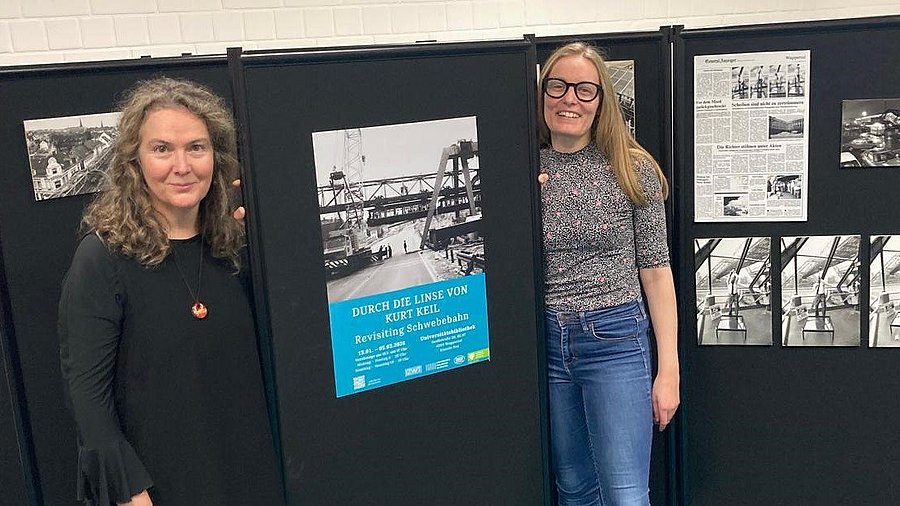
Exhibition: Through the lens of Kurt Keil - The suspension railway
Dr Carmen Pérez González, Pia Stoffels / History
Photo: Thea Schneider
Through the lens of Kurt Keil - suspension monorail
Second exhibition on the work of Wuppertal photographer Kurt Keil in the university library
Kurt Keil is a name that makes many Wuppertal residents sit up and take notice, as his photos characterised the pages of the Westdeutsche Zeitung for decades. After his death, his entire estate was transferred to the Wuppertal University Archive. Photographic historian Dr Carmen Pérez González has since dedicated herself to this collection of images, which is stored in many files and boxes, and has now curated the photographer's second exhibition with the head archivist Dr Friederike Jesse and a team of students. This time, the suspension monorail is the topic of the exhibition..
The entire exhibition was realised by a student project under Pérez González’s supervision. Alongside Barbara Brandau, Jan Emmerich, Berfin Özdemir, Jako Plaß, Christos Roudoniklis and Thea Schneider, it is Pia Stoffels in particular who has taken on the role of main curator. “She has been involved since the start of the 2023 winter semester and has attended all of my Kurt Keil Collection events,” the organiser says, ”she has always had a special interest in the suspension monorail and has therefore also done her own research. In her bachelor’s thesis, which she successfully completed last year, she focussed on the 1999 suspension monorail accident.”
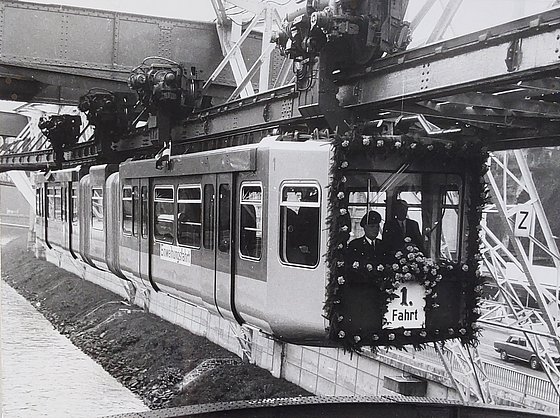
Suspension railway exhibition, first journey in 1972, photo: Kurt Keil Collection, KKS-E-0983, Wuppertal University Archive
The suspension monorail and the city
The exhibition opens in the university library on 13 January. But what does the suspension monorail tell photographically? “There are actually various stories that can be told with the photos of the suspension monorail, because they show the city itself, but also events and changes in the city”, Pia Stoffels explains. “Above all, they show people who live in this city.” The suspension monorail not only connects three parts of the city, Stoffels explains, but Kurt Keil’s pictures also show the changes in the cityscape. “When Kurt Keil started taking photographs at the end of the 1960s, the city looked very different from 2020, the year he died.” The exhibition combines exhibits shown by Kurt Keil in his own exhibition in 1992 along with other archive material from his collection. Additionally, the view of the city’s history is extended, in a sense, into the 2000s by photographs taken with a digital camera, which have not yet been released. .
”This is already the second exhibition that we are preparing with the same team,” Pérez González says. ”The nice thing is that everyone involved knows how to proceed, everyone has their own role. Some pictures that have never been shown before will come as a surprise. It will be an interactive exhibition and visitors will also be able to participate a little,” she promises.
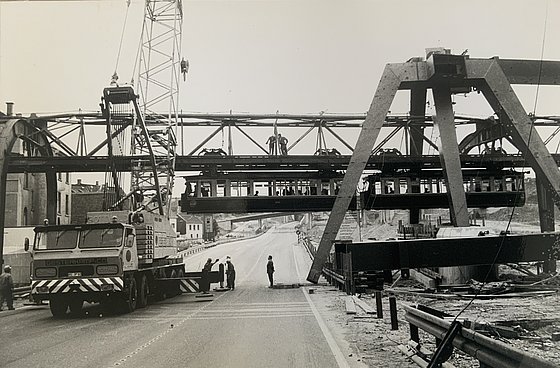
Suspension railway exhibition: conversion, 1972,
Photo: Kurt Keil Collection, KKS-E-0228, University Archive Wuppertal
Suspension monorail and stops change
At the beginning of the 1970s, Wuppertal’s most famous figurehead changed, and Kurt Keil was there. ”When he started, the 1972 series of the suspension monorail was just being introduced, and he documented this process with his photos,” Stoffels explains. ”That's part of the exhibition. At the same time, the suspension monorail stations have also changed. Some of them were destroyed during the war or were replaced. This is why there are also photos of the stations being rebuilt or reopened.” There was also a lot of construction activity around it, the student adds, and the construction of the Sonnborn interchange was certainly one of the most relevant, as Sonnborn was separated by the motorway at the time and the suspension monorail was even relocated. ”Kurt Keil also took many photos of the phases of this construction, and these changes can be seen very clearly in the pictures.”
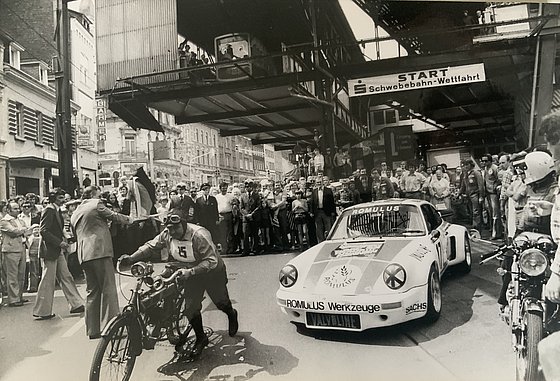
Suspension railway exhibition, suspension railway race, 1976,
Photo: Kurt Keil Collection, KKS-E-0320, University Archive Wuppertal
Pictures from the suspension monorail accident in 1970
His photos of the rescue at height on the Elberfelder Aue are also spectacular. On the approach to the Robert-Daum-Platz station, the train derailed while travelling through a construction site on 8 December 1970. Kurt Keil was even able to take pictures from inside the derailed suspension monorail because the fire brigade let him climb inside using turntable ladders. ”These photos were taken from an unusual angle. From this we can conclude that Kurt Keil took the pictures from the fire brigade's ladder truck. We have heard from many contemporary witnesses that he was obviously a very pleasant person and therefore often managed to get permission to take photos, which other photographers were denied. He was therefore very close to the rescue operation and was able to take these pictures,” Stoffels says.
Pictures of the most serious suspension monorail accident in 1999
The most momentous suspension monorail accident took place in 1999. The exhibition organisers have also included these pictures. ”We decided to show a small selection because it is part of the history of the suspension monorail,” Stoffels says, explaining the decision. ”But we also thought about how best to present it and came to the conclusion that we wanted to organise it in such a way that you can walk past it if you don't want to see it. As a press photographer, Kurt Keil did not document people on site, i.e., no injured people, but photographed the suspension monorail itself.” Later, however, Keil also focussed on what happened to the people, and he also took photos of that. "He attended the memorial service and took photos there; he was at the court case a year later and also took photos there. The scope of these photos of the suspension monorail accident alone is enormous; we are only showing a small selection."
Opening on 13 January at 5 p.m. in the University Library of Wuppertal
Preparations for the exhibition are in full swing and Pérez González is already looking forward to another exhibition location. ”Stephan Andrés Heuschen, former editor of the Westdeutsche Zeitung, has been involved in this project since day one and has once again helped us a lot with identifying some of the people and providing important information,” the photo historian explains. ”He asked me whether we would be interested in a travelling exhibition in the city, at the Zentrum für gute Taten e.V., which is the volunteer agency in Wuppertal Barmen. This will happen in April/May. We are very happy about this opportunity because the work of our students will then also be recognised beyond the university.”
The organisers promise that visitors will gain a new perspective on the history of the suspension monorail and thus, of course, on Wuppertal and are looking forward to welcoming many visitors. Admission is free.
Uwe Blass
Exhibition
Through the lens of Kurt Keil - Revisiting the suspension monorail
Vernissage: 13.01.2026 at 17.00 hrs
University Library, Foyer BZ.07, Gaußstraße 20, 42119 Wuppertal
Opening hours:
13.01. - 05.02.26
Mon-Fri 08.00am - 10.00pm
Sat-Sun 10.00am - 7.00pm
Dr Carmen Pérez González is an astrophysicist, photo historian, and research assistant at the Department of History at the School of Humanities at the University of Wuppertal. She is the project manager of ”Memory Training with the Kurt Keil Collection” (funded by the Dr Werner Jackstädt Stiftung) and the founder of the ”Golden Memories” project.
The exhibition was curated by Pia Stoffels, supported by Barbara Brandau, Jan Emmerich, Berfin Özdemir, Jako Plaß, Christos Roudoniklis, and Thea Schneider.