
Commercial and non-profit day care centres
Dr Marius Mader / Institute for Educational Science
Photo: UniService Third Mission
When pedagogical and economic interests collide
Wuppertal-based childhood researcher Marius Mader on commercial and non-profit day care centres
The younger the child, the more expensive the day care is. Commercial day care centres are expensive for parents of children under the age of three. What has long been common practice in other countries is also growing slowly but steadily in Germany, as the demand for childcare places remains high. Wuppertal-based childhood researcher and social education worker Marius Mader looked into this phenomenon, on which there is little research, and asks: “What motivates people to spend so much money on day care when there are other options?”
Commercial or non-profit day care centre
In order to understand the differences, you first have to look at the structural level, i.e., the framework conditions and requirements, Mader explains. “On the one hand, they are financed differently and have a different legal form. Child day care as a social service is usually organised as a non-profit organisation, i.e., e.V. (registered association, translator’s note) or gGmbH (company with limited liability, translator’s note) and does not operate for profit.” In contrast, commercial day care centres often have the legal form of a GmbH or GBR (Gesellschaft bürgerlichen Rechts, editor’s note), and in the case of larger companies, it can even be a public limited company. "This legal form is also linked to different options for action. In contrast to non-profit day care centres, commercial day care centres can freely handle the profits they generate. Non-profit organisations must always reinvest their profits in their operational purpose.” Church facilities are usually independent or private facilities, but they are usually organised as non-profit organisations, often as e.V. or gGmbH, as the latter is easier to manage.
Paying parents are customers
“In the high-priced segment that I was interested in, the relationship between the welfare state or public authorities such as the youth welfare office and the parents changes with their status as customers,” Mader says. “There is a shift in the relationship between parents as the recipients of the childcare offer and the organisations as the executing bodies.” If the welfare state is no longer the financing and hardly any regulating authority, the parents become the actual financiers. This also means that a self-determined sphere of action develops between parents as buyers/users and the day care centres as providers. Then negotiations can take place, which is not possible in non-profit organisations. Pedagogical interests are then potentially joined by economic interests.”
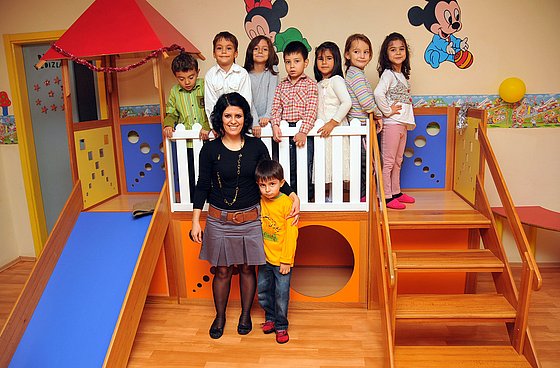
Kindergarten group
Photo: CC BY 3.0
Choosing the right day care centre can be difficult
“The relevant studies show that it makes sense to use day care. Children can benefit from it, that is now virtually undisputed.” Parental decisions in favour of or against child day care are presented in a variety of ways in research. The reasons in favour or against range from ignorance to different access to economic, socio-cultural and linguistic resources. “And with regard to the commercial segment, whether you can afford such a facility naturally depends very much on your financial means,” Mader continues, “the costs for a commercial place are up to four times as high as for a place in a comparable non-profit organisation. The sum can go up to 1,600 euros per month.”
The vexed issue of the legal entitlement to a place at a kindergarten
Parents have a legal right to a place at a kindergarten, but the reality is different. “Yes and no,” the scientist replies, “something is actually shifting at the moment. The legal entitlement only applies to child day care from the age of one. The place does not only apply to day care centres, but also to a place in day care.” The question of the shortage of places is ambivalent and also presents itself differently in the various federal states. Mader comments: “In the west, we have actually had a policy in family education policy for a very long time that has very much adhered to the middle-class family model. As a result, we have a lack of space here in many places, meaning high demand with too little supply. This situation applies in particular to the provision of places for children under the age of three. When it comes to children over three years of age, the situation is better. In addition, parental demand not only relates to the number of places, but also to the duration of childcare. Parents don’t always get the period of childcare from the youth welfare office as they would like or need.” There are also different traditions between East and West. Today, it is evident in various regions in the east that there are too many places available and that day care centres are even being cut back.
The facilities’ offerings vary
Commercial or non-profit: the services offered by the different centres vary. This also has to do with marketing strategies and staging, Mader explains. “There are longer opening hours with greater flexibility, bilingual programmes, and services that go beyond education. This offer even includes a hairdresser coming to the centre. Parents are relieved of some of the day-to-day work.”
Where can parents shape the facilities further?
As a result, you might think now that parents have more to say where they are the payers and the principle of the customer is king applies. But this was not the case in Mader’s study. ”I looked at some non-profit-organisations where parents were very close to the running of the facility. In addition, all non-profit organisations, for example, have a parents’ council, i.e., there is a political co-determination body. As a collective voice, this is something significant. In the commercial centre the situation is different. And parents also considered these collectivisation processes within parenthood important, I would say, . The non-profit organisation was located in a social hotspot. There were unemployed parents who were able to spend time at the centre. They accompanied groups, for example, and became part of everyday life at the centre, which sometimes resulted in very close personal relationships.” In commercial centre, the situation is different. The customer-provider relationship is always latently relevant there and also has an impact on the interaction. The customer pays a lot and also expects a lot. “These conditions lead to economically or commercially motivated cost-benefit calculations. and take a relationship to another level. It also leads to emotional distancing.”

Children playing together
Photo: Pixabay
The day-care centre is a socio-educational space
“The day-care centre is more than just a place for early educational work, it is a place that is not just about education,” Mader states unequivocally. “Day-care centres are also social, personal service providers that are not officially part of the education system. In addition to education, care and upbringing are also key tasks there. Increasingly, it is also a question of child protection and social support. In practice, this can be seen in the form of parent education programmes, day-care social work or family centres, especially with regard to social inequalities.”
First point of contact: youth welfare office
Day-care centres in the Bergisch Land region are run by different organisations. The youth welfare office can serve as the first source of information, as it has the task of advising parents on child day-care issues. This now also happens online, Mader says. "“There are childcare portals where parents can find out about different services and facilities and can also contact the municipal facilities directly to register a place. Commercial facilities are also listed there from time to time.” Parents can also obtain information from their friends and acquaintances, i.e., word of mouth, as well as visiting a playground where you can talk to other parents. "Among other things, it turns out that parents do a lot of research online, especially if they don’t yet live in the place where the child is to be looked after. And then there are also people who drive around, ask on site or use open days or parents’ evenings to develop a gut feeling.”
Uwe Blass
Dr Marius Mader works at the Department of Social Pedagogy/Socio-political Principles at the School of Human and Social Sciences at the University of Wuppertal.